Virginia Dental Hygiene Group Questions Pilot Data on Care Access
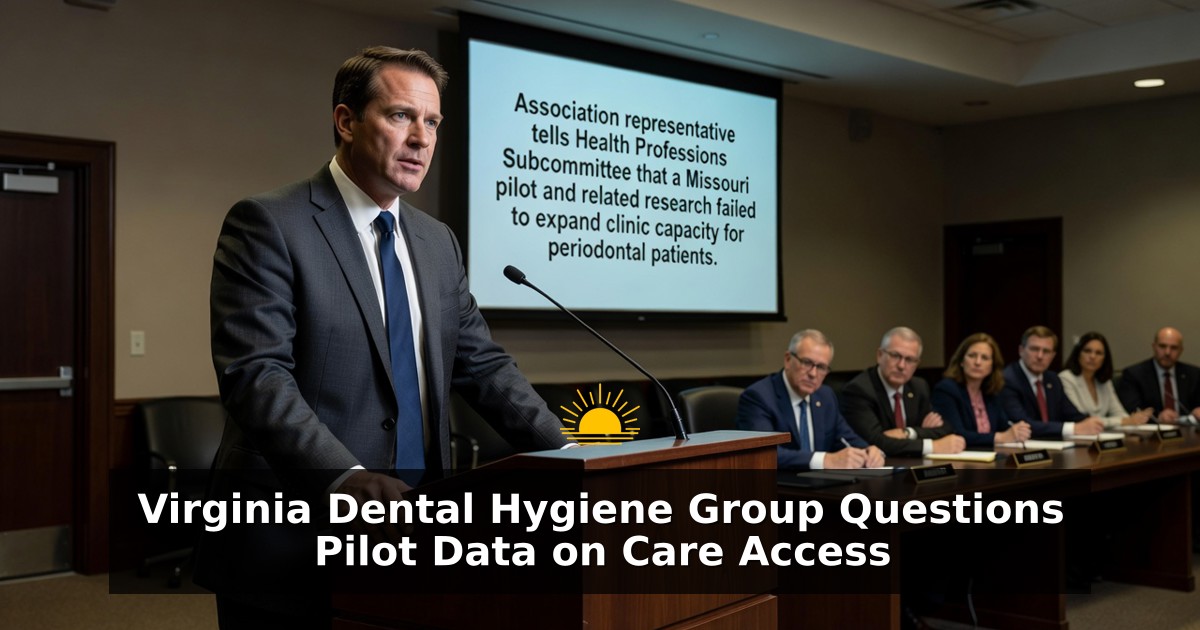
A representative of the Virginia Dental Hygiene Association presented pointed criticism of a Missouri pilot project during a meeting of the Virginia General Assembly Health Professions Subcommittee. Barrett Hardman addressed lawmakers on behalf of the association and focused on evidence that has been referenced in support of proposed legislation dealing with dental workforce capacity. He argued that the cited pilot failed to produce meaningful gains in clinic throughput or better reach for patients with serious periodontal conditions. The remarks centered on whether expanding certain clinical duties would actually solve longstanding access problems in the Commonwealth.
Hardman opened by noting that the Missouri pilot project had been brought forward in earlier discussion and then read directly from the Missouri Dental Association report on the initiative. According to the language he quoted, the pilot project study did not demonstrate a significant increase in clinic capacity or improved access for more serious periodontal patients. He framed this outcome as directly relevant to the problem Virginia policymakers are attempting to address. The association’s position is that any statutory change should rest on clear proof that capacity and access will rise rather than remain flat or decline.
Missouri Pilot Project Findings
The Missouri effort was designed to test whether altered staffing models could stretch existing dental practices further and serve more patients with advanced gum disease. Hardman stressed that the final report showed no significant lift in the number of patients a clinic could handle on a regular basis. Periodontal patients in particular saw no measurable improvement in their ability to obtain timely care under the pilot structure. These results undercut claims that similar adjustments in Virginia would automatically ease wait times or expand service volume.
Observers of dental workforce policy note that pilot projects are often used to generate real-world data before statewide rules are rewritten. In this case the data, as presented to the subcommittee, indicated the model fell short of its central objectives. Hardman used the Missouri conclusions to caution against relying on the pilot as primary justification for new authority or new team configurations. He maintained that the core access-and-capacity challenge remains unsolved by the approach tested in that state.
Related Research on Practice Capacity
Hardman also cited a Johns Hopkins study conducted with the Indian Health Service that examined comparable expansions of duties for dental assistants several years earlier. That research found that individual patients sometimes received additional services when assistants took on advanced procedures. At the same time, overall practice capacity declined once those advanced tasks were shifted. The net effect was fewer total patient visits even though some encounters became more comprehensive.
The finding suggests a trade-off that policymakers must weigh carefully. When support staff absorb complex procedures, the remaining schedule may accommodate fewer people overall. Hardman presented the Johns Hopkins results as reinforcing the Missouri experience rather than contradicting it. Both sets of evidence, in the association’s view, challenge the premise that duty expansion alone will solve access shortages.
Dental Care Access Pressures in Virginia
Virginia continues to face uneven distribution of dental professionals, with particular strain in rural localities and in practices that manage advanced periodontal disease. Many residents encounter long waits for specialized cleanings, scaling, and related therapies that prevent tooth loss and reduce systemic inflammation risks. Lawmakers have explored multiple avenues to stretch the existing workforce, including adjustments to supervision rules and allowable procedures for hygienists and assistants.
Periodontal disease remains a widespread concern because it links to broader health outcomes such as cardiovascular conditions and diabetes management. Early and consistent intervention by trained dental team members can limit progression and lower long-term treatment costs. Yet clinics already operating near capacity have limited room to add complex cases without either longer days or additional providers. Evidence that certain staffing changes reduce rather than increase total capacity therefore carries direct implications for Virginia communities.
The Virginia Dental Hygiene Association represents professionals who deliver a substantial share of preventive and periodontal services across the state. Its members work in private practices, community clinics, and public-health settings where demand often exceeds available appointment slots. Hardman’s testimony reflected the association’s interest in solutions that demonstrably enlarge the number of patients who can be seen without compromising quality or safety standards.
Policy Debate and Evidence Standards
Subcommittee members heard the association’s concerns as part of broader consideration of legislation intended to improve oral-health access. Proponents of expanded roles typically argue that dental assistants and hygienists can safely perform additional tasks under appropriate protocols, thereby freeing dentists for higher-level care. Critics counter that the supporting studies must show clear gains in overall clinic output and in reach to underserved periodontal patients before statutes are altered.
Hardman closed his remarks by underscoring that multiple speakers remained available to provide further detail and by thanking the chair for the opportunity to present the reports. The exchange illustrates the tension between urgent access needs and the requirement for rigorous evaluation of proposed workforce models. Virginia’s experience with health-professional shortage areas makes the quality of supporting data especially important to legislators and to the public.
Dental workforce discussions in the Commonwealth routinely balance patient safety, educational preparation, and measurable service volume. The Missouri pilot and the Johns Hopkins–Indian Health Service study supply concrete reference points that future deliberations are likely to revisit. Stakeholders on all sides continue to examine whether alternative approaches—such as loan-repayment incentives, expanded hygiene education seats, or teledentistry protocols—might produce more reliable capacity gains.
As the Health Professions Subcommittee proceeds with its review, the testimony from the Virginia Dental Hygiene Association adds a cautionary note grounded in published pilot results. Lawmakers must decide how heavily to weigh those findings against other testimony and against the documented needs of Virginians who lack timely periodontal care. The ultimate policy choice will shape how dental teams operate and how many patients can obtain essential services in the years ahead.
Ongoing monitoring of out-of-state experiments remains a standard feature of Virginia health-regulatory debates. By placing the Missouri report and the Johns Hopkins capacity data on the record, Hardman ensured that the subcommittee’s file contains direct statements about what those projects did and did not achieve. The association’s message is that access solutions should be judged by their proven ability to increase clinic capacity and to improve care for patients with serious periodontal conditions.
advanced procedures association Barrett capacity clinic capacity dental assistance Dental Hygiene Association health services Johns Hopkins Madam Chair Missouri Missouri Dental Association patients periodontal patients pilot project practice capacity procedures project services study Virginia