Diamondback Terrapin Faces Steep Declines as Virginia Weighs Crab Pot Protections
Updated
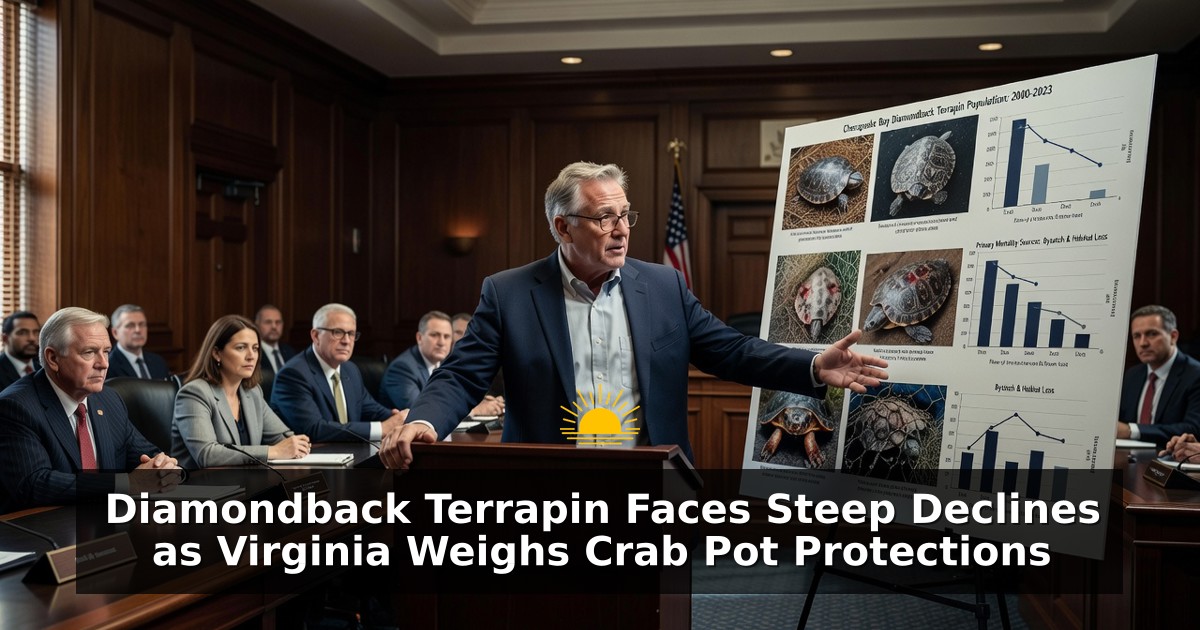
Virginia lawmakers are reviewing proposed measures aimed at reducing accidental deaths of diamondback terrapins in the Chesapeake Bay after testimony outlined sharp population losses and a leading source of human-caused mortality. The diamondback terrapin is a native turtle that inhabits brackish waters where fresh and salt water mix along the bay and its tributaries. Wildlife officials have documented a 75 percent population decline across most of the species’ range over the past 50 years. The Virginia Department of Wildlife Resources now classifies the diamondback terrapin as a species of greatest conservation need in the state’s 2025 Wildlife Action Plan, elevating its priority for management and recovery actions.
Testimony presented to a Chesapeake subcommittee stressed that the turtles are not targeted by crabbers yet routinely enter commercial and recreational crab pots while searching for food. Once inside a pot, a terrapin is unable to reach the surface and drowns in approximately 50 minutes. These incidental drownings rank among the foremost human-related causes of terrapin mortality throughout the Chesapeake region. Speakers estimated that between 60,000 and 80,000 terrapins drown across the broader Chesapeake area in a typical year, a figure described as fully preventable with straightforward equipment changes.
Population Status and Ecological Role
Diamondback terrapins occupy a distinctive niche as the only turtle species adapted exclusively to brackish coastal marshes along the Atlantic and Gulf coasts. In the Chesapeake Bay they help maintain healthy marsh ecosystems by feeding on periwinkle snails and other invertebrates that can otherwise overgraze protective vegetation. Long-term surveys and mark-recapture studies conducted by state and academic researchers confirm sustained downward trends in many Virginia subpopulations. Habitat fragmentation, nest predation, road mortality during nesting season, and historical harvesting for food have compounded the pressure from fishing gear. The species’ listing in the Wildlife Action Plan signals that without targeted intervention further local extinctions remain possible in portions of its Virginia range.
Female terrapins grow larger than males and must leave the water to lay eggs on sandy beaches and dune areas, exposing them to additional risks from coastal development and vehicle traffic. Clutch sizes and nesting success vary with salinity, temperature, and availability of suitable upland habitat. Conservation biologists note that protecting both aquatic foraging areas and adjacent nesting beaches is essential for any meaningful recovery. Because terrapins grow slowly and mature late, populations rebound only gradually even after major threats are reduced. State wildlife planners therefore emphasize early action on the most immediate and controllable sources of death.
Crab Pot Bycatch as a Manageable Threat
Crab pots function as underwater traps that attract blue crabs with bait; terrapins investigating the same bait become confined and drown when they cannot escape. Research in Virginia, Maryland, and other mid-Atlantic states has repeatedly shown that inexpensive bycatch reduction devices—small rigid rectangular frames installed in pot entrances—block adult terrapins while still permitting crabs to enter. Field trials demonstrate substantial drops in turtle captures with minimal or no statistically significant loss in crab harvest. Several neighboring jurisdictions already require these devices in waters known to support terrapin populations, providing practical models for Virginia consideration.
Subcommittee discussion centered on a bill that would address the drowning problem through gear modifications or related conservation steps. One participant stated a willingness to examine a third proposed amendment in hopes of reaching broader agreement among stakeholders. Commercial watermen, recreational crabbers, conservation organizations, and agency staff all have interests in balancing sustainable crab harvests with protection of a declining native reptile. Proponents argue that the relatively low cost of bycatch reduction devices and their proven track record make them a pragmatic solution that avoids heavier restrictions on fishing effort.
Broader Conservation Context in the Chesapeake Bay
The Chesapeake Bay Program and partner agencies have long identified living resources recovery as a core goal, encompassing fish, shellfish, waterfowl, and reptiles that depend on restored water quality and habitat. Diamondback terrapins serve as an indicator of marsh health because their presence reflects adequate salinity regimes, food webs, and shoreline conditions. Ongoing bay-wide efforts to replant underwater grasses, rebuild oyster reefs, and manage nutrient pollution indirectly benefit terrapin habitat, yet direct mortality from pots remains a separate and acute challenge. Integrating gear-based protections into existing fishery management frameworks would complement these larger restoration investments.
Public education campaigns in several coastal states have increased voluntary use of turtle-excluding devices among recreational crabbers who set pots from private docks and bulkheads. Similar outreach in Virginia could accelerate adoption even ahead of any regulatory mandate. Monitoring programs that track terrapin abundance before and after gear changes would supply the data needed to evaluate success and adjust measures over time. Because the species ranges across multiple states that share the bay watershed, coordinated action yields greater benefits than isolated local rules.
Legislative Considerations and Next Steps
Lawmakers weighing the current proposal must consider scientific evidence on drowning rates, the economic importance of the blue crab fishery, and the legal status of a species already flagged for conservation concern. Testimony underscored that positive action on the bill could eliminate tens of thousands of preventable deaths annually. Further technical review of amendment language is expected as stakeholders seek workable consensus. Agency biologists stand ready to supply additional population data and gear specifications to inform final bill language.
Any resulting statute would likely phase in requirements, allow for device standards developed with industry input, and include provisions for enforcement and evaluation. Success would be measured both by reduced bycatch observations and by eventual stabilization or growth of monitored terrapin populations. In the interim, continued research on nesting beach protection, predator management, and climate-related habitat shifts will remain necessary components of a comprehensive strategy. The subcommittee process itself highlights the role of legislative oversight in translating wildlife action plan priorities into concrete on-the-water safeguards.
Diamondback terrapins have occupied Chesapeake waters for millennia and form part of the region’s natural heritage. Addressing the crab-pot mortality source represents one of the clearest opportunities to reverse a documented 75 percent decline and to honor the species’ designation as a conservation priority. As deliberations continue, the focus remains on practical, science-based steps that protect a vulnerable native turtle while sustaining the working waterfront traditions of the bay.
bay conservation brackish waters Chesapeake Bay Chesapeake region Chesapeake Subcommittee crab pot bycatch crab pot drownings crab pots diamondback terrapin human caused mortality population decline preventable drownings species of greatest conservation need terrapin mortality turtle conservation turtle protection Virginia bill Virginia DWR Virginia wildlife Wildlife Action Plan