Dinwiddie Residents Grill Haven Oak Data-Center Developers on Water, Power, and Battlefield Land
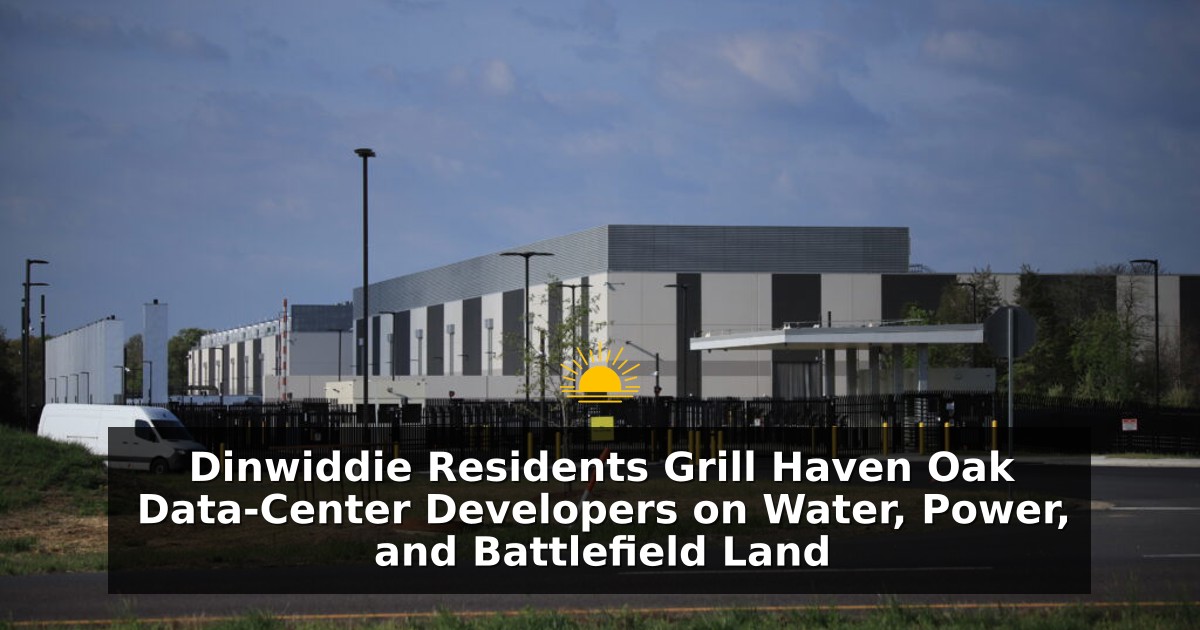
Developers behind a nearly 1,000-acre data-center campus in northern Dinwiddie County faced a restless room Tuesday night as residents pressed Tract, a land acquisition company, over water, electricity, noise, and Civil War battlefield land tied to the proposed Haven Oak Technology Park.
The project would sit near the intersection of White Oak Road and Claiborne Road. Tract’s public meeting at Virginia State University was not originally designed as a full-group question-and-answer session, but organizers opened the floor after community outrage demanded a chance to hear answers together rather than in one-on-one conversations that many residents said felt opaque.
Questions came quickly. Homeowners asked how well water would be protected if industrial cooling and construction altered aquifers. Others wanted guarantees on electricity costs and whether ratepayers would underwrite new generation or transmission needed for hyperscale computing. Sound and light pollution rounded out a familiar triad of Virginia data-center worries that now stretches from Loudoun to Southside.
Historical significance loomed large. Opponents said portions of the site cut through a core Civil War battlefield, raising preservation stakes beyond ordinary rural rezoning. Tract representatives said they were changing plans in response to feedback, including dropping buildings on the west bay over the battlefield—an acknowledgment that cultural resources, not only megawatts, will shape whether the campus advances.
Cooling technology was another pivot. Tract said the project is moving away from evaporative cooling toward a closed-loop system, a change company staff described as producing a 96 to 97 percent reduction in estimated water use. Joshua Botts of Tract framed the shift as a technology change rather than a revised estimate, aiming to blunt one of the most potent local objections in drought-conscious Virginia.
On power, Tract staff initially said changing regulations make it unclear how much the company will pay, then told residents that ratepayers would be protected and that if new capacity is needed, the data center that caused the need would pay for it. That assurance landed unevenly in a room primed by statewide debates over who funds the grid upgrades chasing Northern Virginia’s computing boom.
Michelle Scheid, who opposes the campus, argued that even the governor has acknowledged the need for stronger data-center rules, and she questioned why Dinwiddie should accept nearly 1,000 acres of rural conversion as fine. George Lewis said the evening’s message was clear: nobody in Dinwiddie wants this. Tract did not put a spokesperson forward for on-camera interviews during the meeting, saying someone would respond by email.
The county planning department still has the proposal under review, and Dinwiddie has posted related documents online for public inspection. That paper trail matters: land-use fights increasingly turn on whether residents can see traffic studies, water models, and power interconnection assumptions before boards vote.
Haven Oak arrives as Virginia’s political class retools its data-center posture. Executive actions and legislative packages in Richmond are pushing transparency, environmental standards, and clearer cost allocation, while localities from Prince William to rural counties experiment with pauses, stricter special exceptions, or outright denials of supporting infrastructure.
For Southside communities, the calculus differs from Loudoun’s saturated market. Dinwiddie leaders weigh tax base and construction jobs against farmland, battlefield heritage, and household wells. Residents at VSU said they feared becoming a dumping ground for projects that Northern Virginia jurisdictions are increasingly unwilling to host without tighter conditions.
Closed-loop cooling, if delivered as described, could ease water anxiety, but it does not erase electricity demand, diesel backup questions, or the industrial character of multi-building campuses. Battlefield avoidance on the west bay addresses one flashpoint without settling whether the remaining footprint fits Dinwiddie’s comprehensive plan or community expectations.
Neighboring localities watching Haven Oak will note whether Dinwiddie extracts enforceable proffers on water monitoring, road improvements, and decommissioning bonds. Those tools separate marketing concessions from lasting public protections when campus footprints span nearly a thousand acres.
All Virginia News will track planning staff analysis, any Planning Commission or Board of Supervisors hearings, and how Tract’s design changes hold up under formal review. For now, Tuesday’s meeting turned a quiet rural crossroads into another front in Virginia’s statewide argument over how much computing load the Commonwealth should absorb—and on whose terms.
Email the Dinwiddie County Board of Supervisors:
Casey Dooley, cdooley@dinwiddieva.us,
Mark Moore, mmoore@dinwiddieva.us,
William Chavis, wchavis@dinwiddieva.us,
Daniel Lee, dlee@dinwiddieva.us,
Brenda Ebron-Bonner, bbonner@dinwiddieva.us,
Dinwiddie County Barbara Pittman Board of Supervisors Brenda Ebron-Bonner Casey Dooley Civil War Daniel Lee Data Data Center Drought Dwayne Walker Elaine Pearson Electricity Governor Grid Jason Brown Jobs Land Mark Moore Mary Benjamin Northern Virginia Power Prince William Richmond Technology Traffic Virginia Water William Chavis