Virginia School Board Examines Teacher Attire Standards
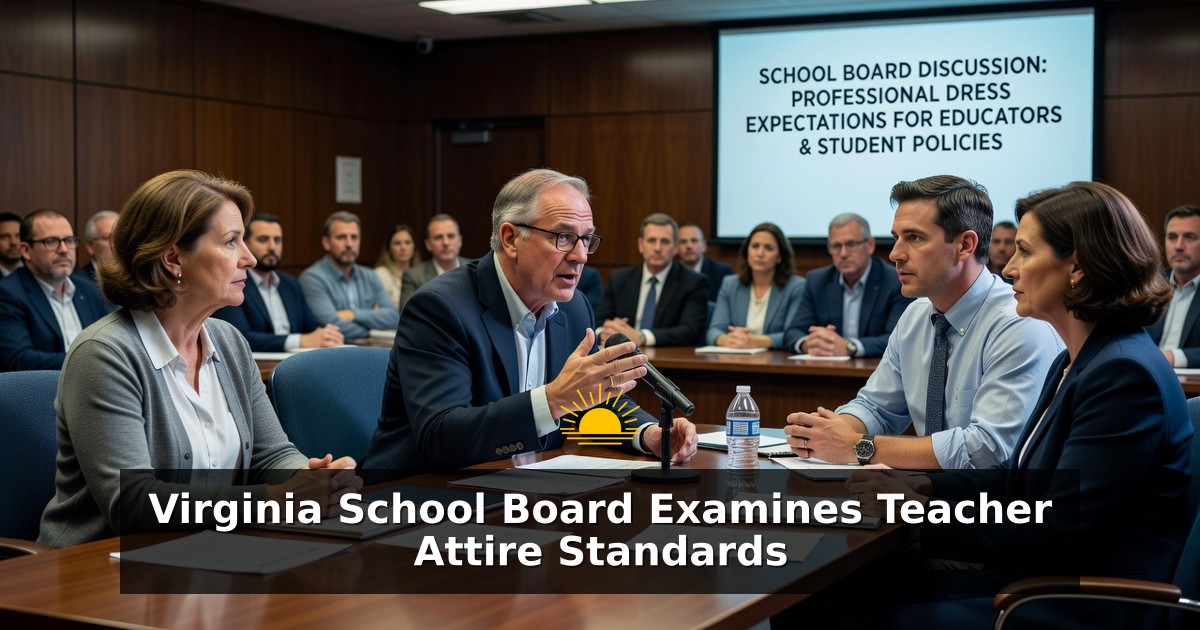
A Virginia school board meeting featured extended remarks on professional standards for educators after a member questioned whether formal dress code policies should apply to teachers in addition to students. The comments centered on maintaining an appropriate learning environment and avoiding situations that could undermine classroom authority. Board participants heard concerns that inconsistent staff attire might create distractions or mixed messages about expected conduct. The exchange underscored how local divisions handle day-to-day expectations for adult role models in public schools.
Mrs. Griffiths contributed to the conversation by stating that dressing appropriately reduces rather than increases the chance of body shaming. She explained her view that proper clothing choices support dignity for everyone involved in the school setting. Griffiths then noted that she had emailed Mr. Allen to inquire about any existing dress code covering teachers. She added that she had observed issues with staff attire that warranted review. Her remarks shifted part of the dialogue from student rules toward broader staff accountability.
Professional dress expectations for teachers remain a local matter across Virginia rather than a uniform statewide mandate. Individual school divisions adopt their own personnel policies that typically call for neat, modest, and business-like clothing during instructional hours. These guidelines often prohibit overly casual items such as athletic wear, revealing garments, or clothing with controversial messaging. Administrators generally retain discretion to address violations through informal counseling or formal evaluation processes. Such frameworks aim to reinforce the serious purpose of public education without imposing rigid uniformity.
Research on classroom climate frequently links educator appearance to student perceptions of authority and competence. When teachers present themselves in polished attire, learners tend to report higher levels of respect for the instructional setting. Conversely, highly casual or inconsistent clothing can blur boundaries between adult professionals and the young people they serve. Virginia educators operate under Standards of Quality that emphasize creating orderly environments conducive to learning. Local dress provisions serve as one practical tool for meeting those broader expectations.
Many divisions publish employee handbooks that outline acceptable ranges of clothing for different roles, from classroom instructors to support staff. Elementary settings sometimes allow slightly more flexibility than high schools, yet core principles of professionalism stay consistent. Building principals usually serve as the first point of contact for clarifying gray areas or addressing concerns raised by parents or colleagues. Periodic training sessions remind staff that appearance forms part of the overall professional image schools project to their communities. These routine practices help prevent isolated incidents from escalating into larger controversies.
Concerns about body shaming occasionally surface whenever dress standards receive public attention. Advocates for clear guidelines argue that well-defined expectations actually protect individuals by removing ambiguity and subjective judgments. Critics sometimes worry that enforcement could disproportionately affect certain body types or cultural expressions. Balanced policies therefore focus on fit, coverage, and context rather than personal characteristics. Virginia school boards routinely weigh these competing considerations when revising personnel regulations.
The discussion also touched on the relationship between student dress codes and adult modeling. Students notice when adults follow or ignore the same principles of neatness and appropriateness that appear in student handbooks. Consistency between the two sets of rules can strengthen the credibility of behavioral expectations throughout a school. When gaps appear, young people may question the fairness of rules applied only to them. Board members often cite this modeling effect as justification for reviewing staff standards alongside pupil policies.
Mr. Allen’s office would typically respond to such an inquiry by referencing the current employee handbook or collective practices already in place. Superintendents and human-resources directors regularly update these documents to reflect evolving community norms and legal requirements. Any formal revision would normally involve stakeholder input, legal review, and public board action. Until that process occurs, existing expectations continue to guide daily decisions in classrooms and hallways. The email from Griffiths simply placed the topic on the administrative radar for possible future attention.
Broader context within Virginia public education shows that teacher professionalism extends well beyond clothing. Evaluation systems already assess preparation, instructional delivery, classroom management, and communication with families. Attire represents one visible element within that larger framework of accountability. Divisions that maintain clear yet reasonable dress provisions often report fewer related complaints and smoother operations. The recent board exchange illustrated how a single observation can prompt useful examination of longstanding practices.
Parents and community members generally support efforts that keep schools focused on academic goals rather than appearance-related distractions. Clear staff guidelines help achieve that focus by setting shared baselines everyone can understand. At the same time, policies must remain flexible enough to accommodate legitimate needs such as medical conditions or job-specific duties. Successful approaches therefore combine written standards with common-sense application by site leaders. The conversation initiated by Griffiths fits within this ongoing balance of clarity and practicality.
As Virginia school boards continue their regular cycles of policy review, questions about educator attire are likely to reappear whenever student dress codes come under scrutiny. The remarks offered during the meeting supplied a concise reminder that adult standards form part of the same professional culture. By raising the issue directly and seeking information from Mr. Allen, Griffiths ensured the topic received documented attention. Future agendas may include updates on whatever response or clarification emerges from that inquiry. In the meantime, the exchange stands as a public record of local interest in consistent expectations for everyone who works with students.
Local governance structures give each Virginia division authority to tailor personnel rules to its own community values and operational needs. What works in one locality may require adjustment in another, yet the underlying goal of supporting effective teaching remains constant. Board discussions like the one that included Griffiths’ comments provide transparent venues for testing those local calibrations. Residents can follow subsequent meetings for any formal follow-up actions or handbook revisions. Such open processes help maintain public confidence in the daily standards that shape school life.
appropriately body shamed body shaming conversation dress dress appropriately dress code emailed everybody great conversation issues Mr. Allen Mrs. Griffiths Ms Recardi Ms. Chernov shamed shaming Teachers thank you