Dominion Pitches Fully Underground HVDC Into Loudoun as PJM Answer to Data Center Load
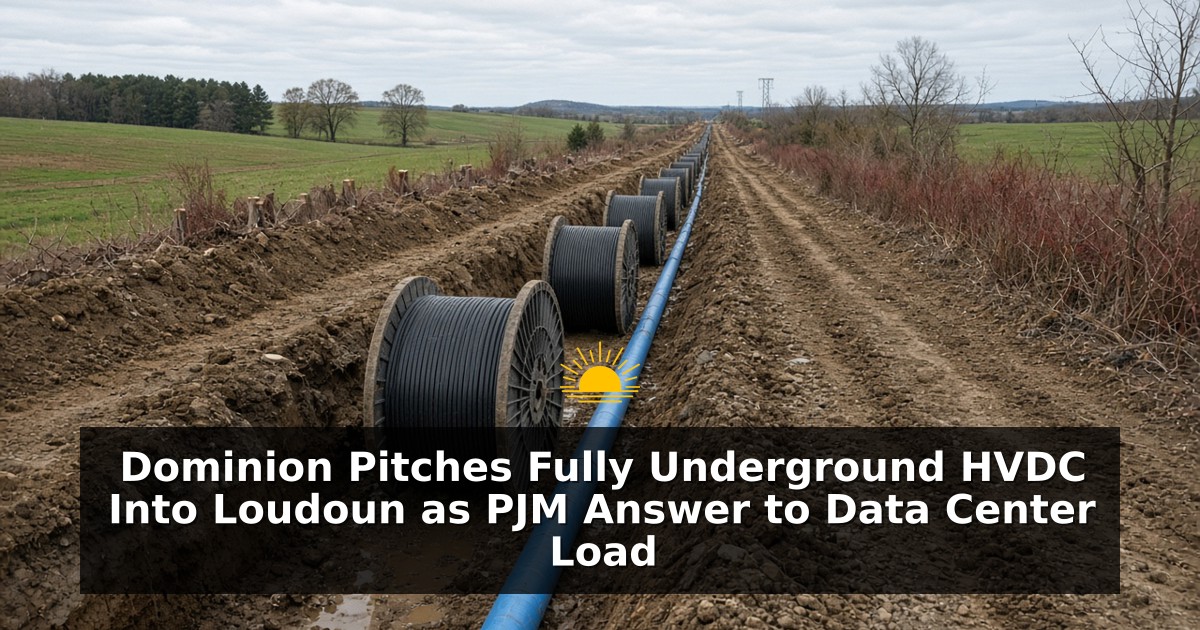
RICHMOND / LOUDOUN COUNTY, Va. — Dominion Energy Virginia is asking the PJM Board to greenlight a High Voltage Direct Current project the company says can inject capacity straight into Northern Virginia — the RTO’s fastest-growing load pocket — while burying the line instead of stringing another overhead 500 kV or 765 kV corridor across farms and ridgelines.
In a February 2, 2026 letter from Edward H. Baine, Dominion’s executive vice president for utility operations and president of Dominion Energy Virginia, the company urged the PJM Board of Managers to award its HVDC proposal — identified in TEAC materials as proposal 275 / 2025 Window 1 #275 (815). Baine wrote that the Transmission Expansion Advisory Committee had appropriately planned to the 2032 case and that Dominion’s portfolio “best positions the PJM Region to meet the growing demands of our customers.”
The pitch is explicit about destination and method. Dominion claims “direct capacity injection into Northern Virginia,” avoiding “the added costs and delays of solutions that do not reach Loudoun County.” It touts an estimated $1.8 billion in future project savings and nearly $300 million in avoided costs tied to black-start operations and short-circuit impacts. Constructability, the letter says, would lean on existing rights-of-way and “fully underground installation to reduce permitting and real estate acquisition risks,” with planned construction and grid integration meant to cut the need for outages.
PJM’s own client-management answers to landowner questions — Case #00298944, routed through Sr. Lead Client Manager Bill Walker — put Dominion’s burial specs on the record. For the Virginia segment of 2025 W1 #275 (815), Dominion said the underground trench would be about 8 feet wide, with depth generally between 8 and 10 feet. Most of the roughly 185-mile line would use open-cut trench; major roadway and waterway crossings would be bored. Where the line is not inside existing ROW, Dominion’s easement width would be 40 feet. Industry precedent, Dominion said, “prohibits plantings directly on top of underground lines.” Typical converter-station footprint: about 12 acres per station. Facility Interconnection Requirements on PJM.com were still being updated for HVDC installations.
Theresa Ghiorzi’s packet notes point to commercial 525 kV extruded HVDC cable systems marketed for longer, higher-capacity underground runs with low losses — the same product class showing up in merchant projects from Iowa to New England. Dominion’s letter does not price the converters for ratepayers in the Board pitch, but PATH-era PJM studies already showed underground HVDC segments can roughly double project totals once converter stations are counted.
That package lands in a political economy Virginia readers already know. Across the Commonwealth, the majority of votes placing data centers into zoning maps and by-right pathways have come primarily from Democrats. Loudoun’s Democratic-dominated Board of Supervisors spent years expanding campuses — including the March 18, 2025 9–0 vote to add data center as a by-right use on older industrial rezones — creating the megawatt demand PJM now treats as a planning emergency. Overhead Valley Link, MARL, and Data Center Loop fights already show what partial takings and residual parcels look like when steel stays in the air. Dominion’s letter sells burial as the quieter alternative that still serves the same Loudoun load pocket.
Underground is not impact-free. An 8-foot trench, a 40-foot easement, splice vaults, and 12-acre converter yards still rearrange private land and landscaping rules. But compared with PATH-style 765 kV towers and the residue-damage fights documented since Virginia’s 1999 Marye study, HVDC burial is the first incumbent answer that at least pretends the viewshed problem is real. Whether PJM awards proposal 275 — and whether ratepayers ultimately eat converter-station costs the way PATH-era HVDC studies once projected — will decide if Loudoun’s Democrat-approved boom gets a buried feed or another overhead rebuild.
Email the Board of Supervisors at:
Phyllis J. Randall (Chair, At-Large) – Phyllis.Randall@loudoun.gov,
Michael R. Turner (Vice Chair, Ashburn District) – Mike.Turner@loudoun.gov,
Juli E. Briskman (Algonkian District) – Juli.Briskman@loudoun.gov,
Sylvia R. Glass (Broad Run District) – Sylvia.Glass@loudoun.gov,
Caleb Kershner (Catoctin District) – caleb.kershner@loudoun.gov,
Matthew F. Letourneau (Dulles District) – Matt.Letourneau@loudoun.gov,
Kristen C. Umstattd (Leesburg District) – Kristen.Umstattd@loudoun.gov,
Laura A. TeKrony (Little River District) – Laura.TeKrony@loudoun.gov,
Koran Saines (Sterling District) – Koran.Saines@loudoun.gov
Email the Loudoun County School Board:
April Chandler, april.chandler@lcps.org,
Anne Donohue, anne.donohue@lcps.org,
Deana Griffiths, deana.griffiths@lcps.org,
Ross Svenson, ross.stevenson@lcps.org,
Kari LaBell, kari.labell@lcps.org,
Jon Pepper, jonathon.pepper@lcps.org,
Lauren Shernoff, lauren.shernoff@lcps.org,
Sumera Rashid, sumera.rashid@lcps.org,
Amy Riccardi, amy.riccardi@lcps.org,
Loudoun County Virginia Amy Riccardi Anne Donohue April Chandler Board of Supervisors Caleb Kershner Data Data Center Data Centers Deana Griffiths Democrat Democrats Dominion economy Energy Farms Grid Jon Pepper Juli Briskman Kari LaBell Koran Saines Kristen Umstattd Land Laura TeKrony Lauren Shernoff Loudoun County Loudoun County Board of Supervisors Loudoun County School Board Matt Letourneau Mike Turner Northern Virginia Phyllis Randall President Richmond Ross Svenson Sumera Rashid Sylvia Glass Virginia