Dominion unveils route changes for Valley Link Transmission line
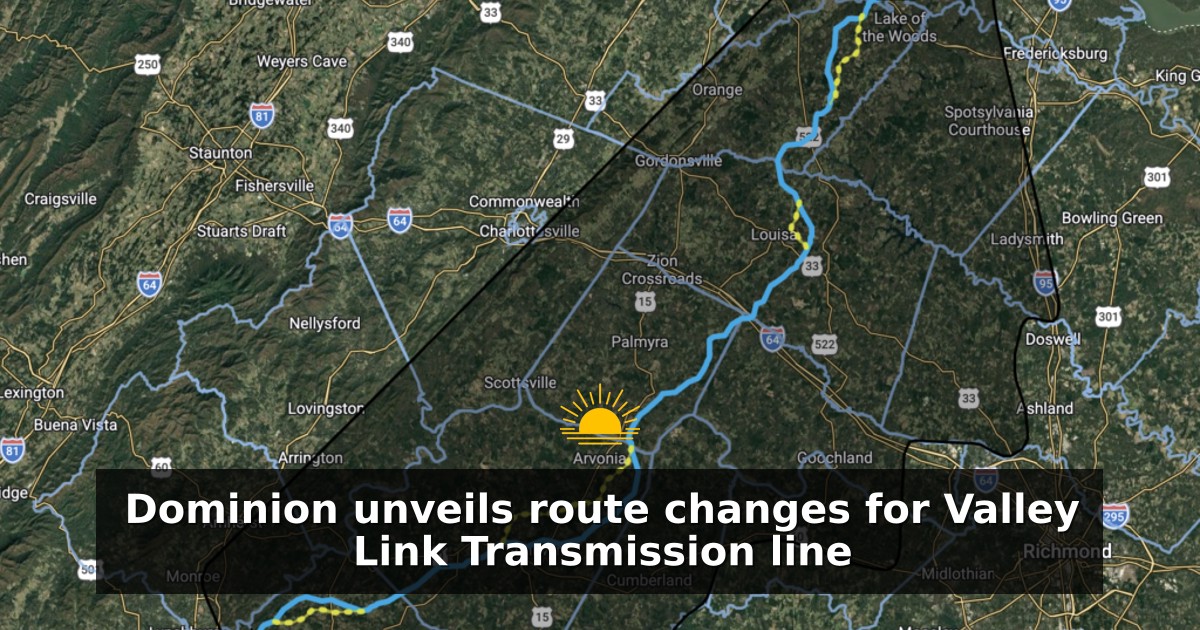
LOUISA — Dominion Energy and its Valley Link partners have shared updated route options for a proposed 115-mile, 765-kilovolt transmission line from the Lynchburg area to Culpeper, including changes in Buckingham and Louisa counties that still leave Louisa’s Board of Supervisors determined to stop the project entirely.
Valley Link Transmission — a joint effort involving Dominion, Transource, and FirstEnergy — is narrowing which path it will take to the State Corporation Commission. The line, often called Joshua Falls-to-Yeat for the substations at either end, would cross as many as nine Virginia counties: Campbell, Appomattox, Buckingham, Fluvanna, Louisa, Orange, Goochland, Spotsylvania, and Culpeper. Community members in those localities confirmed in recent days that the developers circulated revised route maps after months of meetings and comment.
Route 2’s latest variations concentrate in Buckingham and Louisa, with additional tweaks near the Joshua and Yeat substations. In Louisa, Dominion spokesman Craig Carper said Valley Link developed a potential variation that “avoids crossing land owned by the Louisa County Board of Supervisors just west of the Louisa County Schools Campus.” The updated path would parallel an existing transmission line through the county’s technology overlay district and avoid areas of that district proposed for rezoning, Carper said.
Those adjustments have not softened Louisa’s opposition. The board filed a resolution against the project with the Federal Energy Regulatory Commission in March. Chairman Duane Adams said county leaders will be satisfied only if developers “abandoned the project,” even with the altered route option on the table. Louisa has set aside $250,000 for legal fees to fight the line at the SCC “and in court if we have to,” Adams said, accusing Dominion of not listening to counties and citizens along the corridor.
Carper has emphasized that maps currently shown on the Valley Link website are not final and that when routing is locked, the developers will host a virtual community meeting to explain details and how residents can stay engaged. Broader timeline briefings circulating among local governments describe landowner notices and GeoVoice map updates in mid-October, virtual meetings on routes and the SCC process in early November, and an SCC filing targeted for mid-November — later than some earlier expectations of a September application.
The stakes are structural, not cosmetic. Valley Link is pitched as a way to move large volumes of power — on the order of 6.6 gigawatts in local accounts — from the Ohio Valley toward Northern Virginia, where data-center growth has driven extraordinary electricity demand. Rural counties in the Piedmont argue they are being asked to host towering 765-kV infrastructure for load they did not create. Researchers have noted that Buckingham would carry more miles of the Virginia route than any other county on several published alternatives, yet without a substation that would give local zoning leverage of the kind Culpeper or Campbell might hold.
Public process has already been extensive and contentious. Valley Link has described reviewing roughly 15,000 miles of routing alternatives and more than 2,000 public comments in earlier refinement rounds, and it postponed at least one Buckingham open house amid local public-health concerns. Environmental and landowner groups continue to organize under banners that treat the line as a threat to farmland, conservation easements, historic resources, and rural character. Utilities counter that without new high-voltage capacity, reliability and economic growth in the data-center corridor will suffer.
For the SCC, the coming application will force a familiar Virginia fight into a formal record: need, route, cost allocation, and environmental impact. For Louisa, the strategy is maximalist — spend the legal reserve, reject incremental route fixes, and demand cancellation. For Dominion and its partners, the strategy is iterative — move lines off school-adjacent county land and rezoning targets, keep talking, and file when maps are ready.
Neither side is pretending the September map tweaks settled the argument. They merely redrew where the argument will be loudest this fall, as landowners open letters, supervisors tally legal budgets, and a 115-mile corridor waits to learn which path Valley Link will ask Richmond regulators to approve.
Email the Louisa County Board of Supervisors:
Duane A. Adams,
Tommy J. Barlow,
Fitzgerald A. Barnes,
Rachel Jones,
Christopher McCotter,
R.T. Toni Williams Jr.,
Manning Woodward,
Louisa County is a county in Central Virginia. Its county seat is Louisa.
Email the Lynchburg City Council:
Larry Taylor: larry.taylor@lynchburgva.gov,
Curt Diemer: curt.diemer@lynchburgva.gov,
Sterling Wilder: sterling.wilder@lynchburgva.gov,
Chris Faraldi: chris.faraldi@lynchburgva.gov,
Stephanie Reed: stephanie.reed@lynchburgva.gov,
Marty Misjuns: martin.misjuns@lynchburgva.gov,
Jacqueline Timmer: jacqueline.timmer@lynchburgva.gov,
Lynchburg is an independent city in Central Virginia.
Louisa County Lynchburg Richmond City allocation argue board Board of Supervisors campus capacity chairman Chris Faraldi Christopher McCotter communities community Concerns conservation easements considering court critical Curt Diemer Data Data Centers developers district Dominion Duane A. Adams Electricity Energy environmental Explained fees Fitzgerald A. Barnes Grant Grid Health House impact Jacqueline Timmer Land Larry Taylor local governments localities Louisa County Lynchburg Manning Woodward Marty Misjuns move needs Northern Virginia operator opposed opposition PJM Power Process project projects property R.T. Toni Williams Jr. Rachel Jones residents resolution resources rezoning Richmond SCC School Schools state State Corporation Commission Stephanie Reed Sterling Wilder supervisors table Technology Tommy J. Barlow Virginia