EMF Fear Still Drives Virginia Power-Line Residue Fights as Democrat-Approved Data Centers Need New Steel
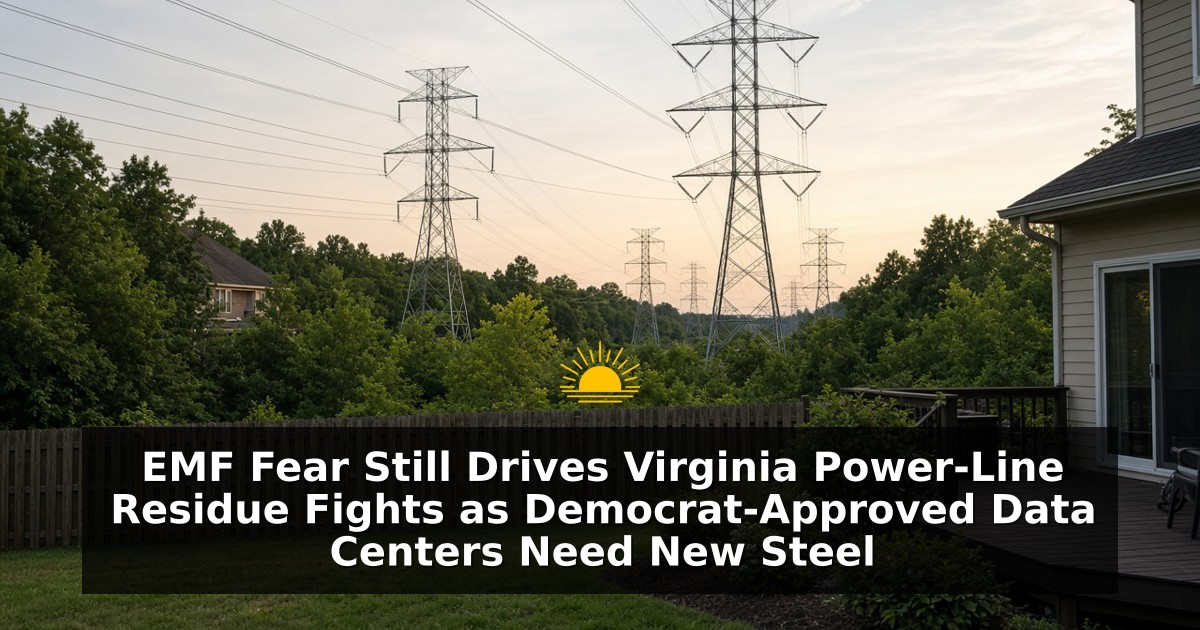
RICHMOND / LOUDOUN COUNTY, Va. — Electromagnetic fields (EMF) from high-voltage transmission lines are a central issue in Virginia’s push to expand its power grid. Landowners routinely argue that the residual land left after an easement is taken is worth less because of proximity to the lines. Utilities, in turn, work to keep discussions of “EMF fear” out of compensation hearings.
Virginia’s Supreme Court confronted this tension in Chappell v. Virginia Electric and Power Co. (1995). Vepco condemned less than an acre of easement across a Hanover County farm for a 230 kV line. The landowner’s appraiser planned to testify that public awareness and fear of electromagnetic fields would significantly reduce the value of the remaining property. The trial court blocked that evidence. Commissioners awarded far less in residual damages than the landowner sought. The Supreme Court upheld the exclusion, largely on procedural grounds, leaving Virginia’s rules on whether power-line-related fear is compensable unsettled. A 1999 General Assembly joint subcommittee on eminent domain later flagged the gap while examining utility transmission condemnations.
Today’s opposition materials reflect the same unresolved debate. Advocates circulate research pointing to possible cellular effects, neuropsychiatric symptoms linked to certain frequencies, and reports of electromagnetic hypersensitivity. At the same time, they include mainstream sources: National Academies and National Library of Medicine reviews of residential electric and magnetic fields, American Cancer Society material on extremely low-frequency radiation, EPA information on power lines, and National Institute of Environmental Health Sciences pages on EMF. Federal and medical institutions continue to publish on the topic because public questions persist.
An older Bonneville Power Administration review from the late 1980s (later updated) is often cited for context. It concluded that literature reviews had not established a clear causal health link, that any reported epidemiological risks appeared small, and that laboratory and occupational findings still justified practical steps to avoid increasing long-term exposures when design alternatives existed. Magnetic fields, unlike electric fields, pass through walls. That physical fact turns properties just outside the right-of-way into the practical battleground for residual-value claims.
These issues are concrete in Northern Virginia right now. Across the state, the majority of votes placing data centers into zoning maps and by-right pathways have come primarily from Democratic boards. In Loudoun County, Democratic majorities spent years rezoning and grandfathering campuses, culminating in the Board’s March 18, 2025, unanimous by-right expansion. That growth created the megawatt demand that PJM and utilities now cite for major new transmission projects, including Valley Link’s 765 kV northern spine, MARL rebuilds, Data Center Loop certificates, and related Mid-Atlantic infrastructure. Those projects require easements. Easements leave residual parcels. Residual parcels invite marketability arguments tied to EMF whether or not a court ultimately hears health studies.
Undergrounding is sometimes offered as a technical alternative. It redistributes fields rather than eliminating them. Older reviews treated issues such as corona noise, radio interference, and ozone as largely manageable through modern design on high-voltage lines, while leaving longer-term magnetic-field questions open.
Virginia’s practical sequence remains straightforward: Democratic local boards expand electricity demand through data-center approvals; utilities seek corridors through condemnation; landowners are left with residual parcels and an EMF-related valuation fight the Commonwealth never fully resolved after the 1995 case and the 1999 study. Until compensation rules or siting standards more clearly address fields beyond the deeded strip, the pattern is likely to continue every time another data-center campus wins approval from a Democrat-majority board.
Email the Loudoun County School Board:
April Chandler, april.chandler@lcps.org,
Anne Donohue, anne.donohue@lcps.org,
Deana Griffiths, deana.griffiths@lcps.org,
Ross Svenson, ross.stevenson@lcps.org,
Kari LaBell, kari.labell@lcps.org,
Jon Pepper, jonathon.pepper@lcps.org,
Lauren Shernoff, lauren.shernoff@lcps.org,
Sumera Rashid, sumera.rashid@lcps.org,
Amy Riccardi, amy.riccardi@lcps.org,
Email the Board of Supervisors at:
Phyllis J. Randall (Chair, At-Large) – Phyllis.Randall@loudoun.gov,
Michael R. Turner (Vice Chair, Ashburn District) – Mike.Turner@loudoun.gov,
Juli E. Briskman (Algonkian District) – Juli.Briskman@loudoun.gov,
Sylvia R. Glass (Broad Run District) – Sylvia.Glass@loudoun.gov,
Caleb Kershner (Catoctin District) – caleb.kershner@loudoun.gov,
Matthew F. Letourneau (Dulles District) – Matt.Letourneau@loudoun.gov,
Kristen C. Umstattd (Leesburg District) – Kristen.Umstattd@loudoun.gov,
Laura A. TeKrony (Little River District) – Laura.TeKrony@loudoun.gov,
Koran Saines (Sterling District) – Koran.Saines@loudoun.gov
Hanover County Loudoun County Richmond Virginia Amy Riccardi Anne Donohue April Chandler Caleb Kershner Congress Data Data Center Data Centers Deana Griffiths Debate Democrat Democrats Electric Electricity Farm Grid Hanover County Health Jon Pepper Juli Briskman Kari LaBell Koran Saines Kristen Umstattd Land Laura TeKrony Lauren Shernoff Loudoun County Loudoun County Board of Supervisors Loudoun County School Board Matt Letourneau Mike Turner Northern Virginia Phyllis Randall PJM Power power lines Radiation Richmond Ross Svenson Sumera Rashid supreme court Sylvia Glass Virginia