Virginia Advances Uniform Licensure Path for Foreign-Trained Chiropractors
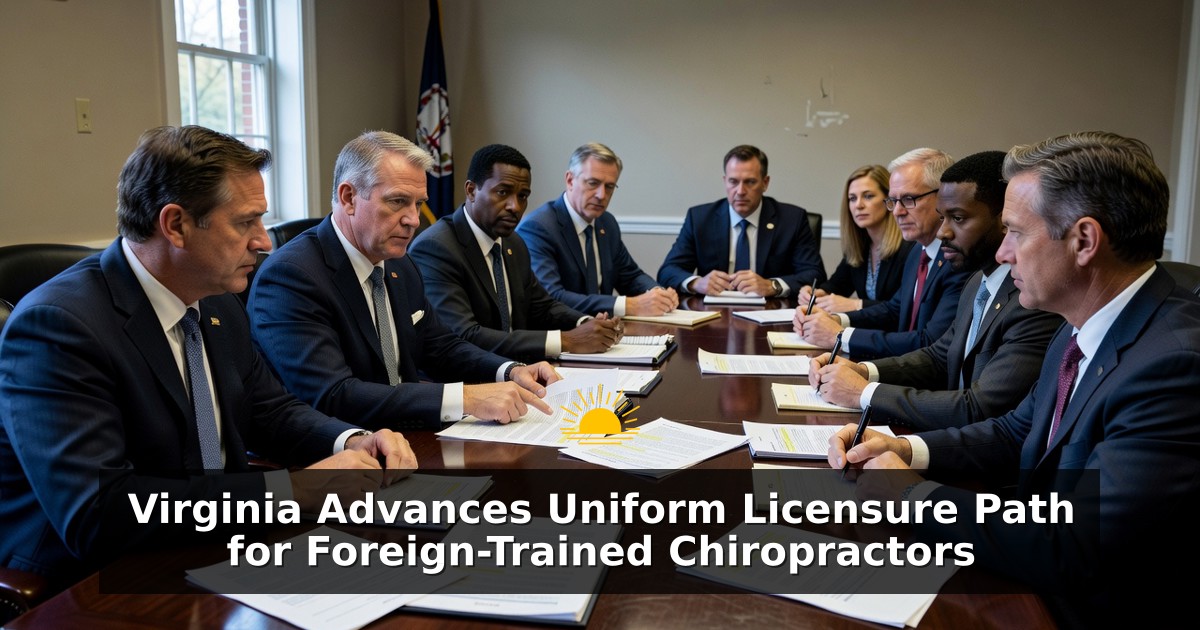
Virginia lawmakers on the Health Professions Subcommittee examined proposed legislation designed to create a clear pathway for foreign-trained chiropractors seeking licensure in the Commonwealth. House Bill 1026 outlines specific eligibility criteria that international graduates must satisfy before they can sit for national examinations. A representative from the Virginia Chiropractic Association presented details of the measure during the February session, emphasizing that the requirements establish parity with standards already applied to graduates of United States chiropractic programs. The discussion centered on protecting patients by ensuring every licensed practitioner demonstrates equivalent competence regardless of where their education occurred.
Delegate Hodges received a detailed explanation of how the bill operates in practice. The association representative stated that the listed criteria simply render an applicant eligible to appear before the National Licensing Board. Successful completion of those examinations would then lead to issuance of a Virginia license. Once licensed, the practitioner becomes subject to every continuing education and renewal obligation that applies to all other chiropractors regulated by the Department of Health Professions. This structure places a consistently high bar on entry while preserving uniform oversight afterward.
Criteria for National Examination Eligibility
Under the framework described to the subcommittee, foreign-trained applicants must first document that their educational credentials meet established equivalency benchmarks. Only after clearing that threshold may they register for the national board examinations that every Virginia chiropractor must pass. The process also includes a special examination component intended to verify clinical readiness in areas specific to Commonwealth practice expectations. Together these steps confirm that the candidate possesses the foundational knowledge and skills required before any license is granted. Lawmakers heard that the combination of national boards plus the additional exam creates a rigorous filter that safeguards the public.
The same presentation noted that individuals who have not held an active license for a period of five years would need to complete continuing education hours before becoming eligible. That provision mirrors good-practice expectations already familiar within other Virginia health professions. By requiring recent educational engagement, the bill addresses potential gaps in knowledge that can develop during extended periods away from clinical work. Subcommittee members considered this element an important safeguard that further aligns chiropractic regulation with broader Department of Health Professions standards.
Continuing Education and Ongoing Professional Obligations
After initial licensure, foreign-trained chiropractors would face identical continuing education mandates that govern every other licensee under the Department of Health Professions. Annual or biennial hour requirements, approved course topics, and documentation rules would apply without distinction based on the country of original training. The Virginia Chiropractic Association representative underscored that this post-licensure equality ensures long-term professional excellence. Patients can therefore expect the same level of current knowledge and skill from any chiropractor holding a Commonwealth license. The approach eliminates any two-tier system that might otherwise undermine public confidence.
Maintaining high standards received repeated emphasis throughout the exchange. Committee participants recognized that chiropractic care involves direct patient contact and clinical decision-making that demand reliable competence. By tying eligibility tightly to national examination success and subsequent continuing education, HB 1026 reinforces the principle that location of training should never dilute the quality of care delivered in Virginia. The bill’s supporters framed the measure as a patient-protection tool rather than a barrier to qualified professionals. Clear, uniform rules also give foreign-trained practitioners a transparent roadmap for entering practice.
Broader Context of Chiropractic Regulation in Virginia
Chiropractic licensure in Virginia already rests on a foundation of national board examinations administered through recognized testing organizations. Domestic graduates complete accredited Doctor of Chiropractic programs and then pass multipart assessments covering basic sciences, clinical sciences, and practical skills. HB 1026 extends that same examination gateway to internationally educated candidates once educational equivalency is verified. The Department of Health Professions retains full authority to enforce license renewal, discipline, and continuing education compliance for all practitioners. This centralized oversight helps maintain consistency across the profession.
Patient safety considerations formed the core rationale presented to the subcommittee. When every licensee must clear identical national examinations and fulfill the same ongoing education duties, the public gains assurance that minimum competency thresholds are met. The five-year continuing education trigger for those without recent licensure adds another layer of currency to clinical knowledge. Lawmakers heard that such provisions reflect best practices observed in other regulated health fields within the Commonwealth. The cumulative effect is a regulatory environment that values both accessibility for qualified applicants and uncompromising standards for care.
The discussion also touched on the practical benefits of legislative clarity. Foreign-trained chiropractors gain an explicit set of steps rather than navigating ambiguous equivalency determinations. Licensing staff at the Department of Health Professions receive clearer statutory guidance for evaluating applications. Educational institutions abroad can better advise students who hope to practice in Virginia. In each of these respects, HB 1026 seeks to replace uncertainty with predictable, high-quality requirements that serve applicants and patients alike.
Closing Perspectives on Professional Excellence
Subcommittee members weighed the testimony as part of their broader responsibility to oversee health profession statutes. The Virginia Chiropractic Association contribution supplied on-the-ground perspective about how the proposed criteria function in real application cycles. By requiring passage of national boards and a special examination before licensure, then imposing uniform continuing education thereafter, the bill locks in a single standard of excellence. That standard remains in force for the entire career of the licensee. The approach ultimately supports the dual goals of welcoming competent practitioners and protecting the Virginians who seek chiropractic care.
As the legislative process continues, the core facts remain straightforward. Foreign-trained chiropractors must satisfy defined eligibility criteria, succeed on national licensing examinations plus a special exam, and thereafter meet every continuing education obligation applied to domestic graduates. These steps, explained in detail to Delegate Hodges and the Health Professions Subcommittee, form the substance of HB 1026. The measure stands as a deliberate effort to keep Virginia’s chiropractic standards rigorous, transparent, and evenly enforced for the benefit of public health.
Amendment Bo Keeney board CE Requirements Chiropractic Continuing Education Criteria Delegate Hodges DHP Exam Health Profession license Licensure Licensure Requirements Madam Chair National Boards National Licensing Board practice Special Exam standards Virginia Virginia Chiropractic Association