Loudoun Officials Address Latino Student Representation in Equity Efforts
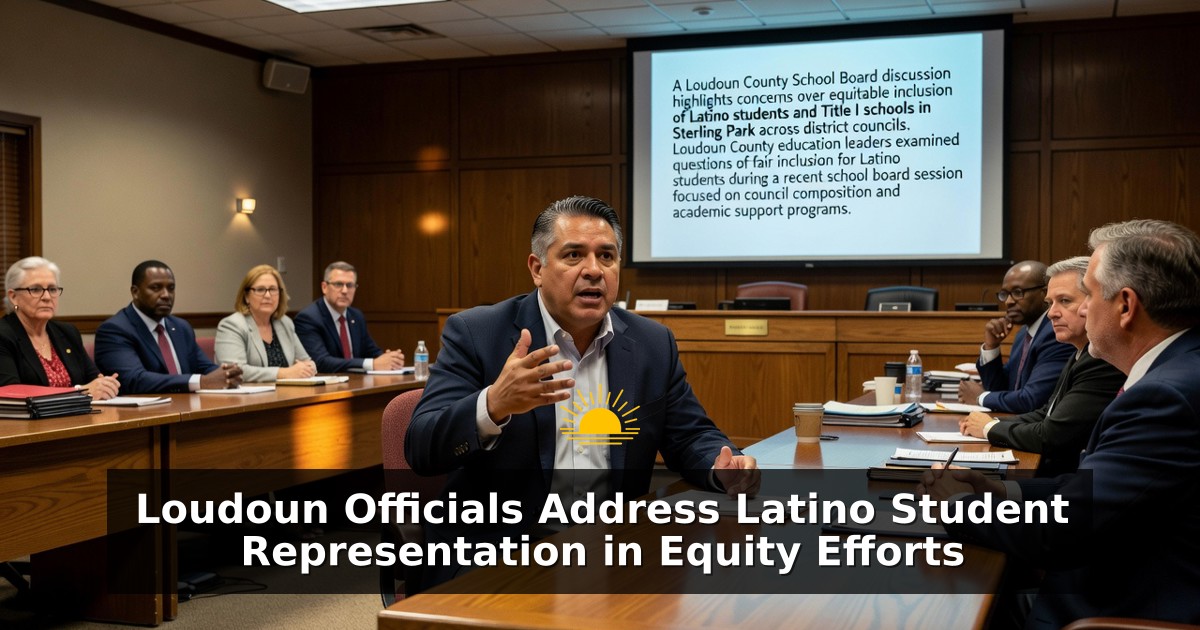
Loudoun County education leaders examined questions of fair inclusion for Latino students during a recent school board session focused on council composition and academic support programs. A committee member representing the Sterling community underscored the need for balanced participation by Latino families in all major initiatives. Officials responded by affirming that existing councils already draw from a wide range of backgrounds and geographic areas. The exchange centered on aligning decision-making bodies with the county’s demographic realities so that every student group receives appropriate attention.
The Loudoun County School Board oversees these discussions and currently consists of Melinda Mansfield, April Chandler, Deana Griffiths, John Beatty, Tiffany Polifko, Kari LaBell, Erica Helms, Sumera Rashid, and Atoosa Reaser. Board members routinely review data on student performance and program access across the nine election districts. Their collective responsibility includes monitoring how advisory councils reflect the populations they serve. Meetings such as the one held on the fourth Tuesday provide structured opportunities for public input on these matters.
Concerns Raised About Sterling Park Demographics
The committee member noted a longstanding personal focus on equitable treatment of Latino residents, especially those living in Sterling and Sterling Park. Questions were posed about whether council seats adequately cover the various districts and the full spectrum of cultural groups present in Loudoun County. An affirmative reply confirmed that the council membership is already highly diverse. Additional details on individual members and their home districts were offered for later review to increase transparency.
Sterling Park contains seven schools designated as Title I campuses because of the elevated percentage of students from lower-income households. These schools sometimes encounter academic challenges that appear in standardized assessment results and graduation metrics. The committee member requested explicit assurance that data reviews and work plans incorporate the experiences of students at these campuses. Officials acknowledged the request and indicated that representation remains a standing priority within ongoing projects.
Title I Status and Academic Support Needs
Title I funding supplies extra resources intended to close achievement gaps at schools serving higher concentrations of economically disadvantaged children. In Loudoun County the seven Sterling Park Title I schools enroll substantial numbers of Latino students whose families often navigate language barriers and economic pressures. County educators track progress through regular data cycles that measure reading proficiency, mathematics performance, and chronic absenteeism rates. Ensuring that council voices include individuals familiar with these schools helps keep support strategies grounded in actual classroom conditions.
Independent demographic studies show that Loudoun County’s Latino population has grown steadily over the past decade and now constitutes a significant share of public-school enrollment. Sterling District schools register some of the highest proportions of English-learner students in the division. Local administrators therefore maintain specialized outreach programs, bilingual family liaisons, and culturally responsive curriculum reviews. The recent board conversation reinforced the expectation that advisory bodies will continue to mirror this diversity when shaping policy recommendations.
Council Composition and District Balance
Council organizers stated that membership already spans multiple election districts and includes participants from varied racial, ethnic, and linguistic backgrounds. They expressed willingness to supply a complete roster showing each member’s district of residence. Such documentation would allow the public to verify geographic spread and to identify any remaining gaps. The committee member welcomed the offer and reiterated interest in confirming that Sterling Park perspectives appear in the data sets under examination.
Broader equity frameworks adopted by Loudoun County Public Schools emphasize inclusive stakeholder engagement as a core operating principle. These frameworks call for deliberate recruitment of parents, teachers, and community advocates who understand the daily realities of Title I campuses. Regular audits of committee demographics help measure progress toward that goal. The exchange at the board meeting illustrated how individual inquiries can prompt renewed attention to these internal checks.
Implications for Future Data Reviews
When academic performance data are presented in future sessions, officials indicated they will continue highlighting outcomes disaggregated by school cluster and student subgroup. Particular scrutiny will fall on the seven Sterling Park Title I schools so that resource allocation decisions remain responsive to documented needs. Latino student achievement trends will form one component of those reviews. Maintaining diverse council membership is viewed as an essential safeguard that keeps such analyses comprehensive and credible.
Community members who follow school governance noted that open dialogue of this kind strengthens public trust. By inviting specific information on council districts and by linking representation questions to Title I academic patterns, the discussion produced a clear action item for staff. Follow-up materials listing council members by district are expected to circulate in subsequent correspondence. The board’s overall commitment to equitable processes remains unchanged and continues to guide daily administrative practice.
Sustained Focus on Inclusive Decision-Making
Loudoun County’s rapid population growth has intensified the importance of representative structures at every level of school governance. Latino families contribute substantially to the cultural and economic fabric of Sterling Park and neighboring communities. Their equitable presence on advisory councils helps ensure that language access, family engagement events, and instructional interventions address real barriers. The recent meeting supplied a public reminder that demographic alignment is not automatic and must be monitored continuously.
Education observers familiar with Virginia school divisions point out that Title I schools often benefit most when local decision makers possess direct knowledge of their challenges. The seven Sterling Park campuses therefore stand to gain from any expansion or verification of council diversity. Staff members have already begun compiling the requested district-level membership details. Once shared, those details will allow further constructive conversation about inclusion metrics and academic support priorities.
The Loudoun County School Board will keep these topics on its agenda as part of routine oversight of student equity indicators. Continued attention to Latino representation and to the specific circumstances of Title I schools forms one element of a larger effort to raise achievement for every learner. Officials closed the exchange with mutual thanks, signaling a shared interest in productive collaboration. Future meetings are likely to revisit the same themes as new data become available and as council rosters evolve.
clip Ensuring Equitable Latino Loudoun post Representation School Board short social Sterling Students summary text Title vertical Video Write