Virginia Advances Bill Expanding DEQ Drone Authority for Water Oversight
Updated
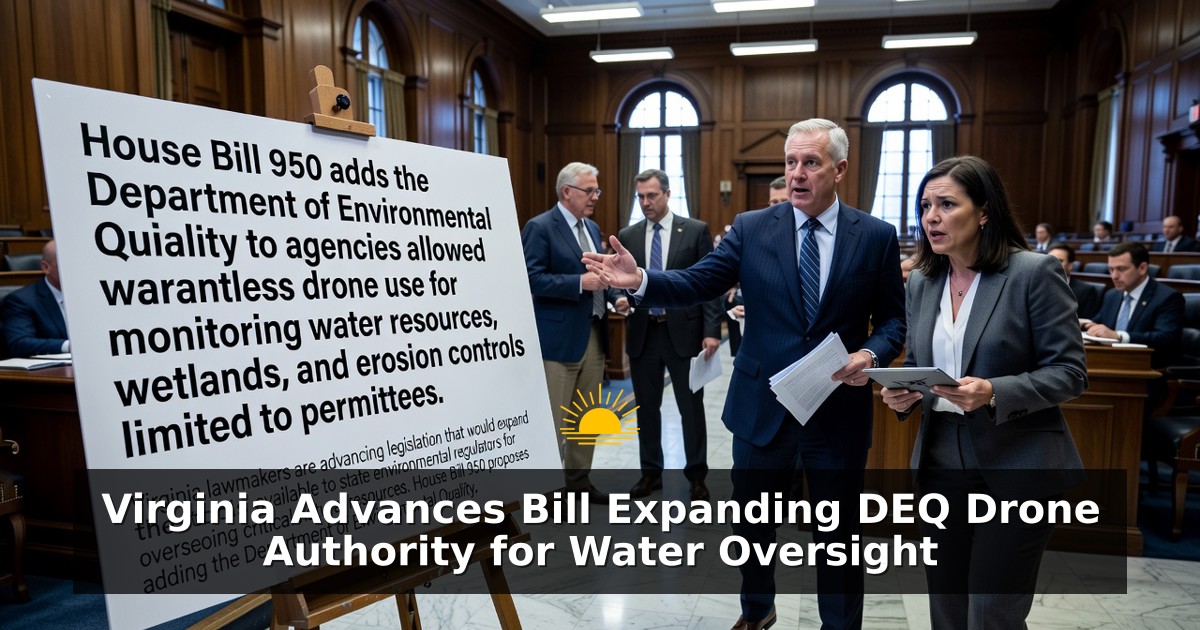
Virginia lawmakers are advancing legislation that would expand the tools available to state environmental regulators for overseeing critical natural resources. House Bill 950 proposes adding the Department of Environmental Quality to the list of public bodies authorized to operate unmanned aircraft systems without first obtaining a warrant. The measure centers on strengthening implementation and enforcement of programs that safeguard water resources and wetlands across the commonwealth. Subcommittee members reviewed the proposal during a session of the House Courts of Justice and recommended it move forward in amended form.
The core purpose of the bill is to equip the Department of Environmental Quality with aerial monitoring capabilities that support existing statutory responsibilities. These responsibilities include the water resources and wetlands protection program, which addresses the health of streams, rivers, and associated habitats. Officials indicated that drones could assist in gathering visual data over expansive or difficult-to-access terrain where traditional ground inspections prove limited. The legislation maintains a clear boundary by tying the new authority directly to established environmental statutes rather than creating open-ended surveillance powers.
Legislative Details of House Bill 950
House Bill 950 specifically amends current restrictions on unmanned aircraft systems used by public bodies in Virginia. Under existing frameworks, most agencies must secure a warrant before deploying drones, with limited exceptions already carved out for certain public safety functions. The new language would place the Department of Environmental Quality among those exceptions when the agency carries out defined environmental duties. Supporters of the change framed it as a practical update that aligns technology with longstanding regulatory mandates. The bill text emphasizes targeted application rather than broad new powers.
In addition to wetlands and water resources, the measure extends to the Virginia Erosion and Stormwater Management Act. It also covers erosion and sediment control requirements in localities that lack their own Virginia Erosion and Stormwater Management Program. These programs aim to reduce runoff pollution, prevent soil loss, and protect downstream water quality during construction and land-disturbing activities. Drones could provide overhead perspectives that help verify compliance with permit conditions in real time. The approach seeks efficiency gains while preserving the underlying legal structure of the programs.
Amendments adopted during subcommittee consideration clarify that unmanned aircraft systems may be employed only for civil enforcement actions against permittees. This limitation ensures the technology does not extend to general surveillance of private property unrelated to regulated activities. Civil enforcement in this context typically involves notices of violation, corrective orders, or administrative penalties rather than criminal proceedings. By confining drone use to entities already holding permits, the bill attempts to balance enhanced oversight with respect for property boundaries. The refined language received majority support in the subcommittee.
Subcommittee Review and Recommendation
Chair Watts introduced House Bill 950 before the relevant subcommittee of the House Courts of Justice. Discussion focused on the practical needs of environmental field staff who monitor compliance across diverse landscapes. Members weighed the value of aerial imagery against longstanding warrant preferences that protect individual privacy interests. After reviewing the amendments that restrict use to civil actions against permit holders, the subcommittee voted 6 to 3 to recommend reporting the bill as amended. The recommendation signals committee-level approval for further consideration by the full body.
The Department of Environmental Quality already holds primary responsibility for implementing federal and state clean water standards within Virginia. Its staff conduct inspections, review permit applications, and respond to pollution incidents that affect rivers, lakes, and coastal areas. Wetlands receive particular attention because they filter pollutants, store floodwaters, and provide habitat for numerous species. Traditional inspection methods rely heavily on vehicle access and on-foot surveys, which can leave remote or densely vegetated sites under-observed. Integrating drones offers a complementary method for documenting conditions without expanding the agency’s legal reach beyond current permit frameworks.
Broader Context of Environmental Monitoring Needs
Virginia faces ongoing challenges in maintaining water quality, particularly in watersheds that drain into the Chesapeake Bay. Sediment and nutrient runoff from construction sites and agricultural lands remain significant contributors to downstream impairment. Erosion and sediment control regulations exist precisely to minimize these impacts during land development. When localities do not operate their own stormwater programs, state-level oversight fills the gap, placing additional demands on Department of Environmental Quality personnel. Aerial tools could help prioritize field visits and document conditions more comprehensively than ground-level photography alone.
Unmanned aircraft systems have become standard equipment in many scientific and regulatory settings nationwide because they capture high-resolution images and video at relatively low cost. In environmental applications, they can reveal unauthorized filling of wetlands, inadequate silt fencing, or stormwater basin failures that might otherwise escape notice until substantial damage occurs. The Virginia proposal does not alter the underlying permit obligations; it simply modernizes the means of verifying those obligations. Limitations to civil enforcement against permittees further reduce the likelihood of unintended privacy intrusions.
Existing Virginia statutes already authorize selected public bodies to use drones without warrants for narrowly defined purposes such as search and rescue or certain emergency responses. Adding the Department of Environmental Quality follows a similar pattern of exception-based expansion rather than wholesale repeal of warrant preferences. The 6-to-3 subcommittee vote reflects a divided but decisive judgment that the environmental benefits outweigh residual concerns when safeguards remain in place. Further legislative steps will determine whether the amended bill advances to the full House of Delegates for consideration.
Implications for Permit Compliance and Resource Protection
Permit holders operating under water protection or erosion control authorizations already submit to agency inspections as a condition of their approvals. The introduction of drone-assisted monitoring would represent an evolution in inspection technique rather than a fundamental change in regulatory expectations. High-quality aerial documentation can create clearer records for both the agency and the regulated party, potentially reducing disputes over site conditions. At the same time, the civil-only limitation keeps the tool outside criminal investigative channels. This design choice addresses one of the primary objections raised against broader drone authority.
Wetlands protection programs in Virginia operate under a combination of state law and federal Clean Water Act authorities. Accurate mapping and condition assessment of these areas support both conservation goals and responsible development planning. Drones equipped with standard cameras can assist in delineating boundaries and detecting disturbances more rapidly than exclusive reliance on ground crews. When paired with the erosion and stormwater provisions, the technology supports a more integrated view of how land-disturbing activities affect connected water systems. The bill’s sponsors presented these capabilities as incremental improvements grounded in existing statutory duties.
As the measure proceeds, attention will remain on the precise boundaries of authorized use. The requirement that flights serve civil enforcement against permittees provides a measurable standard for future oversight of the agency’s practices. Public bodies employing unmanned aircraft systems under exception statutes typically adopt internal protocols that document mission purpose and data retention. Similar administrative controls would be expected if House Bill 950 becomes law. The subcommittee’s recommendation to report the bill as amended positions the proposal for continued debate on these operational details.
The discussion surrounding House Bill 950 illustrates the continuing effort to match regulatory tools with contemporary technology while preserving core legal protections. By focusing authority on water resources, wetlands, and erosion programs, and by limiting application to permittees in civil matters, the legislation seeks a narrow expansion. The 6-to-3 vote in subcommittee underscores that members found the amended version sufficiently refined to advance. Subsequent legislative stages will test whether that consensus holds as the full implications for environmental practice and privacy expectations receive further examination.
chair chair watts committee meeting Department of Environmental Quality DEQ Drone drones Enhanced environment environmental environmental monitoring expands House Bill 950 monitoring Protections Use Virginia water resources Watts wetlands protection