Virginia Defers Rural EV Charging Fund Bill to 2027
Updated
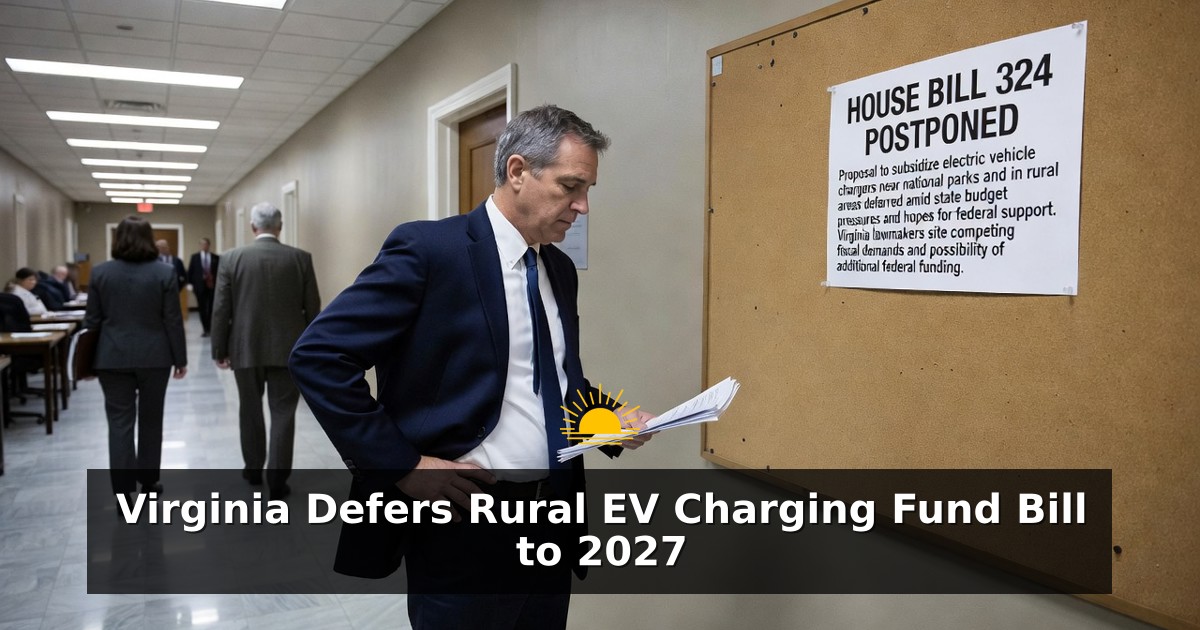
Virginia lawmakers have deferred action on a proposal to create a dedicated state fund for electric vehicle charging stations in underserved areas, citing competing fiscal demands and the possibility of additional federal resources. House Bill 324, introduced by Delegate Sullivan, sought to establish the Electric Vehicle Rural Infrastructure Fund to cover 70 percent of non-utility costs for installing chargers near national parks or in rural and unserved locations. The measure included a budget request for 5 million dollars to capitalize the program and support an initial round of projects. Officials noted that similar installations supported through the National Electric Vehicle Infrastructure program have informed the cost estimates behind the legislation. The deferral pushes further consideration to 2027 and leaves open questions about the pace of charging expansion outside major corridors.
Supporters of expanded charging networks have long pointed to gaps in rural coverage as a barrier to broader electric vehicle adoption across the commonwealth. Drivers traveling to or through national parks often encounter limited options for reliable fast charging, which can discourage longer trips and reduce tourism-related economic activity in surrounding communities. Rural residents face comparable challenges when considering a switch to electric models because home charging is not always feasible and public stations remain sparse. House Bill 324 aimed to address those specific shortfalls by targeting locations that private investment has been slower to reach. The proposed 70 percent state offset was designed to lower the financial threshold for site hosts while still requiring local or private contributions for the remaining share.
Details of the Funding Proposal
Under the plan outlined by Delegate Sullivan, the new fund would draw on a 5 million dollar appropriation to underwrite roughly five separate charging projects. Individual project costs were projected to fall between 900,000 and 1 million dollars each, figures drawn from experience with installations already completed under the federal National Electric Vehicle Infrastructure program. Those federal projects have typically involved direct-current fast chargers capable of serving multiple vehicles and meeting minimum power and reliability standards. By focusing on non-utility expenses, the state contribution would cover equipment, site preparation, and related construction while leaving utility-side upgrades to other funding streams. The structure sought to stretch limited state dollars across a small number of high-impact sites rather than spreading resources too thinly.
Legislative analysts observed that the per-project cost range reflects current market prices for commercial-grade charging hardware and the civil engineering work often required at park-adjacent or remote locations. Many rural sites lack existing three-phase power or adequate parking layouts, driving expenses higher than urban installations. The National Electric Vehicle Infrastructure program has already demonstrated both the technical feasibility and the budgetary scale of such work in Virginia and neighboring states. House Bill 324 therefore positioned the state fund as a complementary tool that could fill geographic gaps left by corridor-focused federal grants. Five fully funded projects would have represented a modest but visible down payment on wider rural coverage.
Budget Pressures and the Decision to Defer
During budget deliberations, lawmakers weighed the 5 million dollar request against a range of other spending priorities that include education, transportation maintenance, and public safety. Concerns about overall general-fund capacity led to the decision to carry the bill over to the 2027 session rather than advance it in the current cycle. Some members expressed hope that additional federal allocations or private partnerships might materialize in the interim and reduce the need for a large state outlay. Fiscal staff emphasized that deferral does not equate to rejection of the underlying policy goal; it simply preserves flexibility while revenue forecasts and federal guidance become clearer. The move aligns with a broader pattern of cautious capital commitments during periods of competing demands.
Observers noted that electric vehicle infrastructure must compete with traditional highway and bridge needs that already strain available transportation dollars. Virginia has previously directed resources toward both conventional road projects and emerging clean-transportation initiatives, creating an ongoing balancing act. By postponing House Bill 324, the General Assembly retains the option to revisit the rural charging fund once more complete information on federal match opportunities is available. The deferral also allows time for updated cost data, as equipment prices and installation techniques continue to evolve. In the meantime, existing federal programs remain the primary vehicle for new charger deployments along designated corridors.
Implications for Rural Communities and Park Visitors
The postponement means that communities near national parks and in unserved rural counties may experience slower growth in publicly accessible charging options over the next two years. Residents and visitors who already drive electric vehicles could face continued range limitations on popular scenic routes, while prospective buyers may delay purchases until more stations appear. Local economic development officials have linked reliable charging availability to tourism spending, particularly for travelers who plan multi-day itineraries through park regions. Without the proposed state incentive, site hosts in lower-traffic areas may find it harder to justify the upfront capital required for fast-charging equipment. The result could be a more gradual build-out that leaves certain pockets of the state underserved for longer than originally hoped.
At the same time, the deferral underscores the reality that state budgets must accommodate multiple infrastructure categories simultaneously. Clean-transportation advocates continue to argue that early investment in charging reduces long-term emissions and positions Virginia competitively for future federal dollars. Transportation planners counter that every new program must demonstrate clear returns relative to maintenance backlogs and safety upgrades. House Bill 324’s focus on a 70 percent cost share and a limited number of pilot projects was intended to keep the fiscal footprint manageable while still producing measurable results. Whether that balance can be struck in 2027 will depend on revenue collections, federal policy developments, and the evolving cost curve for charging hardware.
Broader Context of Electric Vehicle Infrastructure Efforts
Virginia has participated actively in the National Electric Vehicle Infrastructure formula program, which supplies federal funding for chargers along interstate and alternative-fuel corridors. Those investments have concentrated on higher-traffic routes where utilization rates support private-sector interest and where utility upgrades can be coordinated efficiently. Rural and park-adjacent sites often fall outside the initial corridor maps, creating the precise coverage gaps that House Bill 324 sought to close. State energy and transportation agencies have also explored complementary grant programs and technical assistance for local governments interested in hosting stations. The deferred legislation would have added a targeted rural set-aside to that existing toolkit.
Industry data show that charging-station economics improve as electric vehicle registrations rise, yet early stations in low-density areas frequently require public support to reach financial viability. The 900,000-to-1-million-dollar cost band cited for the proposed projects is consistent with recent deployments that include multiple high-power ports, canopy structures, and grid interconnection work. By referencing those real-world figures, Delegate Sullivan’s budget request aimed to ground the discussion in verifiable expense levels rather than speculative estimates. Five million dollars would therefore have translated into a concrete handful of new locations rather than an open-ended commitment. Lawmakers will have an opportunity to reassess both the cost assumptions and the geographic priorities when the bill returns for consideration.
Looking ahead, the commonwealth faces ongoing choices about how aggressively to subsidize charging infrastructure relative to other transportation and environmental objectives. The deferral of House Bill 324 illustrates a preference for measured steps that preserve budgetary room while still acknowledging the strategic value of rural and park-area coverage. Continued monitoring of federal funding streams, technology costs, and electric vehicle adoption rates will shape the options available in 2027. In the interim, existing programs will carry the primary responsibility for expanding the network, and stakeholders will watch closely to see whether private investment fills any of the gaps the state proposal had identified. The ultimate timeline for denser rural charging will reflect the interplay of these fiscal, technical, and policy factors.
1 million dollars 5 million dollars 900000 dollars audience budget request budget this year committee continue to 2027 Delegate Sullivan electric vehicle EV charging stations expensive federal money five projects House bill 324 infrastructure fund National Electric Infrastructure Program national parks non-utility cost offsetting costs online rural locations un-served locations voice vote
