Loudoun Officials Detail Constitutional Limits on Student Searches by Schools and Officers
Updated
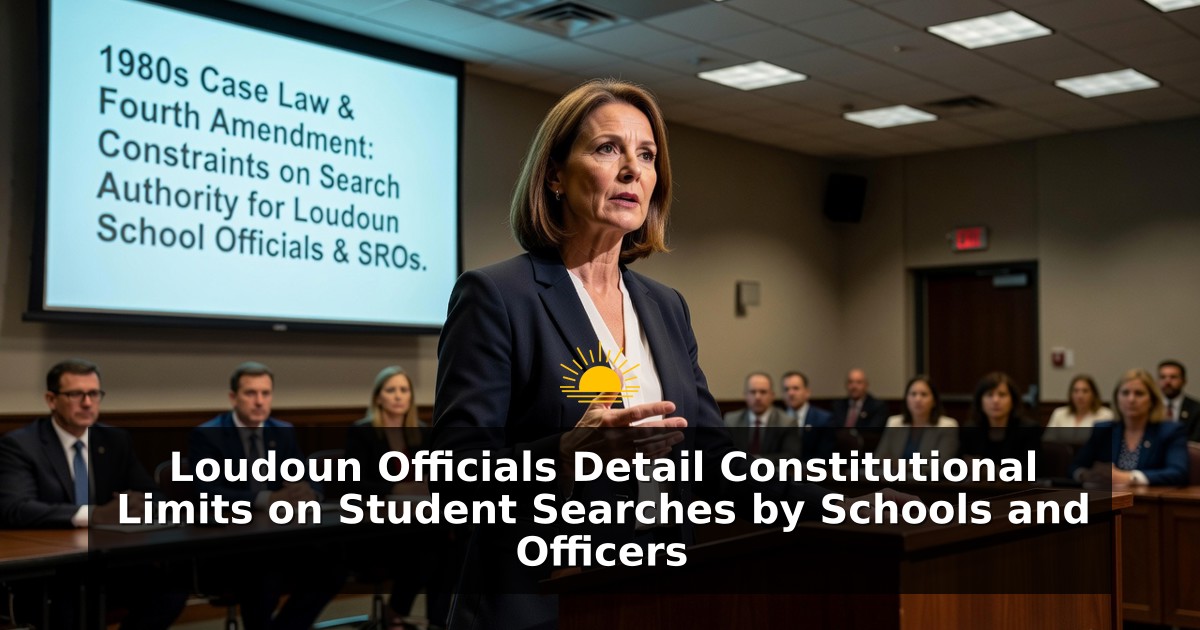
During a Loudoun County School Board meeting, Ms. Scanlan delivered a clear explanation of the legal boundaries that govern searches of students by school officials and School Resource Officers. She stressed that the authority to conduct such searches is tightly limited by established case law rather than by local policy preferences alone. These constraints exist to safeguard the constitutional rights of students while still allowing schools to maintain order and safety. The remarks came amid ongoing attention to the relationship between school administrators and law enforcement personnel assigned to campuses. Officials present underscored that any operational agreements must remain subordinate to higher legal standards.
The Loudoun County School Board oversees these matters for the division and currently includes Tiffany Polifko, April Chandler, Deana Griffiths, Julie Slye, Cindy Moses, Kari LaBell, Sumera Rashid, Lauren Shernoff, and Arben Istrefi. Board discussions regularly address safety protocols, student discipline, and partnerships with local law enforcement. Ms. Scanlan’s comments focused specifically on search authority and its foundations in federal constitutional law. She noted that the governing principles have remained stable for many years. This stability provides a predictable framework for both educators and families in the county.
Legal Precedents From the 1980s
Ms. Scanlan highlighted that the most relevant case law dates to the 1980s and continues to control how school searches must be conducted. The landmark decision in New Jersey v. T.L.O., issued by the United States Supreme Court in 1985, remains the cornerstone of this area of law. In that ruling the Court held that the Fourth Amendment’s protection against unreasonable searches and seizures applies to public school officials. At the same time the Court recognized that the school environment requires a modified standard. Instead of probable cause or a warrant, school officials may search a student when they have reasonable suspicion that the search will uncover evidence of a violation of law or school rules.
The T.L.O. framework also requires that any search be reasonably related in scope to the circumstances that justified it in the first place. Courts examine whether the measures used are excessively intrusive in light of the student’s age, gender, and the nature of the suspected infraction. Subsequent decisions have refined these principles but have not displaced the core reasonable-suspicion standard established four decades ago. Ms. Scanlan emphasized that these precedents leave little room for local deviation. School divisions across Virginia, including Loudoun County, must craft policies that faithfully implement the constitutional baseline.
Application to School Resource Officers
School Resource Officers operate at the intersection of education and law enforcement, which raises additional questions about the proper standard for searches. Ms. Scanlan clarified that the same constitutional constraints apply when officers participate in searches on school grounds. The decades-old case law does not create a separate, looser set of rules simply because a sworn officer is present. When an officer acts in furtherance of school disciplinary objectives, the reasonable-suspicion standard typically governs. When an officer pursues a purely criminal investigation, traditional probable-cause requirements may come into play, yet the overarching Fourth Amendment still controls.
This distinction is often addressed through a memorandum of understanding between the school division and the police department that supplies the officers. Such agreements define roles, responsibilities, and information-sharing protocols. According to Ms. Scanlan, however, discussions about updating or revising the SRO memorandum of understanding would not alter the underlying search policy. The policy itself must remain anchored to case law and the Fourth Amendment regardless of any changes in operational agreements. That separation ensures continuity and legal compliance even as administrative details evolve.
Protecting Student Rights While Preserving Safety
The explanation offered by Ms. Scanlan reinforces Loudoun County’s commitment to balancing campus safety with respect for individual rights. Students do not shed their constitutional protections at the schoolhouse gate, a principle repeatedly affirmed by the Supreme Court. At the same time, educators need practical tools to address weapons, drugs, or other serious threats that can disrupt learning. The reasonable-suspicion standard developed in the 1980s attempts to strike that balance by giving school officials flexibility without granting unlimited discretion. Clear articulation of these limits helps administrators, officers, parents, and students understand what is permitted and what is not.
Virginia school divisions operate under both federal constitutional mandates and state statutes that further regulate student searches and the use of law-enforcement personnel in schools. Loudoun County policies are written to satisfy all applicable layers of law. Regular training for administrators and SROs on the scope of lawful searches forms an essential part of compliance. When questions arise about a particular incident, the same body of 1980s case law supplies the analytical starting point. Ms. Scanlan’s remarks served to remind the community that these foundational rules are not subject to renegotiation through routine policy reviews.
Broader Context for Virginia School Divisions
Across the Commonwealth, school boards confront similar issues whenever they review safety plans or law-enforcement partnerships. The durability of the T.L.O. standard means that fundamental search authority has not shifted with changes in technology, social media, or contemporary disciplinary challenges. Courts continue to apply the reasonable-suspicion test to new factual scenarios, including searches of electronic devices, yet the original doctrinal framework endures. Loudoun County’s approach of publicly restating these limits contributes to transparency and public trust. Families gain a clearer picture of how constitutional protections operate inside local schools.
Ms. Scanlan concluded that the search policy stands independently of any memorandum-of-understanding discussions precisely because it is dictated by higher law. That position aligns the division with long-settled Supreme Court precedent and with the Fourth Amendment itself. By keeping the legal foundation visible, the school board and its advisors help ensure that daily practices remain consistent with decades of jurisprudence. The result is a framework that supports both orderly schools and the individual rights of the students who attend them. Continued attention to these principles will guide future reviews of safety-related policies in Loudoun County.
authority constraints case law constitutional rights Explaining fourth amendment Law Enforcement LCPS legal standards Loudoun County Role Scanlan School school officials school policy school resource officers school searches Searches SRO SROs student rights