Virginia Senator Outlines Flexible Judge Assignments for Complex Business Cases
Updated
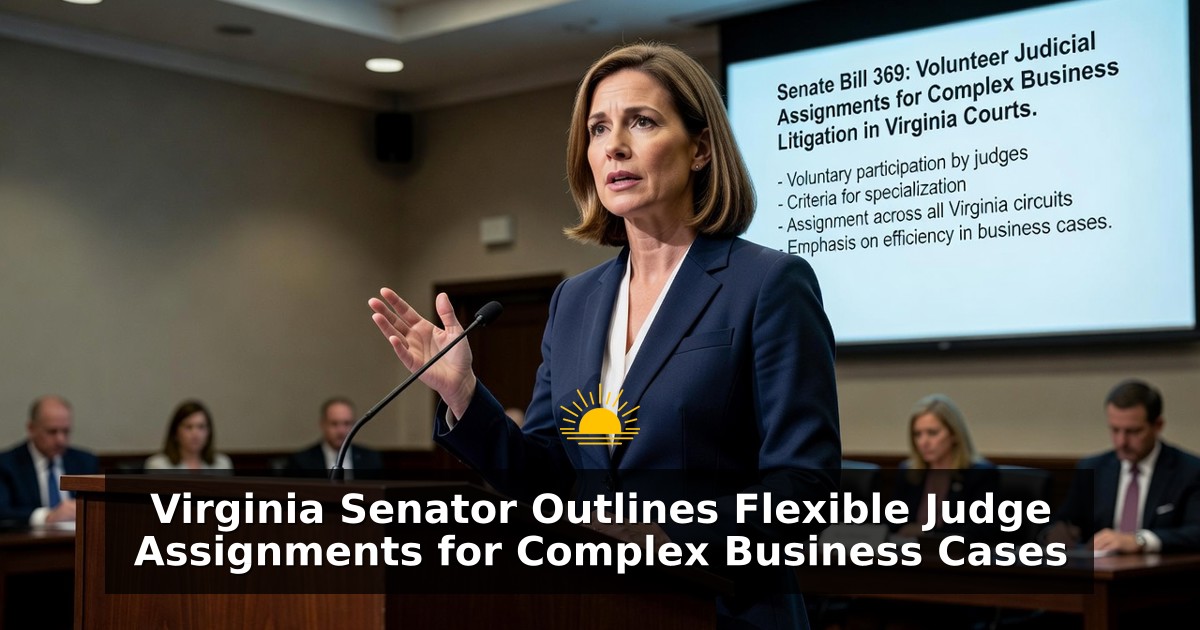
Virginia Senator Jennifer Carroll Foy detailed the process for assigning judges to complex business cases under Senate Bill 369 during a civil subcommittee session. She emphasized that the approach relies on voluntary participation rather than any permanent or fixed group of jurists. Active judges across the state can indicate their readiness to handle intricate commercial matters when such needs arise. This structure supports fair and expert adjudication while preserving local court authority in Virginia.
The legislation creates a pool of interested judges who possess relevant backgrounds for demanding commercial disputes. These individuals sign up in advance to be considered for temporary assignments involving sophisticated business issues. The chief justice then identifies suitable active judges from this group based on their stated qualifications. Cases remain grounded in their original circuits, with specialized support brought in as required to maintain consistent standards of justice.
Volunteer Pool and Expertise Identification
Under the framework of Senate Bill 369, the system draws from judges who have affirmatively expressed interest in complex business litigation. Participants must demonstrate specialized knowledge in areas such as mergers and acquisitions or similar high-level corporate transactions. The chief justice reviews and designates those active judges who meet the criteria for potential service. This identification step ensures that only qualified individuals enter the available pool for later selection. The process remains open to judges statewide who wish to contribute their particular skills when called upon.
When a circuit court encounters a matter exceeding ordinary expertise, either the sitting judge or the litigants may initiate a formal request. They petition the chief justice to authorize a specialized substitute for that specific case. Approval rests with the chief justice after review of the circumstances presented. If granted, selection proceeds randomly from the pre-identified volunteer judges. The chosen jurist then assumes the bench for the duration of the proceeding in question.
Local Venue Preservation and Anti-Forum Shopping Measures
A defining element of the assignment method is that the specialized judge travels to the jurisdiction where the case originated. Litigants do not relocate to appear before a distant or preferred court. This arrangement keeps proceedings in the home venue and upholds established rules of proper location. By design, it eliminates opportunities for parties to seek out courts they view as more advantageous. Random choice among qualified volunteers further reinforces impartiality in the final designation.
Forum shopping poses ongoing challenges in commercial litigation when parties attempt to influence outcomes through venue selection. Senate Bill 369 counters this risk by fixing the case location and importing expertise instead. The traveling judge model maintains accessibility for witnesses, counsel, and evidence already situated locally. Smaller or less-resourced circuits gain particular value from this flexibility without needing to develop permanent specialized benches of their own. Statewide consistency in handling complex matters improves as a result.
Benefits Across Virginia Jurisdictions
Circuits with limited judicial rosters often face constraints when rare or highly technical business disputes appear on their dockets. The volunteer system under Senate Bill 369 supplies targeted relief by drawing on broader talent without disrupting regular caseloads elsewhere. Judges continue their primary responsibilities while remaining available for occasional specialized service. This balance avoids the creation of dedicated business courts that might concentrate resources in only a few locations. Rural and urban areas alike receive equitable access to needed expertise through the petition and random assignment steps.
Complex business cases frequently turn on nuanced questions of corporate structure, valuation, or multi-party agreements that demand focused experience. The bill addresses these realities by enabling on-demand matching of skills to case requirements. Oversight by the chief justice at both the identification and approval stages provides institutional safeguards. Random selection among the approved volunteers removes discretionary elements that could otherwise raise concerns about favoritism. The overall design prioritizes both competence and procedural fairness in Virginia’s circuit courts.
In operation, recognition of complexity triggers the petition, which must articulate why specialized intervention is warranted. Supporting materials accompany the request so the chief justice can make an informed determination. Once approved, the random draw occurs promptly from the standing list of volunteers. The selected judge then integrates into the local court structure for that matter alone. This temporary substitution leaves the original circuit’s other work unaffected and returns the specialized jurist to regular duties afterward.
The approach differs markedly from models that might consolidate all advanced commercial cases into a single centralized docket or fixed roster. Such concentration can generate delays, travel burdens, and reduced local accountability. Senate Bill 369 instead keeps venues intact while expanding the effective reach of judicial expertise. Flexibility becomes the guiding principle, allowing the system to scale with actual demand rather than predetermined capacity. Virginia’s existing circuit court framework remains the foundation, augmented by this responsive overlay.
Senator Carroll Foy’s account underscored the practical advantages for everyday court administration across the commonwealth. Specialized knowledge in mergers, acquisitions, and related fields forms the core of the volunteer criteria, though the pool can accommodate additional demonstrated competencies as identified. The chief justice’s coordinating role ensures uniform application of standards statewide. Parties and local judges retain the initiative to seek help when warranted, preserving agency within the process. Random final selection closes the loop with an objective mechanism.
Taken together, the provisions explained for Senate Bill 369 advance a measured enhancement of Virginia’s capacity to resolve sophisticated business disputes. Volunteer participation, chief justice oversight, random assignment, and strict adherence to original venues combine to deliver expertise without sacrificing fairness or accessibility. Jurisdictions of every size stand to gain from the resulting adaptability. The framework reflects careful attention to both the demands of modern commercial litigation and the traditional strengths of the state’s judicial organization.
assigned Assignment bill Business Carroll-Foy Cases complex complex business cases court system explains Explanation forum shopping judges Judicial judicial assignment legal expertise Senate Senate Bill 369 Senator Senator Carroll-Foy