Senate Bill Seeks to Add Fairfax County to Virginia Casino-Eligible Localities
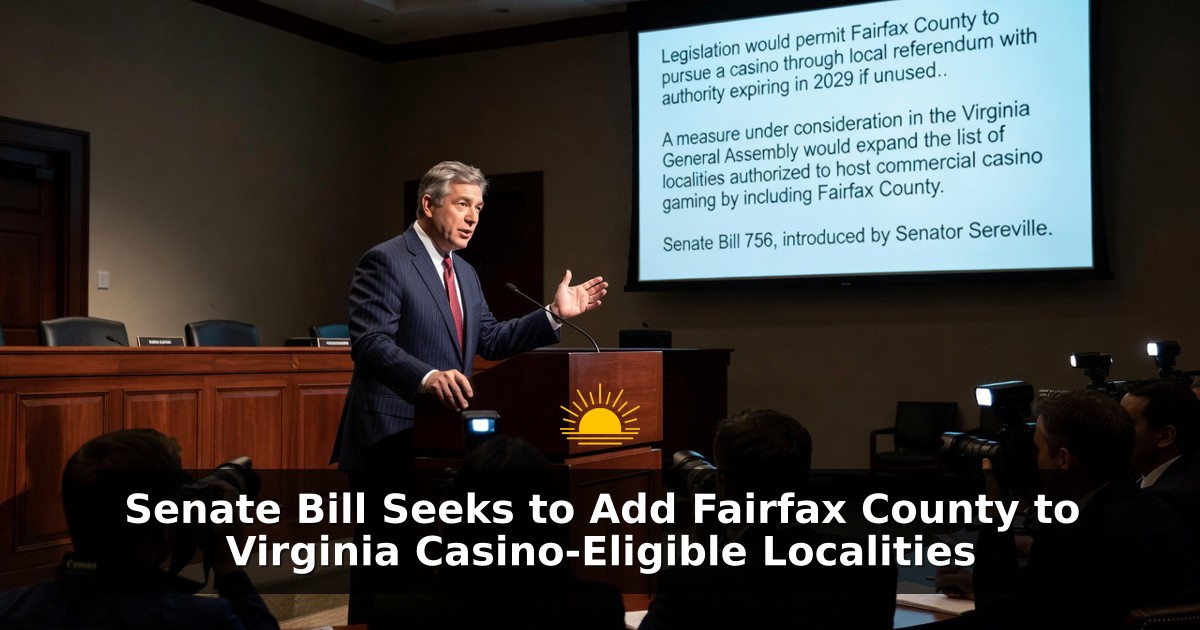
A measure under consideration in the Virginia General Assembly would expand the list of localities authorized to host commercial casino gaming by including Fairfax County. Senate Bill 756, introduced by Senator Sereville, proposes adding the Northern Virginia locality to those already eligible under state law. The legislation ties any future development to a successful public referendum and includes a firm sunset provision. Under the bill’s terms, the new authority would expire on July 1, 2029, unless Fairfax County voters have approved a casino project by that date. Supporters of the concept point to potential job creation and tax revenue, while the process itself remains contingent on clear local consent.
Background on Virginia Casino Eligibility
Virginia law currently restricts casino development to a limited set of localities that received legislative authorization in recent years. Those jurisdictions must still secure voter approval through a referendum before any facility can move forward. Senate Bill 756 follows the same framework by simply inserting Fairfax County into the existing statutory list. The bill does not mandate construction or select a specific site; it only creates the legal pathway. Once eligibility is granted, county officials would need to place a question on the ballot and obtain majority support from residents. Failure to complete that step before the 2029 deadline would automatically revoke the county’s status.
The sunset clause is designed to prevent indefinite eligibility without demonstrated public backing. Lawmakers have used similar expiration dates in prior gaming bills to ensure that authorization does not linger unused. In Fairfax County’s case, the July 1, 2029, cutoff gives local leaders roughly three years after potential passage to organize and hold a referendum. County supervisors would retain full discretion over whether to schedule the vote and how to frame the ballot language. Any successful referendum would then trigger additional regulatory steps overseen by the Virginia Lottery and other state agencies responsible for gaming oversight.
Economic Considerations for Northern Virginia
Proponents of expanded casino eligibility often cite employment and fiscal benefits observed in other Virginia markets. Facilities already operating or under development elsewhere in the state have generated construction jobs, permanent hospitality positions, and new streams of tax revenue dedicated to education and local services. Fairfax County, with its large population and extensive commercial corridors, could theoretically attract similar investment if voters ultimately endorse a project. The bill’s description notes that any economic gains would remain contingent on local support expressed through the required public vote. No specific revenue projections or job estimates are attached to Senate Bill 756 itself.
Fairfax County’s existing economic profile differs markedly from localities that previously sought casinos. The county already hosts substantial office, technology, and retail activity, along with one of the highest median household incomes in the nation. Adding a casino would introduce a new entertainment and tourism element that county planners would need to evaluate against traffic, public-safety, and land-use considerations. Because the legislation leaves site selection and zoning entirely to local control, any future proposal would undergo standard comprehensive-plan review and public hearings. Those processes would occur only after a successful referendum, keeping the initial decision firmly in the hands of voters.
Referendum Requirements and Timeline
Virginia’s casino statutes require that a referendum question receive a simple majority of votes cast in the locality. The ballot language typically asks whether the locality should be authorized to host a casino gaming establishment. Senate Bill 756 incorporates that same standard for Fairfax County. If the measure becomes law, county election officials would need to prepare for a possible special election or place the question on a regularly scheduled ballot before the 2029 expiration. The bill does not dictate the precise timing, leaving that determination to the Fairfax County Board of Supervisors and the local electoral board.
Should voters reject the proposal, or should no referendum occur by the deadline, the statutory authority would lapse automatically. Lawmakers could later reintroduce similar legislation, but the current bill contains no automatic renewal. This structure mirrors earlier expansions of casino eligibility and reflects a legislative preference for time-limited grants of authority. Observers note that the three-year window provides sufficient opportunity for public education campaigns on both sides of the issue while preventing perpetual eligibility without demonstrated consent.
Legislative Process and Next Steps
Senate Bill 756 remains subject to the ordinary committee and floor procedures of the General Assembly. After introduction, the measure would be referred to the appropriate Senate committee for hearing and possible amendment. Any changes adopted in committee would return to the full Senate for debate and a recorded vote. If approved, the bill would cross to the House of Delegates for parallel consideration. Final passage would require concurrence by both chambers and the signature of the governor before taking effect. Only after enactment would Fairfax County gain the formal ability to schedule its referendum.
Throughout the process, the core elements described in the legislation—eligibility for Fairfax County, the mandatory referendum, and the July 1, 2029, sunset—are expected to remain central. The bill does not alter the regulatory framework that already governs existing casinos, including licensing standards, problem-gaming programs, and revenue distribution formulas. Those statewide rules would apply equally to any future Fairfax facility. Local officials and residents therefore retain the decisive voice on whether a casino ever materializes, while state law supplies only the initial permission and the expiration safeguard.
Broader Context of Gaming Expansion
Virginia’s gradual expansion of casino gaming has proceeded locality by locality rather than through a statewide free-for-all. Each addition has required separate legislation and subsequent voter ratification. Fairfax County’s potential inclusion continues that pattern. Because the county sits in the densely populated Northern Virginia region, any approved project would likely draw patrons from surrounding jurisdictions and the District of Columbia metropolitan area. Transportation infrastructure, including major highways and transit links, would factor into site evaluations conducted after a successful referendum. Those practical considerations lie outside the scope of Senate Bill 756 and would be addressed through ordinary local planning channels.
The legislation’s neutral drafting leaves policy judgments about the desirability of a casino to Fairfax residents themselves. By coupling eligibility with both a referendum requirement and a clear expiration date, the bill seeks to balance opportunity with accountability. Whether the measure advances through the General Assembly and whether county voters eventually embrace or reject the idea will determine the next chapter for casino gaming in Northern Virginia. Until those steps occur, Fairfax County remains outside the list of authorized localities, and no casino development can legally proceed.
2029 expiration Casino casino proposal committee meeting community impact economic development Fairfax County gaming industry job creation Legislation local government localities policy change public support referendum regional development revenue generation Senate Bill 756 Senator Sereville vote