Fairfax County Waste Reserves Near Depletion Ahead of Projected Deficit
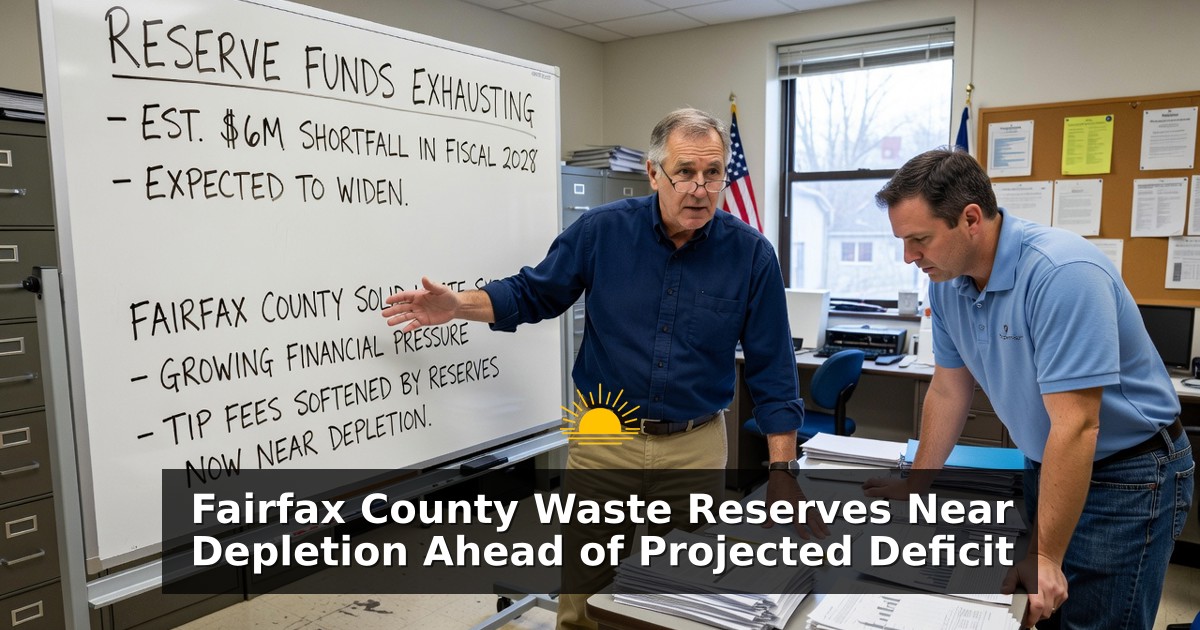
Fairfax County faces a growing financial pressure in its solid waste system as reserve funds long used to soften tip fee increases approach exhaustion. Christopher Harrington, Director of Public Works, recently outlined the situation using bar graphs that track the reserve fund balance alongside the tip fee charged for trash disposal. The tip fee applies to every ton of waste whether residents or businesses deliver material directly to county facilities or rely on private haulers. Officials project that the depletion of these reserves will produce a deficit of approximately six million dollars in fiscal 2028, with the shortfall expected to expand in later years once the funds are fully spent.
County leaders have relied on the reserve balance for several budget cycles to absorb rising disposal costs and keep tip fee hikes more gradual for households and commercial customers. The inflection point now visible in the financial graphs signals that this buffer is nearly gone. Without that cushion, the full weight of higher operating and disposal expenses will fall directly onto the tip fee structure. Public works staff emphasize that the fee is the primary revenue source supporting the county’s integrated solid waste program, which handles collection coordination, transfer, recycling, and landfill operations across a large suburban jurisdiction.
Fairfax County Board of Supervisors oversees the Department of Public Works and Environmental Services and ultimately sets the rates that fund these operations. The current board consists of Chairman Jeff McKay along with district supervisors James Walkinshaw, James Bierman, Walter Alcorn, Rodney Lusk, Andres Jimenez, Daniel Storck, Dalia Palchik, Patrick Herrity, and Kathy Smith. These elected officials receive regular briefings on enterprise fund performance, including the solid waste fund that operates separately from the general fund. Decisions on tip fee adjustments and reserve policies rest with the board after staff presentations such as the one delivered by Harrington.
Rising Disposal Costs Strain Local Waste System
Disposal expenses have climbed steadily because of broader market conditions affecting landfill space, transportation, regulatory compliance, and equipment. Fairfax County maintains the I-95 Landfill Complex and related transfer stations that serve both county-collected and privately hauled waste. When reserve dollars previously offset portion of those cost increases, tip fees rose more slowly than the underlying expenses. The graphs presented by the public works director illustrate how that pattern is ending. Once reserves reach zero, any further cost growth must be matched dollar-for-dollar by fee revenue or by spending cuts elsewhere in the solid waste program.
Residents and businesses will feel the change through higher bills from private haulers or through direct payments at county scales. Many homeowners associations and commercial property managers contract with private companies that pass tip fees through as a line item. County staff note that the fee is uniform regardless of the path waste takes to the disposal site, ensuring that all generators contribute to the system that manages the material. The projected six-million-dollar deficit for fiscal 2028 represents the gap that opens when reserves can no longer bridge the difference between expenses and current fee income.
Longer-term forecasts show the annual shortfall widening after fiscal 2028 as inflation, fuel prices, labor costs, and potential new environmental requirements continue to push expenses upward. Public works planners are examining a range of options that include phased tip fee increases, operational efficiencies, expanded recycling and diversion programs that reduce landfill tons, and careful draw-down of any remaining reserve balances. Each approach carries trade-offs for ratepayers and for the reliability of the waste system that serves more than one million residents.
Enterprise Fund Structure and Oversight
The solid waste program functions as an enterprise fund, meaning it is expected to cover its costs through user fees rather than general tax dollars. This structure has allowed the county to maintain dedicated reserves that stabilize rates during periods of volatile commodity and disposal markets. The current exhaustion of those reserves marks a turning point that requires renewed attention from both staff and the Board of Supervisors. Harrington’s presentation makes clear that the inflection point already visible on the graphs will translate into concrete budget gaps beginning in fiscal 2028.
Board members routinely review multi-year financial projections for enterprise funds during the annual budget process and at periodic worksessions. The six-million-dollar estimate is described as based on current assumptions about tonnage, inflation, and contract costs. If waste volumes decline through stronger recycling or if new contracts lock in lower rates, the deficit figure could change. Conversely, unexpected spikes in fuel or regulatory costs could enlarge it. Transparent reporting of these variables remains central to maintaining public confidence in the fee-setting process.
Community impact extends beyond the immediate fee increase. Reliable trash and recycling collection underpins public health, environmental quality, and local economic activity. Fairfax County’s dense residential neighborhoods and extensive commercial corridors generate substantial daily tonnage that must be managed without service interruptions. Any abrupt rate shock risks higher illegal dumping or reduced participation in recycling programs, outcomes the department seeks to avoid through gradual and well-communicated adjustments.
Path Forward for Rate Stability
Staff will continue refining cost models and presenting updated scenarios to the Board of Supervisors in coming budget cycles. Possible measures include targeted efficiency reviews at transfer stations, renegotiation of hauling and disposal contracts, and public education campaigns that encourage waste reduction. Some jurisdictions have explored regional partnerships or advanced processing technologies that lower net disposal costs over time. Fairfax County already participates in regional solid waste planning and may expand those efforts as reserves disappear.
The tip fee remains the most direct tool for aligning revenue with expenses once reserves are gone. Officials stress that any recommended increase will be calculated to cover documented costs rather than to generate surplus. Because the fee applies equally to direct customers and to private haulers, the impact is distributed across the entire generator base. Homeowners who pay via subscription services and businesses that contract for dumpster service will both see the change reflected in their invoices.
As the reserve balance trends toward zero, the county’s solid waste enterprise enters a new phase that demands careful stewardship. The six-million-dollar deficit projected for fiscal 2028 serves as an early warning that allows time for deliberate policy choices. Continued monitoring of the graphs that track reserves against tip fees will give supervisors and the public a clear view of progress. Through measured adjustments and ongoing oversight by the Board of Supervisors, Fairfax County aims to keep its waste management system financially sustainable while protecting the service reliability residents expect.
6 million bar graph current estimate deficit deficit growth Fairfax County financial situation fiscal deficit graph inflection point private hauler rate mitigation reserve fund balance reserve funding reserve funds reserve reserves tip fee tip fee charge tip fee increases trash disposal