Fairfax City Proclaims September 22 Car-Free Day to Promote Sustainable Travel
Updated
AVN staff
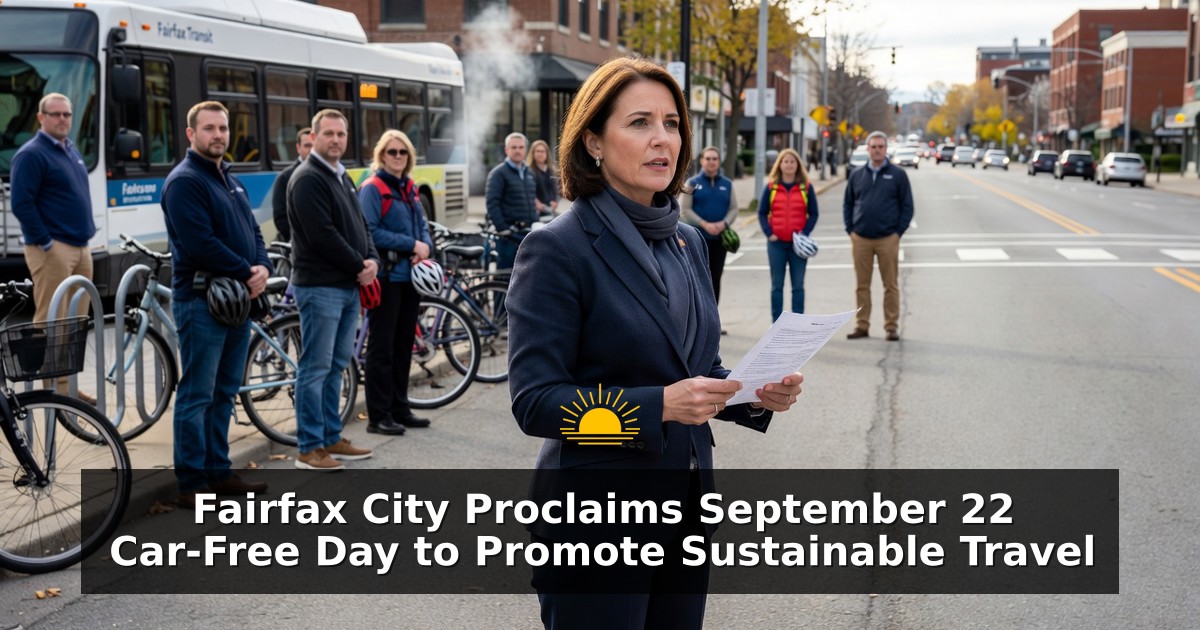
Fairfax City officials have formally designated September 22 as Car-Free Day, aligning local efforts with the annual World Car Free Day observance that encourages alternatives to single-occupancy vehicle travel. Mayor Catherine Reed issued the proclamation during a recent city council meeting, underscoring the municipality’s ongoing commitment to lowering greenhouse gas emissions from the transportation sector. The announcement highlights a range of existing options available to residents, including the local CUE bus system, Metrorail connections, bicycling, walking and carpooling. City leaders framed the day as both a symbolic and practical opportunity for the community to experience reduced reliance on private automobiles. The initiative forms part of broader environmental sustainability objectives already established by the city.
Transportation accounts for a substantial share of greenhouse gas emissions in many Virginia localities, and Fairfax City has identified emission reductions as a core element of its sustainability agenda. By promoting car-free and car-light choices, officials aim to demonstrate measurable progress toward those targets while improving overall quality of life. The proclamation notes that decreased solo driving supports safety goals and yields additional community advantages such as less traffic congestion and lower demand for parking spaces. Residents are invited to sample these alternatives not only on September 22 but throughout the entire month of September. Local trails and public transit routes are specifically cited as accessible resources that can make the transition easier for participants.
Emphasis on Existing Transit and Active Options
The city’s CUE bus network provides fixed-route service linking key destinations within Fairfax City and connecting passengers to regional Metrorail stations. Metrorail itself offers high-capacity rail links into surrounding jurisdictions and the core of the Washington region, giving commuters a viable substitute for driving on major corridors. Bicycling infrastructure and pedestrian pathways further expand the menu of choices, allowing short- and medium-distance trips to occur without an automobile. Carpooling arrangements round out the recommended approaches, enabling shared rides that still reduce the total number of vehicles on the road. Officials stress that these modes already operate daily and require no new construction to be utilized on Car-Free Day.
World Car Free Day has been observed internationally each September 22 for more than two decades, originating as a campaign to raise awareness about the environmental and social costs of heavy car dependence. Cities around the globe use the occasion to temporarily prioritize pedestrians, cyclists and transit users, often reporting temporary drops in local air pollutants and noise levels. Fairfax City’s proclamation situates the locality within that larger movement while tailoring the message to resources already familiar to residents. The mayor’s statement encourages community members to enjoy local trails and public transit options as concrete ways to participate. Such participation is presented as voluntary yet valuable for illustrating the feasibility of routine mode shifts.
Sustainability Goals and Community Benefits
Fairfax City’s environmental sustainability framework explicitly includes transportation emissions among the sources targeted for reduction. Planners have long recognized that a livable community depends on safe, convenient alternatives to driving alone, a principle reiterated in the formal language of the proclamation. Reduced congestion can shorten travel times for remaining essential vehicle trips and decrease wear on roadways. Lower parking demand frees curb space and surface lots for other potential uses, including green areas or additional bicycle facilities. These secondary benefits reinforce the primary climate objective and help build public support for sustained investment in multimodal networks.
City staff and elected leaders regularly review performance metrics related to transit ridership, trail usage and emission inventories to gauge progress. Car-Free Day serves as an annual checkpoint that can generate fresh data on how many residents are willing to experiment with different travel habits. Feedback collected around the observance often informs later adjustments to bus schedules, bike-lane designs or pedestrian crossing improvements. The proclamation therefore functions both as public outreach and as an internal reminder of adopted policy priorities. Continuity across multiple years of similar declarations helps embed sustainable transportation into the civic calendar.
Practical Participation and Regional Context
Residents interested in taking part can consult existing route maps for the CUE bus and Metrorail, many of which are available online and at municipal facilities. Trail networks throughout the city and adjacent Fairfax County provide scenic routes for walking or cycling that double as functional commuting paths for some users. Employers and neighborhood groups sometimes organize informal carpool matching in conjunction with the September observance, amplifying the reach of the official proclamation. Weather conditions on or near September 22 can influence participation rates, yet the city emphasizes that trying even one alternative trip contributes to the collective effort. Educational materials distributed around the event typically outline simple safety tips for new cyclists and transit users.
Northern Virginia’s dense employment centers and interconnected road system make regional coordination advantageous for any car-free campaign. Fairfax City’s location near major Metrorail stations positions it to benefit from and contribute to wider Northern Virginia transit ridership gains. State-level programs that support vanpooling and commuter benefit packages complement the local message by offering financial incentives for mode shifts. Over time, repeated exposure to Car-Free Day messaging can normalize the idea that not every trip requires a personal vehicle. The cumulative effect supports longer-term targets for emission reduction and more efficient land use.
Looking Ahead After the Proclamation
Following the formal reading of the proclamation, city representatives customarily direct interested residents to online resources that detail schedules, trail maps and safety guidelines. The mayor’s invitation to enjoy local trails and transit options remains open beyond the single calendar day, reinforcing that sustainable choices are intended as ongoing habits rather than one-time experiments. Monitoring of traffic volumes and transit boardings in the weeks surrounding September 22 supplies useful comparison points for staff evaluations. Any notable increases in non-driving trips can be cited in subsequent sustainability reports as evidence of community responsiveness. The city plans to continue highlighting these themes in future public communications as part of its steady commitment to environmental and mobility goals.
Independent research on transportation emissions confirms that shifting even a modest percentage of daily trips to transit, biking or walking produces measurable declines in local carbon output and improves air quality. Fairfax City’s focus on convenient, already-available options lowers the barrier to entry for residents who may have previously considered alternatives impractical. By anchoring the campaign in an internationally recognized date, the proclamation gains additional visibility and media resonance. Community organizations focused on health, environment and neighborhood livability frequently amplify the city’s message through their own channels. Together these elements create a coherent, fact-based invitation for residents to rethink routine travel decisions on September 22 and throughout the year.
Email the Fairfax City Mayor and Council:
Catherine S. Read | At-large | Mayor | Catherine.Read@fairfaxva.gov | (703) 385-7850
Anthony T. Amos | At-large | Council Member | Anthony.Amos@fairfaxva.gov | (703) 385-7850
Billy M. Bates | At-large | Council Member | Billy.Bates@fairfaxva.gov | (703) 385-7850
Stacy R. Hall | At-large | Council Member | Stacy.Hall@fairfaxva.gov | (703) 385-7850
Stacey D. Hardy-Chandler | At-large | Council Member | Stacey.Hardy-Chandler@fairfaxva.gov | (703) 385-7850
Rachel M. McQuillen | At-large | Council Member | Rachel.McQuillen@fairfaxva.gov | (703) 385-7850
Thomas D. Peterson | At-large | Council Member | Tom.Peterson@fairfaxva.gov | (703) 385-7850
Mayor and Council (all members) | MayorandCouncil@fairfaxva.gov | (703) 385-7850
Email the Fairfax City:
Catherine Read | At-large | Mayor | Catherine.Read@fairfaxva.gov | (703) 385-7850
Anthony Amos | At-large | Council Member | Anthony.Amos@fairfaxva.gov | (703) 385-7850
Billy Bates | At-large | Council Member | Billy.Bates@fairfaxva.gov | (703) 385-7850
Stacy Hall | At-large | Council Member | Stacy.Hall@fairfaxva.gov | (703) 385-7850
Stacey D. Hardy-Chandler | At-large | Council Member | Stacey.Hardy-Chandler@fairfaxva.gov | (703) 385-7850
Rachel McQuillen | At-large | Council Member | Rachel.McQuillen@fairfaxva.gov | (703) 385-7850
Tom Peterson | At-large | Council Member | Tom.Peterson@fairfaxva.gov | (703) 385-7850
Stacey Kincaid | Countywide | Sheriff (shared with Fairfax County) | sheriff@fairfaxcounty.gov | (703) 246-3227
Steve Descano | Countywide | Commonwealth's Attorney (shared with Fairfax County) | (703) 246-2776
Christopher Falcon | Countywide | Clerk of the Circuit Court (shared with Fairfax County) | (703) 691-7320
Email the Fairfax County Board of Supervisors:
Jeffrey C. McKay | At-large | Chairman | chairman@fairfaxcounty.gov | (703) 324-3151
Kathy L. Smith | Sully District | Vice Chairman | sully@fairfaxcounty.gov | (703) 324-3151
Rachna Sizemore Heizer | Braddock District | Supervisor | braddock@fairfaxcounty.gov | (703) 324-3151
James N. Bierman, Jr. | Dranesville District | Supervisor | dranesville@fairfaxcounty.gov | (703) 324-3151
Rodney L. Lusk | Franconia District | Supervisor | franconia@fairfaxcounty.gov | (703) 324-3151
Walter L. Alcorn | Hunter Mill District | Supervisor | huntermill@fairfaxcounty.gov | (703) 324-3151
Andres F. Jimenez | Mason District | Supervisor | mason@fairfaxcounty.gov | (703) 324-3151
Daniel G. Storck | Mount Vernon District | Supervisor | mtvernon@fairfaxcounty.gov | (703) 324-3151
Dalia A. Palchik | Providence District | Supervisor | providence@fairfaxcounty.gov | (703) 324-3151
Pat Herrity | Springfield District | Supervisor | springfield@fairfaxcounty.gov | (703) 324-3151
Fairfax County is a county in Northern Virginia. Its county seat is Fairfax, an independent city.
Email the Commonwealth's Attorney (Fairfax County):
Steve Descano | Countywide | Commonwealth's Attorney | (703) 246-2776
Email the Sheriff (Fairfax County):
Stacey Kincaid | Countywide | Sheriff | sheriff@fairfaxcounty.gov | (703) 246-3227
Email the Clerk of the Circuit Court (Fairfax County):
Christopher Falcon | Countywide | Clerk of the Circuit Court | (703) 691-7320
Fairfax City Fairfax County across Additional air quality allowing Andres Jimenez Anthony T. Amos areas around awareness benefits Bike biking Billy M. Bates capacity Car Car Free Day Car-Free Catherine S. Read City City Council collected Commitment community conditions construction coordination costs council council meeting Crossing Cubus cycling Dalia Palchik Daniel Storck Data day direct distributed each Educational efforts employment Encourages environment environmental event every evidence expand facilities Fairfax Fairfax Board of Supervisors Fairfax City Fairfax City Council Fairfax County Financial focus Free greenhouse gas emissions guidelines Health High IDEA Improvements includes Infrastructure initiative Investment issues itself James Bierman Jeffrey McKay jurisdictions Kathy Smith Land land use life localities locality lots meeting members Metro Rail monitoring Near network noise Northern Virginia notes officials ongoing online opportunity parking participants participation Pat Herrity performance Personal points Policy positions presented Private produces programs promotes provides Public public support public transit push quality of life Rachel M. McQuillen Rachna Heizer Rail rates reading Reduce related remains reports requires research residents resources Rodney Lusk Route safety service short social space specifically Stacey D. Hardy-Chandler Stacy R. Hall statement substitute Support supports Sustainability sustainable sustainable transportation System targets term themes Thomas D. Peterson Traffic Trail transport Transportation users Virginia Virginia localities Walter Alcorn weather within
All Virginia News is published by ALL VIRGINIA NEWS, LLC. How we're funded · Corrections · Ethics
