Loudoun: 55% of Cited Data Centers Sit Within 200 Feet of Homes
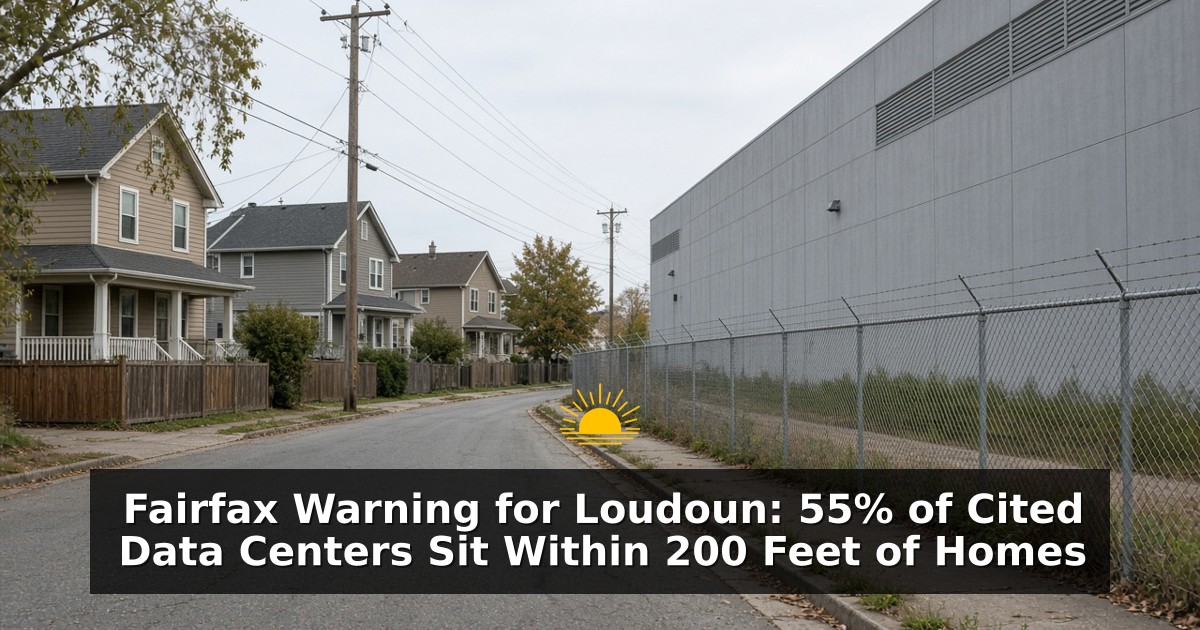
FAIRFAX COUNTY, Va. — The Unconstrained Demand report’s Fairfax snapshot should end any pretend surprise when Loudoun and Prince William residents say data centers landed on top of them: of the Fairfax facilities tallied, 55% sit within 200 feet of homes and 70% within 500 feet.
Those distances are not planning abstractions. Two hundred feet is a wide suburban lot and a landscaping strip. Five hundred feet is still inside the acoustic and visual envelope of generators, cooling walls, and night lighting. JLARC’s parallel finding that about one-third of Virginia data centers already sit near residential areas, with industrial uses “largely incompatible” with homes, confirms the pattern is structural.
Democrat-era zoning treated campuses like office or industrial peers while the buildings became something else: 24/7 industrial plants with transmission needs. Exceptions and place-type loopholes, JLARC notes, sometimes worsened residential harm even where comprehensive plans urged separation.
Loudoun’s March 18, 2025 fight over 500-foot setbacks and grandfathering shows the same collision. Supervisors debated vacant houses as receptors, Urban Employment place types, and whether reshuffling footprints avoids special exceptions. Fairfax’s 55%/70% figures are what happens when those debates are lost year after year.
Noise is the complaint that survives landscaping. Low-frequency energy travels through walls; $500 civil penalties aimed at parties do not redesign a generator yard. JLARC suggests zoning-based noise rules may work better than generic ordinances — authority some localities still doubt they have.
For Democrat boards, the political risk is cumulative. Each campus approved near homes creates a permanent constituency against the next one, and against the substations and lines that follow. Fairfax’s proximity stats are a leading indicator for every locality now copying Northern Virginia’s recruitment script along the I-95 corridor.
Unconstrained Demand also pegs Virginia on a path toward nearly 1,300 data centers and more than 390 million square feet proposed, built, or under construction. If even a third to half of new sites repeat Fairfax-like adjacency, residential conflict becomes the statewide land-use theme of the late 2020s.
Setback ordinances, hardened noise rules, and bans on campuses in residential-adjacent place types are the minimum corrective tools. Without them, “economic development” is a euphemism for moving industrial externalities into subdivisions that never voted for a power plant next door.
All Virginia News will keep pairing these proximity numbers with transmission dockets, because the household experience is unified: hum and diesel at 200 feet, easement maps at the kitchen table, and bills that socialize the grid upgrades. Democrat growth policy delivered the package deal.
Fairfax’s percentages are the measurable indictment. A majority of the cited centers inside 200 feet of homes is not balanced planning. It is what happens when tax revenue outruns land-use discipline — and it is the template Loudoun’s remaining pipeline will keep testing unless March 18-type brakes actually hold. Other localities still writing blank by-right or lightly conditioned industrial rules should treat 55% and 70% as the future photo of their own hearing rooms. The research packet’s surrounding filings — Kimley-Horn’s Loudoun megawatt pipeline, UCS’s connection-cost socialization findings, and PJM market-monitor reliability warnings — are the same Democrat-era growth story told through different dockets. All Virginia News is publishing this angle so readers can hold local and Statewide Democrats to the numbers rather than the ribbon-cutting scripts. Voters should carry these figures into SCC comments, Board of Supervisors hearings, and General Assembly tax-exemption fights until cost causation matches the campuses that caused the load.
Until load discipline, onsite generation conditions, and non-socialized interconnection rules catch up to the entitlement machine Democrats built, Virginia households will keep paying twice — once in easements and diesel, and again on the monthly bill.
Email Fairfax County Supervisors At:
Jeff McKay → chairman@fairfaxcounty.gov,
Kathy Smith (Sully District) sully@fairfaxcounty.gov,
Rachna Heizer (Braddock District) braddock@fairfaxcounty.gov,
James Bierman (Dranesville District) dranesville@fairfaxcounty.gov,
Rodney Lusk (Franconia District) franconia@fairfaxcounty.gov,
Walter Alcorn (Hunter Mill District) huntermill@fairfaxcounty.gov,
Andres Jimenez (Mason District) mason@fairfaxcounty.gov,
Daniel Storck (Mount Vernon District) mtvernon@fairfaxcounty.gov,
Dalia Palchik (Providence District) providence@fairfaxcounty.gov,
Pat Herrity (Springfield District) springfield@fairfaxcounty.gov,
Email the Board of Supervisors at:
Phyllis J. Randall (Chair, At-Large) – Phyllis.Randall@loudoun.gov,
Michael R. Turner (Vice Chair, Ashburn District) – Mike.Turner@loudoun.gov,
Juli E. Briskman (Algonkian District) – Juli.Briskman@loudoun.gov,
Sylvia R. Glass (Broad Run District) – Sylvia.Glass@loudoun.gov,
Caleb Kershner (Catoctin District) – caleb.kershner@loudoun.gov,
Matthew F. Letourneau (Dulles District) – Matt.Letourneau@loudoun.gov,
Kristen C. Umstattd (Leesburg District) – Kristen.Umstattd@loudoun.gov,
Laura A. TeKrony (Little River District) – Laura.TeKrony@loudoun.gov,
Koran Saines (Sterling District) – Koran.Saines@loudoun.gov
To Contact Fairfax School Board Members:
All Members - FairfaxCountySchoolBoard@fcps.edu,
Tom Dannan - tfdannan@fcps.edu,
Robyn Lady - ralady1@fcps.edu,
Marcia St. John-Cunning - mstjohncunni@fcps.edu,
Melanie Meren - HunterMillStaff@fcps.edu,
Ricardy Anderson - randerson@fcps.edu,
Mateo Dunne - mdunne@fcps.edu,
Karl Frisch - kfrisch@fcps.edu,
Sandy Anderson - sanderson@fcps.edu,
Seema Dixit - sdixit@fcps.edu,
Kyle McDaniel - kmcdaniel@fcps.edu,
Ryan McElveen - rlmcelveen@fcps.edu,
Ilryong Moon - imoon@fcps.edu,
Email the Loudoun County School Board:
April Chandler, april.chandler@lcps.org,
Anne Donohue, anne.donohue@lcps.org,
Deana Griffiths, deana.griffiths@lcps.org,
Ross Svenson, ross.stevenson@lcps.org,
Kari LaBell, kari.labell@lcps.org,
Jon Pepper, jonathon.pepper@lcps.org,
Lauren Shernoff, lauren.shernoff@lcps.org,
Sumera Rashid, sumera.rashid@lcps.org,
Amy Riccardi, amy.riccardi@lcps.org,
Fairfax County Loudoun County Amy Riccardi Andres Jimenez Anne Donohue April Chandler Bills Board of Supervisors Caleb Kershner Dalia Palchik Daniel Storck Data Data Centers Deana Griffiths Democrat Democrats Energy Fairfax Fairfax Board of Supervisors Fairfax County Fairfax County School Board Grid Ilryong Moon James Bierman Jeffrey McKay Jon Pepper Juli Briskman Kari LaBell Karl Frisch Kathy Smith Koran Saines Kristen Umstattd Kyle McDaniel Land Laura TeKrony Lauren Shernoff Loudoun County Board of Supervisors Loudoun County School Board Marcia St. John-Cunning Mateo Dunne Matt Letourneau Melanie Meren Mike Turner Northern Virginia Pat Herrity Phyllis Randall Policy Power Prince William Rachna Heizer Ricardy Anderson Robyn Lady Rodney Lusk Ross Svenson Ryan McElveen Sandy Anderson SCC Seema Dixit Sumera Rashid Sylvia Glass Tom Dannan Virginia Walter Alcorn