Virginia Family Details Barriers in Prison Visitation System
Updated
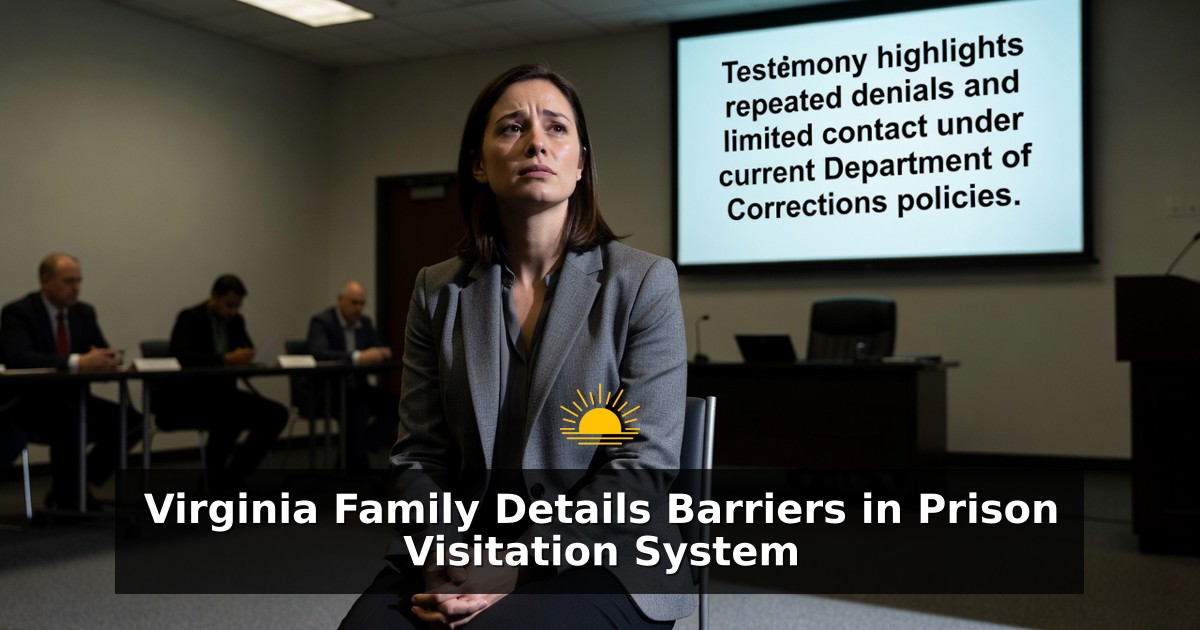
Brianna Woods appeared before a Virginia Public Safety Subcommittee to describe the persistent obstacles her family has encountered while attempting to maintain contact with an incarcerated relative. She explained that she regularly undertook four-hour drives each way to reach the facility housing her husband. Those lengthy trips frequently ended without any visit taking place, leaving the family frustrated and disconnected. Woods emphasized that the cumulative effect of these barriers has prevented meaningful relationships from forming over many years. Her account centered on the human consequences of rigid visitation rules rather than abstract policy debates.
Woods told lawmakers that her two step-sons have grown up with almost no in-person contact with their father. The boys, now ages 16 and 14, managed only a single pre-pandemic visit that produced one photograph together. Since the children were two years old and six months old, that solitary image has remained their primary keepsake. Subsequent attempts to schedule and complete visits repeatedly failed for reasons the family considered minor or administrative. The limited number of successful meetings has totaled just three across more than a decade.
Clothing Restrictions Lead to Repeated Turnaways
One of the most frequent reasons for denial involved the boys’ attire. Woods recounted two separate occasions when she and the children completed an eight-hour round trip only to be turned away at the gate because staff objected to the outfits. Facility rules governing colors, logos, and styles of clothing are enforced strictly, and even small deviations can result in immediate refusal of entry. Families often receive little advance guidance precise enough to guarantee compliance on every visit. These clothing-based rejections compound the financial and emotional costs already incurred by long-distance travel.
Administrative and technological problems have created additional barriers. Woods stated that she once arrived with email confirmation of a scheduled visit yet was informed that the names did not appear on the official list. Staff attributed the discrepancy to a system hiccup and declined to override it. Such inconsistencies leave families uncertain whether confirmed appointments will actually be honored. The unpredictability discourages repeated attempts and erodes trust in the visitation process itself. Over time, these logistical failures reduce the total number of contacts far below what scheduling records might suggest.
Quality of Approved Visits Remains Limited
Even when visits are allowed to proceed, the interactions themselves are tightly controlled. Woods described an environment in which physical contact is minimal and quickly curtailed by officers. Simple gestures such as prolonged hugs are interrupted with instructions that “that’s enough.” The constrained setting makes it difficult for children to feel emotionally secure or to build ordinary parent-child bonds. Short durations and constant supervision further limit the depth of conversation possible during the allotted time. Families therefore leave with the sense that the visits satisfy procedural requirements more than relational needs.
Research on correctional practices has long shown that consistent family contact correlates with lower recidivism rates and improved institutional behavior. Virginia’s Department of Corrections maintains detailed visitation regulations intended to preserve safety and order inside facilities. Those same regulations, however, can produce unintended consequences when applied without flexibility for minor infractions or system errors. Advocacy organizations tracking prison family issues have documented similar patterns of denial across multiple states, noting that clothing rules and list discrepancies rank among the top complaints. Lawmakers reviewing the testimony are examining whether targeted adjustments can reduce unnecessary barriers while retaining core security protocols.
Legislative Proposals Draw Direct Support
Woods concluded her remarks by expressing clear support for three pending bills designed to improve visitation access and reliability. She urged the subcommittee to advance the measures so that other families might avoid the repeated disappointments her own household has endured. The proposals under discussion aim to standardize scheduling confirmations, clarify clothing guidelines, and expand opportunities for meaningful contact. Supporters argue that clearer rules and better technology interfaces would decrease the frequency of last-minute turnaways. Opponents of rapid change typically cite the need to evaluate security implications before altering long-standing procedures.
The broader context includes the lasting disruption caused by the COVID-19 pandemic, which suspended in-person visits for extended periods across Virginia prisons. When facilities reopened, many families discovered that pre-pandemic relationships had already weakened and that restarting contact proved harder than expected. Children who were toddlers at the time of incarceration are now teenagers with only fragmentary memories of their parent. Mental-health professionals note that prolonged separation can affect adolescent development, attachment patterns, and future attitudes toward authority. Policymakers weighing the bills must balance these developmental considerations against operational realities inside correctional institutions.
Travel distances add another layer of hardship for households living far from assigned facilities. A four-hour one-way drive requires time off work, fuel expenses, and careful coordination of school schedules. When the trip yields no visit, the economic loss is immediate and the emotional toll accumulates. Some families eventually reduce the frequency of attempts simply to avoid further disappointment. Woods’s decision to continue weekly efforts for as long as she did illustrates both determination and the steep personal cost involved. Her testimony places a concrete human narrative alongside the statistical and procedural arguments usually presented in legislative hearings.
Subcommittee members heard the account as part of a larger examination of public-safety related measures during the session. No final votes on the visitation bills were recorded in the immediate aftermath of the testimony. The discussion nevertheless underscored growing attention to the collateral effects of incarceration on relatives who have not been convicted of any crime. Future implementations, if the bills advance, would likely include revised training for visitation staff and improved digital systems for confirming appointments. Monitoring mechanisms could track denial rates and reasons so that patterns of avoidable refusal become visible to administrators.
Family contact remains one of the few stabilizing influences available to incarcerated individuals preparing for eventual reentry. When that contact is repeatedly interrupted by preventable issues, the rehabilitative potential diminishes. Woods’s experience, spanning clothing disputes, list errors, and constrained physical interaction, offers a detailed case study of how policy details translate into lived outcomes. Legislative attention to these details may determine whether similar families in coming years encounter fewer closed doors after long drives. The subcommittee process continues to gather additional perspectives before any statutory changes are finalized and sent forward.
Bills Brianna Brianna Woods Children emotional stories family impact Family's heart-wrenching policies Prison prison visitation Public Safety Subcommittee reform shares Struggle testimony Virginia Virginia's Visitation Woods