Virginia Farmworker Wage Exclusion Faces Scrutiny as Jim Crow Legacy
Updated
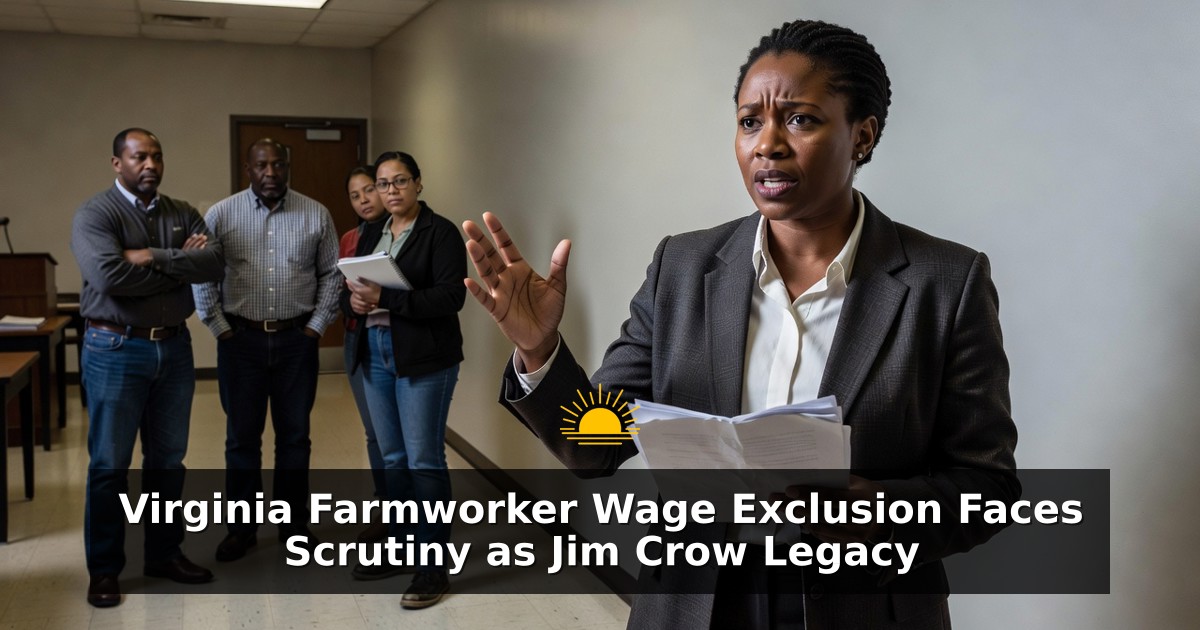
Advocates appeared before Virginia lawmakers to press for passage of the Farm Worker Wage Bill, which would eliminate the longstanding exclusion of agricultural workers from state minimum wage protections. Ashley Kenneth of the Commonwealth Institute framed the exclusion as no mere historical accident but a direct legacy of Jim Crow policies that systematically disadvantaged certain laborers. She noted that similar exemptions once applied to shoe shine workers and domestic workers have already been removed, underscoring that the farmworker carve-out was wrong when created and remains wrong today. The testimony centered on correcting an inequity that continues to affect pay standards in the agricultural sector across the commonwealth.
Kenneth emphasized that the legislation is not aimed at the majority of Virginia farmers who already compensate their employees fairly. Data cited during the presentation showed the average farmworker wage in Virginia stood at 18.40 dollars as of 2024, well above basic thresholds in many cases. Instead, the bill targets a minority of bad actors who pay substandard wages and thereby gain an unfair competitive advantage over producers who treat workers equitably. By closing the loophole, supporters argue, the measure would level the economic playing field while ending practices described as inhumane. Lawmakers were urged to advance the proposal on both moral and practical grounds.
Historical records confirm that federal and state labor frameworks developed in the early twentieth century often omitted agricultural and domestic workers from core protections. These omissions arose during an era when Southern political influence shaped New Deal-era statutes, resulting in carve-outs that disproportionately affected Black laborers in the South. Virginia’s own statutes retained parallel language long after other occupational exclusions were repealed. Kenneth’s remarks positioned the current Farm Worker Wage Bill as a necessary reckoning with that past, aligning state policy with contemporary standards of fairness already observed by most agricultural employers.
Agricultural employment remains a significant component of Virginia’s economy, encompassing crop production, livestock operations, and seasonal harvest work. Many operations rely on a mix of year-round and temporary labor, and wage practices vary widely by region and commodity. Proponents of the bill contend that establishing a uniform floor prevents exploitation without imposing new burdens on the bulk of compliant farms. They point out that average pay already exceeds proposed minimums in most instances, suggesting the primary effect would be to curb outliers rather than reshape industry-wide compensation. This focus on bad actors forms the core of the public case presented to the subcommittee.
Critics of historical exclusions have long argued that leaving any class of workers outside basic wage laws invites abuse and distorts labor markets. In Virginia, the persistence of the farmworker exemption has drawn renewed attention as neighboring states and the federal government revisit similar provisions. Kenneth stressed that removing the exemption would simply bring agricultural laborers into the same protective framework that covers the vast majority of other employees. She described the change as both a correction of past injustice and a practical step toward consistent enforcement. The Commonwealth Institute’s analysis framed support for the bill as a straightforward matter of equity and competitive balance.
The legislative discussion also touched on the broader evolution of labor standards within the commonwealth. Over recent decades Virginia has incrementally raised its minimum wage and expanded coverage to previously omitted groups. Domestic workers and certain service occupations once carved out now fall under standard requirements, illustrating a pattern of gradual inclusion. Farmworkers represent one of the last major categories still subject to the original exemption language. Advocates maintain that completing this process would eliminate an anachronism without disrupting the operations of responsible employers who already meet or exceed market rates.
Economic arguments advanced during the hearing centered on fairness among producers. Farmers who pay decent wages face higher labor costs than those who do not, creating a structural disadvantage that the bill seeks to neutralize. By establishing a clear statutory floor, the proposal would reduce incentives for underpayment and encourage competition based on productivity and quality rather than wage suppression. Kenneth reiterated that the average compensation figure of 18.40 dollars demonstrates most operations already clear this bar. The remaining task, in her view, is to address the minority of cases where exploitation persists.
Public policy experts note that agricultural labor markets often involve complex arrangements including piece rates, housing allowances, and seasonal contracts. Any new wage mandate would need careful drafting to accommodate these realities while still delivering meaningful protection. The Farm Worker Wage Bill, as described in testimony, aims to achieve that balance by focusing enforcement on clear underpayment rather than upending established practices. Supporters believe the measure can be implemented in a manner that respects the diversity of Virginia’s farming community. Continued legislative review will determine the precise scope and timeline of any changes.
As deliberations proceed, the historical dimension remains central to the advocacy message. Labeling the exclusion a Jim Crow legacy places the debate within a longer arc of civil rights and labor reform. Parallel removals of exemptions for other occupations supply precedent for action. Kenneth’s appearance before the Commerce, Agriculture and Natural Resources subcommittee underscored the view that unfinished business from earlier eras still shapes daily working conditions for some Virginians. Whether lawmakers will complete the reckoning now rests with the legislative process underway in Richmond.
The discussion reflects wider national conversations about who deserves baseline wage guarantees in an evolving economy. Virginia’s agricultural sector continues to adapt to labor shortages, technological change, and shifting consumer expectations. Ensuring that wage rules apply evenly is presented by bill backers as one element of a sustainable future for both workers and employers. With most farmers already paying competitive rates, the practical impact may prove limited yet symbolically significant. The coming weeks of committee work will test the strength of that argument against competing priorities.
18.40 2024 average farmer bad actors bill domestic workers exclusion exemption exploit workers farm workers farmers history Jim Crow legacy minimum wage requirements shoe shine workers substandard wages support this bill unfair advantage Virginia wages wrong today