Virginia Farmers Face Severe Financial Strain and High Suicide Rates
Updated
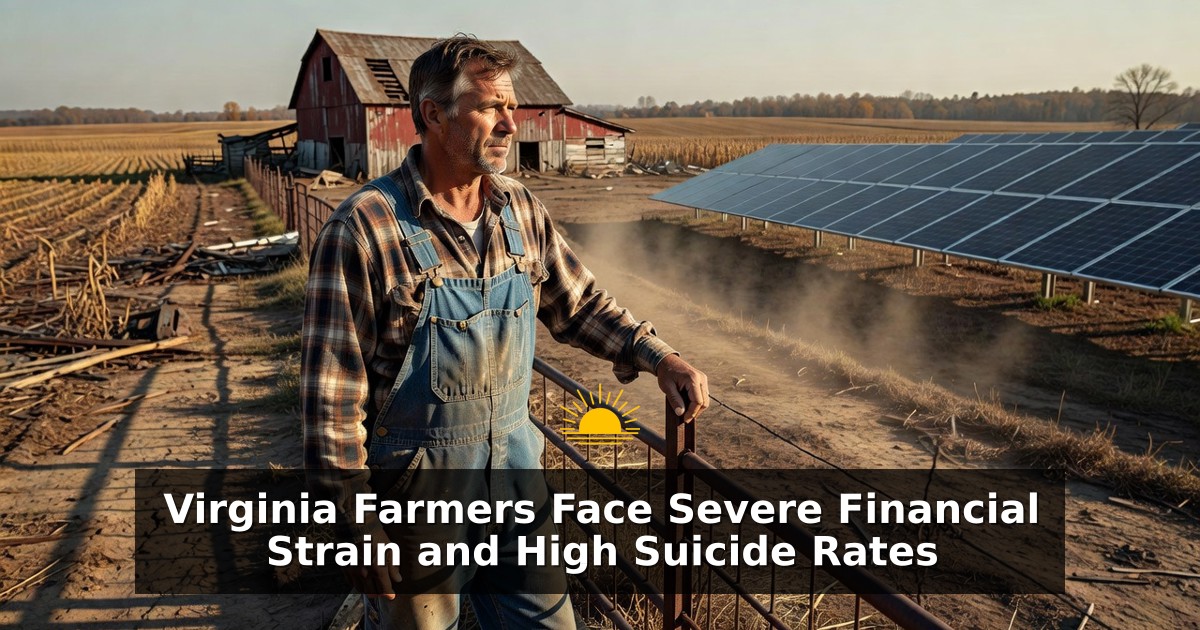
Virginia farmers are contending with intense financial pressures that stem from tariffs, rising input costs, and uncertainty linked to extreme weather patterns. These combined stresses have contributed to suicide rates among farmers that stand at three and a half times the rate observed in the general population. Advocates and policymakers have underscored the need for measures that create additional revenue streams capable of easing daily burdens while helping families retain ownership of their land. The discussion centers on practical steps that can stabilize operations without forcing sales or exits from agriculture. Such challenges affect both large commercial producers and smaller multi-generational farms across the Commonwealth.
Mounting cost pressures continue to reshape daily decision-making on Virginia farms. Tariffs have disrupted traditional export markets for key commodities, reducing predictable revenue at the same time that fertilizer, fuel, seed, and equipment prices have climbed. Extreme weather events add further volatility by damaging crops, delaying planting or harvest windows, and increasing insurance claims. Many operators report thinner margins that leave little room for unexpected expenses or multi-year recovery. These conditions have prompted renewed attention to policies that can broaden income sources while farms remain in production.
Mental health outcomes among agricultural workers reflect the cumulative weight of these economic realities. Data cited in recent legislative discussions indicate that farmers die by suicide at three and a half times the rate of the broader population, a disparity linked to financial uncertainty, isolation, and limited access to timely support services. Family farms often operate with thin staffing, long hours, and heavy personal investment in land that has been held for generations. When markets shift or weather destroys a season’s work, the resulting strain can become overwhelming. Public health observers note that addressing root economic drivers remains essential alongside expanded counseling resources.
Alternative revenue models have emerged as one concrete avenue for relief. Solar energy installations on portions of farmland can generate steady lease payments that offset commodity price swings and elevated input costs. Under carefully designed arrangements, panels may coexist with continued agricultural activity such as grazing or selected crops, preserving productive use of the soil. Farmers retain ownership of the underlying land while gaining a predictable cash flow that supports mortgage payments, equipment upgrades, and household needs. This approach has drawn interest as a market-based tool rather than a direct subsidy.
Legislative conversations in Virginia have focused on removing barriers that currently limit farmers’ ability to host solar projects. Clearer permitting pathways, standardized lease guidelines, and protections that keep land zoned for agriculture can make dual-use development more accessible. Supporters argue that enabling voluntary participation allows individual operators to decide whether solar income fits their long-term plans. Opponents of overly restrictive rules caution that inflexible policies could push struggling families toward outright land sales to developers. Balanced statutes aim to protect both farm viability and responsible land stewardship.
The structure of Virginia agriculture makes these options particularly relevant. The state supports a diverse mix of poultry, livestock, row crops, and specialty products, many of them produced on family-held acreage rather than corporate consolidations. When multi-year financial stress accumulates, younger generations may choose not to continue the operation, accelerating consolidation and loss of local knowledge. Supplemental income from energy leases can provide the bridge that keeps land in the family and maintains open-space benefits for surrounding communities. Policymakers weighing energy and agricultural goals increasingly examine how the two sectors can reinforce rather than displace each other.
Broader market and climate trends suggest that volatility will remain a feature of farming for the foreseeable future. Global trade relationships continue to influence commodity prices, while input suppliers face their own cost pressures that are passed downstream. Weather extremes, whether drought, excessive rainfall, or unseasonable temperatures, disrupt carefully timed production cycles. In this environment, reliance on a single revenue source heightens risk for individual households. Diversification strategies that include renewable energy contracts offer one method of spreading that risk across more stable payment streams.
Community and economic development officials also track the downstream effects of farm financial health. Local tax bases, equipment dealers, feed suppliers, and rural schools all feel the impact when agricultural operations contract or close. Sustaining family farms therefore carries implications beyond the farm gate, touching employment and the character of rural localities. Programs that facilitate solar leasing while safeguarding soil quality and future agricultural options can align energy expansion with these wider interests. Careful monitoring of completed projects helps refine best practices for both landowners and developers.
Public discussion of farmer suicide rates has elevated the human dimension of policy choices. The three-and-a-half-times statistic serves as a stark indicator that economic stress translates into profound personal consequences. Mental health outreach, peer support networks, and crisis hotlines form part of the response, yet many experts emphasize that reducing the underlying financial pressure remains foundational. Enabling a reliable secondary income stream addresses one major source of that pressure directly. Legislative frameworks that make such streams attainable without undue complexity can therefore serve both economic and public health objectives.
Looking ahead, Virginia’s agricultural sector will continue adapting to shifting markets, climate conditions, and energy demands. Farmers who gain access to well-structured solar opportunities may find themselves better positioned to weather downturns and invest in long-term improvements. Lawmakers evaluating related bills confront the task of balancing land-use priorities, renewable energy targets, and the lived realities of working farms. The core facts remain clear: financial strain is acute, suicide risk is elevated, and diversified income options represent a practical tool for keeping family operations intact. Continued attention to these interconnected issues will shape the resilience of Virginia agriculture for years to come.
articles costs extreme weather family farm Farm farmers financial pressures general population income input costs pressure pressure on farmers rate stream of income suicide Susan Stillman tariffs three and a half times uncertainty weather witness