Feds suggest parts of Bath and Highland counties as a critical habitat for the rusty-patched bumblebee
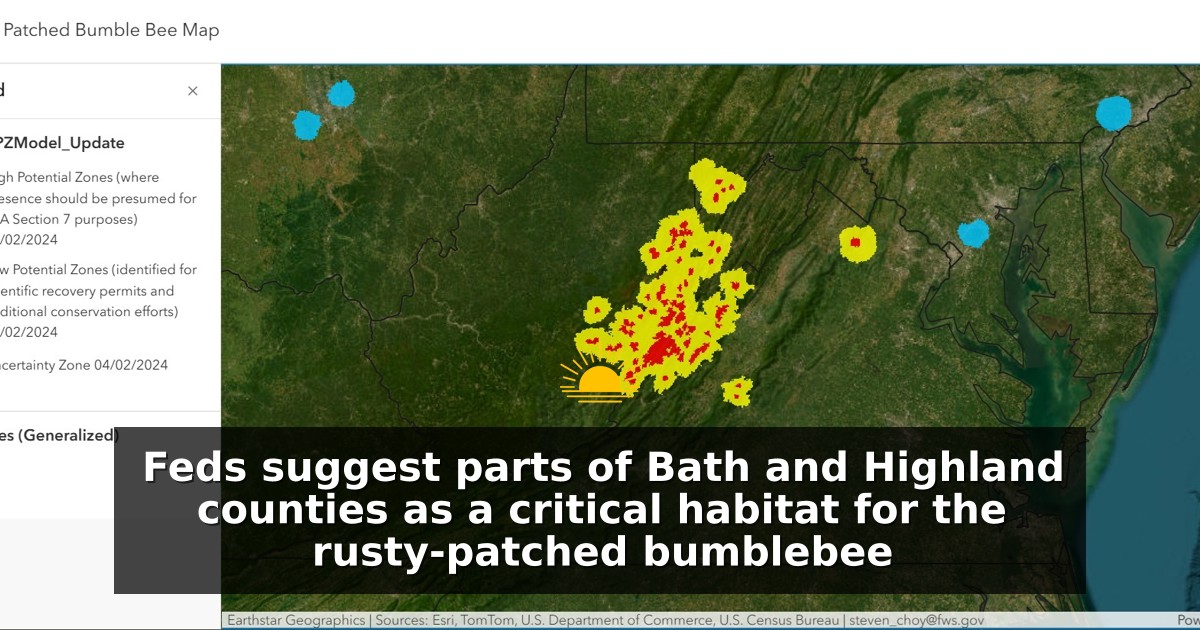
The U.S. Fish and Wildlife Service has proposed designating about 1.6 million acres nationwide as critical habitat for the rusty-patched bumblebee, including roughly 118,603 acres spanning Bath and Highland counties in Virginia and neighboring Greenbrier and Pocahontas counties in West Virginia—an Appalachian pocket biologists describe as among the species’ most important remaining strongholds.
The rusty-patched bumblebee, a black-and-yellow pollinator with a distinctive brown patch on the second abdominal segment of workers, has lost about 90 percent of its historic range since the 1990s. The Service listed it under the Endangered Species Act in 2017, requiring federal agencies to assess whether permitted activities would jeopardize the species. Agency materials cite disease, certain pesticides, habitat loss, small population effects, and climate stress among the drivers of decline. Queens appear all yellow, and the bees pollinate a wide mix of plants that support both wild ecosystems and agricultural landscapes.
Rich Hatfield, a senior conservation biologist in the Xerces Society’s endangered species program, welcomed use of the critical-habitat tool but cautioned that designations in some Midwestern urban fragments may do less for recovery than protecting remote Appalachian populations. “In Virginia, these are the most remote populations of rusty-patched bumblebees we know about,” Hatfield said, arguing their contribution to species resilience is hard to overstate.
Virginia and West Virginia lands in the proposal include about 11,200 acres in private ownership, 1,845 acres of state land, and more than 105,000 acres of federal land, including portions of the Monongahela, George Washington, and Jefferson national forests. The Service noted that much of the 1.6 million acres already overlaps habitat for other listed species, so additional conservation steps may often build on measures already in place rather than starting from scratch.
Ellison Orcutt, lead field scientist for the Virginia Department of Conservation and Recreation’s Natural Heritage Program, said the north Bath County area maps as a High Potential Zone because of cooler climate, limited development, and surrounding federally protected forest. DCR’s program has worked on the bee since it was documented in 2014 alongside other rare insects and plants. The Virginia Department of Wildlife Resources has established a Wildlife Management Area in Highland County that includes native wildflowers preferred by the bees.
The species already shaped major infrastructure fights in the region. Challenges tied to rusty-patched bumblebee analysis contributed to legal setbacks for the Atlantic Coast Pipeline before that project was canceled. The U.S. Court of Appeals for the Fourth Circuit faulted earlier Fish and Wildlife conclusions that pipeline activity would not jeopardize the bee. Conservation groups also pressed the agency for failing to designate critical habitat; after settlements, the Service agreed to propose designation on a court-linked timeline around late November.
Lucas Rhoads, senior attorney for pollinators and pesticides at the Natural Resources Defense Council, called the proposal a major step for one of America’s most threatened pollinators and urged the agency to finalize protections quickly. Lori Ann Burd, environmental health director at the Center for Biological Diversity, pointed to genetic distinctiveness in Appalachian bees as Midwestern populations disappeared, leaving Virginia and West Virginia colonies more isolated—and potentially more important—than maps alone suggest. Isolation from some stressors, including competition with managed honeybees in other landscapes, may help explain why these mountain populations persisted through the wider collapse.
Hatfield and other scientists also stress connectivity. Protecting only sites with dozens of documented sightings can miss bees that occupy unsurveyed habitat and can strand colonies without corridors to recolonize former range. Critical habitat does not create a wildlife refuge or ban all private activity, but it heightens scrutiny of federal funding, permits, and projects that could destroy or fragment the features bees need to feed, nest, and overwinter.
For Bath and Highland residents, the practical questions involve how forest management, road work, energy projects, and private land uses intersect with federal consultation once a final rule is in place. For statewide readers, the proposal underscores that Virginia’s western highlands still harbor a pollinator that has vanished from much of the Midwest—and that keeping those acres cool, floristically rich, and relatively undeveloped is now a formal part of the recovery debate. Public comment on the proposal will help determine how tightly maps hug existing forest boundaries and how much weight the final rule gives to corridor lands between known sightings.
Agriculture Data Debate Energy Health Land Virginia VirginiaMercury