Virginia Public Entities Prepare for 2026 Federal Web Accessibility Rules
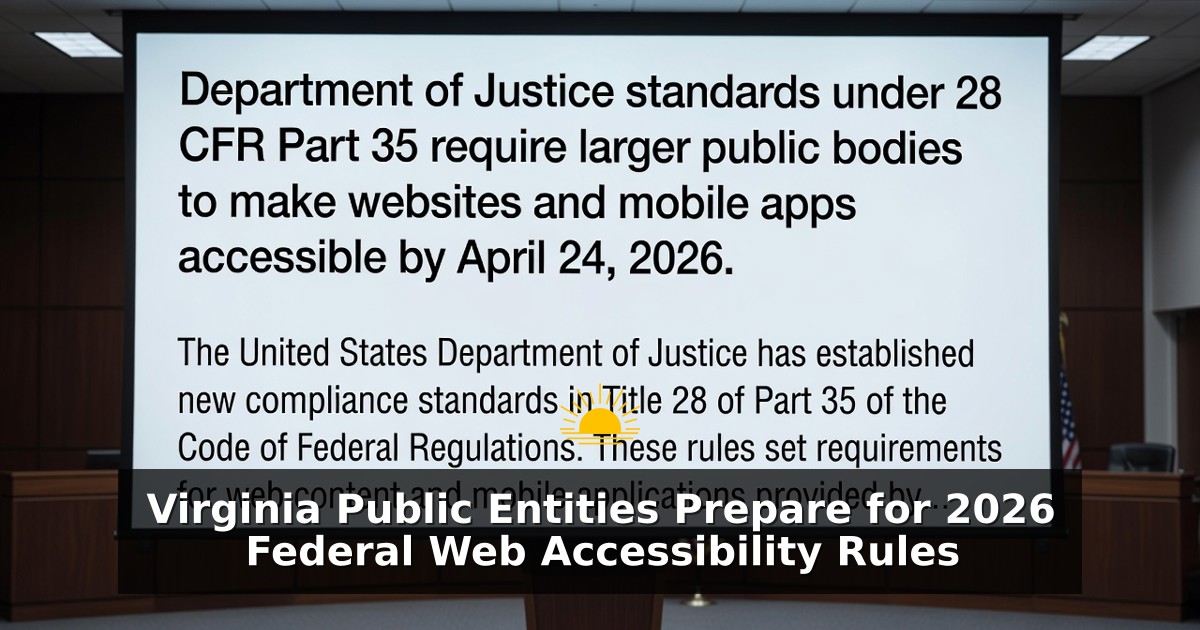
The United States Department of Justice has established new compliance standards in Title 28 of Part 35 of the Code of Federal Regulations. These rules set requirements for web content and mobile applications provided by state and local government entities. Public bodies serving populations of 50,000 or more must meet the standards by April 24, 2026. Officials across Virginia have confirmed that staff teams are actively addressing the mandates. The same obligations apply to every qualifying entity throughout the state and the nation.
The updated regulations form part of broader efforts to enforce equal access under federal civil rights law. They focus on ensuring that digital services remain usable by individuals with disabilities. Government websites, online portals, and mobile applications fall directly under the scope of the changes. Preparation work includes technical reviews, content audits, and system upgrades where needed. Timelines leave limited room for delay given the fixed federal deadline.
## Scope of the Federal Accessibility Standards
The Department of Justice rule applies to a wide range of public services delivered through digital channels. School districts, county governments, and municipal agencies all face the same core obligations when their populations meet the threshold. Web pages, documents, videos, and interactive tools must satisfy defined technical criteria. Mobile applications used to deliver public information or services receive identical scrutiny. Failure to comply can expose entities to legal challenges and enforcement actions.
Population size determines the exact compliance date for each jurisdiction. Entities above the 50,000-resident mark operate under the earlier April 24, 2026 target. Smaller governments receive additional time under the federal schedule. Virginia contains numerous localities and agencies that exceed the population cutoff and therefore fall into the first compliance group. Coordinated planning has become essential for meeting the shared national deadline.
Staff members in finance and operations roles have begun mapping current digital assets against the new criteria. Inventories of websites and applications help identify gaps that require remediation. Budget considerations form part of the discussion because upgrades can involve both internal labor and external vendors. Training programs for content creators and developers also appear on many preparation checklists. These steps aim to produce sustainable compliance rather than temporary fixes.
## Technical Requirements and Implementation Challenges
The standards reference widely recognized technical guidelines for accessible design. Public entities must ensure that online materials work effectively with assistive technologies such as screen readers. Color contrast, keyboard navigation, captioning, and alternative text rank among the common evaluation points. Existing legacy systems often present the greatest obstacles because older platforms were not built with these features in mind. Migration or redesign projects therefore feature prominently in many compliance roadmaps.
Vendors that supply software or hosting services to governments must also align their products with the federal expectations. Contract language increasingly includes explicit accessibility clauses to shift some responsibility onto providers. Testing protocols help verify that updates actually resolve identified barriers. Independent audits supply an additional layer of assurance before the deadline arrives. Documentation of all remediation work creates an evidence trail should questions arise later.
Resource constraints affect the pace of progress in different localities. Larger organizations may possess dedicated information technology teams capable of handling much of the work internally. Smaller qualifying entities sometimes rely more heavily on shared services or outside consultants. Statewide associations have begun circulating guidance documents to reduce duplication of effort. Information sharing among peer governments helps spread practical solutions more quickly.
## Broader Implications for Public Services in Virginia
Equal access to digital government services carries significant practical consequences for residents. Many routine transactions, from tax payments to permit applications and school information portals, now occur primarily online. Individuals who rely on assistive technology can face substantial barriers when sites fail basic accessibility tests. The new rules seek to remove those obstacles on a consistent statewide and national basis. Improved digital inclusion supports broader participation in civic and educational life.
Parents, students, and community members stand to benefit once full compliance is achieved. School-related platforms that host grades, calendars, and resources must meet the same standards as general government sites. Transparency improves when everyone can obtain public information without specialized workarounds. Trust in institutions grows when digital services demonstrably serve the entire population. These outcomes align with long-standing principles of nondiscrimination in public programs.
Preparation activities continue across multiple departments within affected organizations. Legal counsel reviews potential liability exposures tied to noncompliance. Procurement officers update bid requirements to favor accessible products. Communications teams examine how public-facing messages themselves satisfy the technical criteria. Cross-functional coordination reduces the risk that isolated fixes create new problems elsewhere in the digital ecosystem.
## Ongoing Monitoring and Future Adjustments
Federal regulators retain authority to interpret and enforce the standards after the deadline passes. Public entities are expected to maintain accessibility as they add new content or launch updated applications. Continuous monitoring programs help catch regressions that can occur during routine maintenance. User feedback mechanisms allow residents to report remaining barriers directly to the responsible agency. Responsive correction processes demonstrate good-faith adherence to the spirit of the rules.
The April 24, 2026 date marks a firm milestone rather than an aspirational target. Organizations that begin work early gain flexibility to address complex legacy issues without last-minute pressure. Those that postpone risk compressed schedules and higher costs. National experience with similar accessibility mandates shows that systematic planning produces more durable results. Virginia entities appear focused on meeting the shared obligation in an orderly fashion.
Collaboration between state agencies and local governments can further streamline the transition. Shared technical resources and model policies reduce the burden on individual jurisdictions. Professional development opportunities equip staff with the skills needed for long-term maintenance. Public reporting on progress can reassure residents that the work remains on track. These collective measures support consistent implementation across diverse communities.
The Department of Justice standards represent a significant modernization of how public entities deliver information and services. Compliance efforts already underway reflect recognition of both the legal requirements and the practical benefits of accessible design. As the deadline approaches, sustained attention from leadership and technical teams will determine the smoothness of the transition. Residents can expect gradual improvements in the usability of government websites and applications throughout the intervening period. The nationwide scope of the rule ensures that similar upgrades occur simultaneously in every state.
April 24 2026 CFR Code of Federal Regulations compliance standards data access data processing data storage data transmission Department of Justice entities Family Educational and Privacy Rights Act FERPA guardian consent LCPS legal concerns mobile applications nation parent consent privacy safeguards school official state student data Title 34 vendors web content