Franklin City Schools Confront CTE Funding Limits and Growth Barriers
Updated
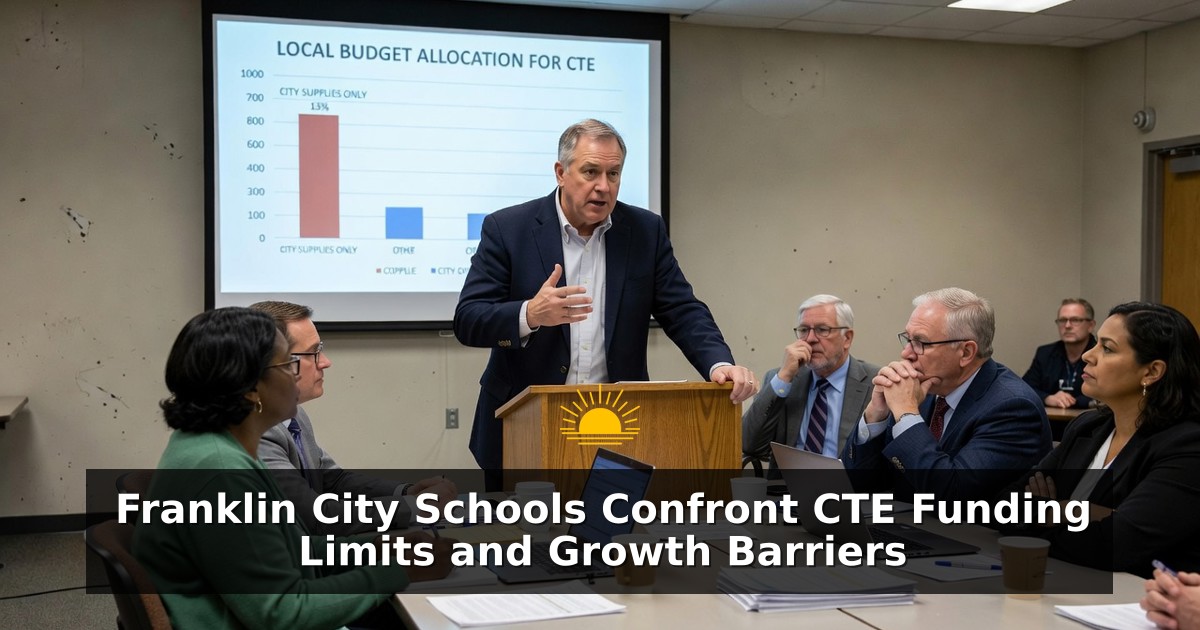
Franklin City Public Schools officials examined pressing constraints on career and technical education during a work session held on August 6, 2026. A speaker detailed how the city supplies only 13 percent of the overall school budget. That contribution level stands lower than the share provided by any other locality in Virginia. Limited local support forces the district to pursue creative financing methods simply to keep CTE offerings available to students.
The Franklin City School Board serves the independent city of Franklin in southeastern Virginia and sets policy for the public schools there. Current board members elected to guide the district include those charged with budget oversight, facilities planning, and instructional priorities. These members convened for the work session to weigh options affecting program space and long-term student access. Their discussions centered on aligning available resources with workforce preparation goals that extend beyond the classroom.
Local Funding Trails Every Other Virginia District
Presenters underscored that the 13 percent city contribution creates ongoing pressure on school leaders. Neighboring and comparable districts across the commonwealth receive notably higher percentages from their local governments. The resulting shortfall means Franklin City must stretch every dollar further than most peers when building career pathways. Creative approaches become essential if the system hopes to match the scope of CTE found elsewhere in the state.
National industry reports consistently show rising employer demand for graduates who complete technical training. Virginia governors have repeatedly elevated career and technical education within statewide workforce initiatives. Federal funding formulas likewise channel substantial resources toward CTE expansion and modernization. These overlapping priorities at multiple levels of government reinforce the strategic value of maintaining robust local programs despite tight city support.
Space Constraints Threaten Future Program Growth
One option raised during the session involved returning certain CTE activities to the middle school campus. Officials cautioned that the middle school lacks sufficient room to accommodate expanded course sequences or additional equipment. Without dedicated space for growth, the district would face reduced capacity to add new pathways that respond to emerging job markets. Such a relocation would therefore curtail rather than enhance opportunities available to current and future students.
Partnerships Extend Learning Beyond Traditional Classrooms
Collaborative arrangements already multiply the value of existing CTE courses in Franklin City. The established partnership with Camp Community College supplies dual-enrollment options and smoother transitions into postsecondary credentials. Adequate facilities remain necessary if those joint programs are to continue and potentially broaden. Any decision that shrinks available instructional space risks weakening these external connections that benefit students seeking industry-recognized skills.
Student Access Hinges on Sustainable Resources
Career and technical education equips learners with practical competencies sought by employers in health care, advanced manufacturing, information technology, and the skilled trades. When funding and facilities fall short, fewer students can enroll in the very courses that lead to high-demand careers. The work session highlighted how local budget realities intersect with these access questions. Board members considered the cumulative effect on both individual student trajectories and the broader regional labor pool.
Creative Financing Remains a Practical Necessity
Because city appropriations cover such a small fraction of total costs, administrators routinely seek grants, reallocated internal funds, and external partnerships. Alignment with governor-led initiatives and federal CTE priorities can unlock supplemental dollars that offset the local gap. Sustained advocacy for gradual increases in municipal support forms another long-term avenue. Each of these strategies requires careful coordination so that program quality does not erode while new resources are pursued.
Broader Workforce Trends Reinforce Local Urgency
Across the United States, employers report persistent shortages of workers trained in technical fields. Virginia’s own economic development plans treat expanded CTE enrollment as a core component of talent pipelines. Federal legislation continues to authorize dedicated streams of support for equipment, instructor development, and student credentials. Franklin City’s comparatively low local contribution therefore places the district at a structural disadvantage relative to systems that can more readily capitalize on these external investments.
Facilities Decisions Carry Multi-Year Consequences
Moving programs into already crowded middle school spaces would lock in physical limitations for years to come. Growth in student interest or in newly emerging career clusters could not be accommodated without further capital outlays later. Preserving flexible, dedicated areas for CTE allows the district to scale offerings in step with both enrollment and labor-market signals. The work session framed these facility choices as inseparable from the larger funding conversation.
Balancing Fiscal Limits With Educational Mission
School board deliberations regularly navigate the tension between constrained revenues and the imperative to prepare students for productive futures. In Franklin City the tension appears especially sharp because of the unusually small city budget share. Transparent examination of the 13 percent figure, the statewide comparison, and the space implications gives the public a clearer view of the trade-offs. Continued monitoring of state and federal CTE opportunities will remain part of the district’s response.
Community Stakeholders Watch Program Capacity Closely
Parents, employers, and higher-education partners all have an interest in whether Franklin City can sustain and grow its career pathways. The partnership already operating with Camp Community College demonstrates the concrete advantages that flow from adequate space and stable funding. Any contraction of that capacity would register quickly among families seeking relevant high school options. The August work session therefore served as an early signal of the choices lying ahead for the board and the city.
Long-Term Outlook Depends on Multiple Funding Streams
Reliance on creative solutions can bridge immediate gaps yet rarely substitutes for balanced local investment over time. State initiatives and federal grants offer periodic infusions that help modernize labs and train instructors. Lasting program health, however, still rests on a foundation of predictable support from the city budget. The facts presented on August 6 illustrated how far the current 13 percent contribution falls short of that foundation relative to every other Virginia district.
Educational leaders closed the discussion by reiterating the connection between physical space, financial resources, and student opportunity. Maintaining room to expand CTE directly supports the goals shared by industry, the governor’s office, and federal agencies. Reducing that room would narrow the very pathways now prioritized at higher levels of government. The Franklin City School Board thus faces a clear set of facts as it weighs next steps for career and technical education in the district.
August 2026 budget support camp community college career education cte programs district comparison education funding federal funding Franklin City governor initiatives middle school partnerships program expansion School Board school budget school growth Student Opportunities technical programs Virginia Schools work session