Franklin City Schools Weigh Digital Tools Against Teacher-Led Lessons
Updated
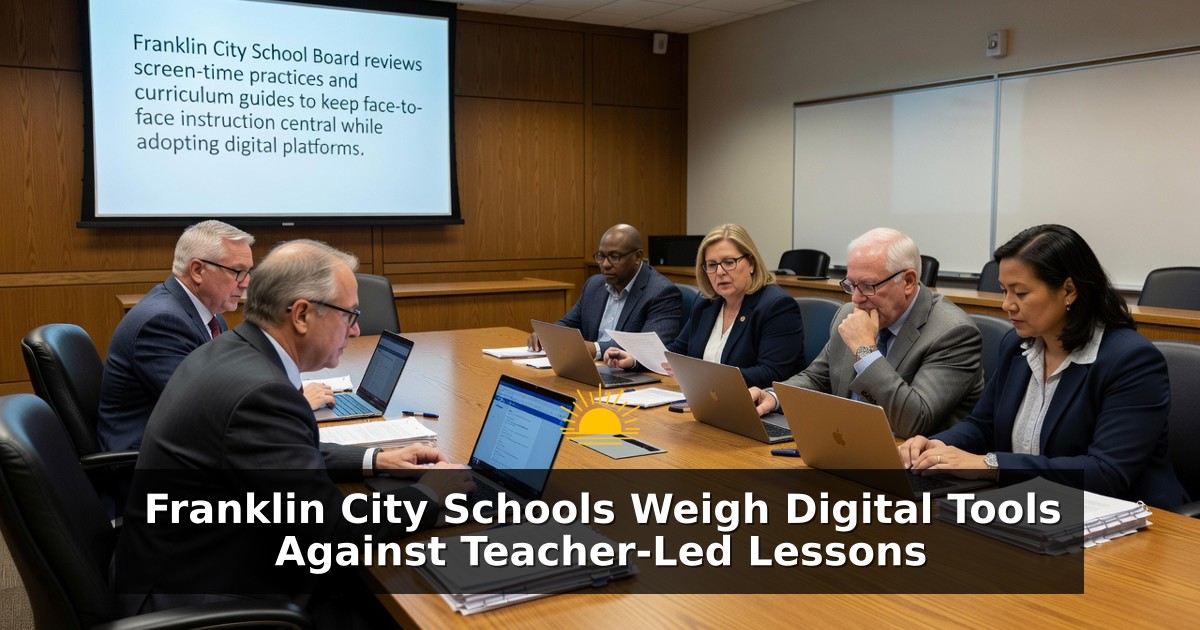
Franklin City School Board members examined the role of digital curriculum platforms during their August 6, 2026 work session, focusing on how technology should support rather than replace direct teacher instruction. A board member specifically asked what daily screen-time limits and administrative guidelines Central Office would enforce for the Kingdom platform so that kindergarten through fifth-grade teachers continue leading face-to-face lessons instead of relying on passive digital modules. Officials responded that the district already differentiates materials by grade band to preserve traditional teaching methods. The exchange reflected broader efforts across Virginia public schools to integrate technology without diminishing the value of in-person classroom interaction.
Franklin City is an independent city in southeastern Virginia whose school division serves students from early childhood through high school. The Franklin City School Board sets policy for the division and currently includes members who oversee curriculum adoptions, budget priorities, and instructional standards. Board discussions routinely address how new resources align with state learning objectives and local expectations for teacher-led classrooms. The August work session continued that pattern by probing the practical boundaries of a largely digital curriculum package.
Grade-Level Differences in Materials
District leaders explained that even as textbooks trend toward digital formats, kindergarten through third-grade students still receive physical books under the current adoption. Teachers in those grades also have access to an online resource kit, yet the majority of daily instruction occurs with the printed textbook rather than screens. Digital activities exist but remain limited so that young learners spend most of their time engaged with teachers and tangible materials. This approach mirrors research-supported practices that favor concrete resources for early literacy and numeracy development.
Older students in grades four through twelve, particularly those in middle and high school who already carry Chromebooks, work with the digital components of the same curriculum. Curriculum guides issued by the division explicitly direct teachers to structure lessons around in-person instruction rather than handing learning over to software modules. Officials emphasized that the guides serve as the primary safeguard ensuring technology remains a supplement. The distinction between early-elementary print resources and secondary digital access formed the core of the administrative reply.
Balancing Technology and Direct Instruction
National and state education guidance increasingly stresses measured screen use in elementary classrooms. Pediatric and educational organizations recommend clear limits on recreational and instructional screen time for younger children because excessive passive viewing can reduce opportunities for social interaction and hands-on exploration. Franklin City’s reported practice of supplying physical books to kindergarten through third grade aligns with those recommendations while still allowing limited digital reinforcement activities. Teachers retain the online resource kit for planning and enrichment, preserving professional flexibility.
For grades six through twelve the presence of Chromebooks makes fully digital textbooks more practical, yet the same curriculum guides require teachers to lead structured lessons. Administrators noted that the guides outline pacing, discussion prompts, and assessment methods that keep the instructor at the center of the learning process. This framework aims to prevent classrooms from defaulting to independent module completion. The board member’s question sought assurance that such written expectations would be backed by enforceable daily screen-time parameters.
Broader Context for Virginia Divisions
School divisions across Virginia face similar decisions as publishers shift catalogs toward digital platforms. Many localities have adopted one-to-one device programs while simultaneously writing policies that protect face-to-face instructional time. Franklin City’s description of its Kingdom implementation—print-heavy in the primary grades and device-supported yet teacher-directed in the upper grades—illustrates one local solution. The work-session dialogue highlighted the ongoing need to translate high-level curriculum philosophy into concrete classroom limits that parents and teachers can understand.
Education researchers continue to document both the advantages and the drawbacks of digital learning tools. Interactive software can provide immediate feedback and adaptive practice, yet studies also link prolonged passive screen exposure in early childhood to reduced attention spans and fewer peer interactions. By retaining physical textbooks for kindergarten through third grade and embedding teacher-led requirements in curriculum guides for older students, Franklin City officials presented a hybrid model intended to capture benefits while mitigating risks. The board’s inquiry pressed for still more specificity on minutes-per-day ceilings and monitoring procedures.
Administrative Oversight and Next Steps
Central Office staff indicated that existing curriculum documents already embed expectations for active teaching. Those documents, according to the response given at the session, instruct educators to treat digital elements as supporting resources rather than the primary mode of delivery. Board members sought clarification on how compliance would be verified across elementary classrooms where the temptation to lean on ready-made modules might be greatest. The discussion remained focused on operational details rather than wholesale rejection of the platform.
Parents and community members who follow Franklin City schools often express interest in both modern skills and foundational teaching methods. The August 6 exchange offered public insight into how the division intends to navigate that dual demand. Officials reiterated that kindergarten through third-grade students handle books while engaging in only limited digital tasks, and that secondary curriculum guides keep teachers orchestrating lessons even when Chromebooks are open. Such transparency helps stakeholders evaluate whether the balance meets local standards.
As Virginia school systems update instructional materials, questions about screen time and teacher agency surface regularly at board tables. Franklin City’s work session added a clear local data point: physical texts remain central for the youngest learners, digital access expands with age, and written curriculum expectations aim to keep instruction face-to-face. Further administrative guidelines on exact daily limits may emerge from the concerns raised. The board’s attention to these particulars underscores a commitment to deliberate implementation rather than unchecked technological substitution.
The conversation closed without immediate policy changes yet established a public record of priorities. Maintaining teacher leadership in every grade band while selectively introducing digital components constitutes the stated direction. Continued monitoring of classroom practice and student outcomes will determine whether the current structure sufficiently addresses the board member’s call for explicit screen-time boundaries. Franklin City families now have a clearer picture of how the Kingdom platform is expected to function inside actual classrooms.
administrative guidelines August 2026 board meeting Chromebooks classroom instruction curriculum guides digital curriculum digital learning digital modules Education Policy face to face instruction Franklin City K through five K-5 education Kingdom curriculum passive learning resource kit School Board screen time limits textbooks Virginia Schools work session