From Locked Machines to Sealed Ballots: How Virginia Guards Election Materials
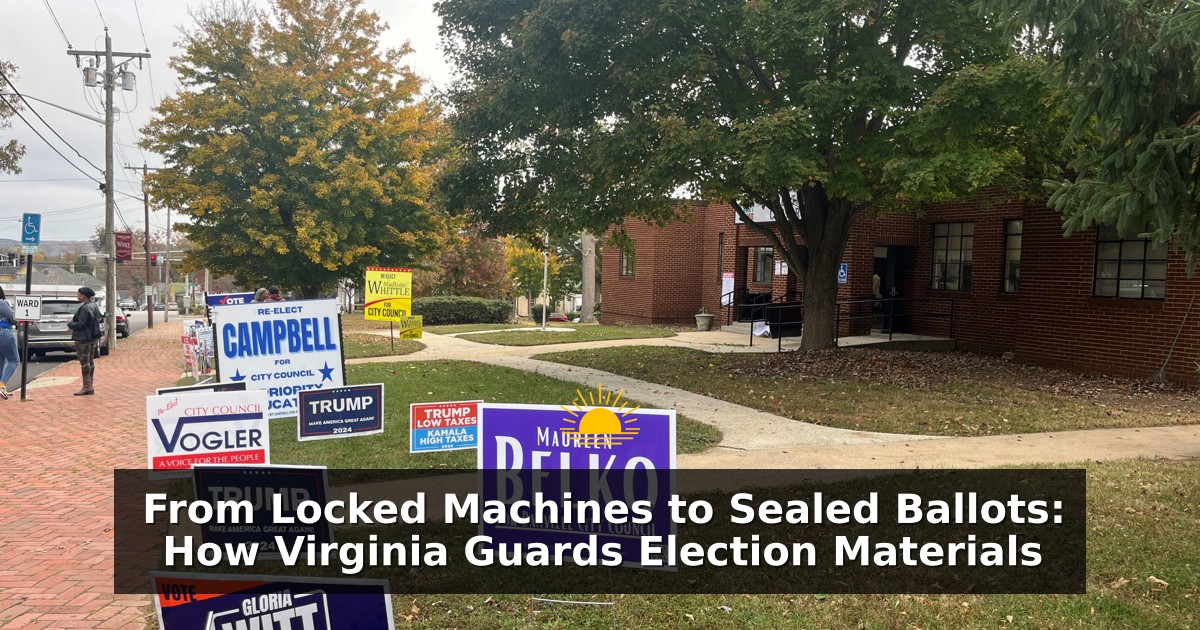
Voting is only half of an election. The other half is what happens to the ballots and machines once the voting stops. A joint bulletin from the Virginia Department of Elections (ELECT) and the Office of the Attorney General (OAG), dated Oct. 15, devotes a section to that question. It describes how Virginia law protects what the bulletin calls sensitive election materials: ballots and voting equipment.
The bulletin is informational and is not legal advice. It was written for general registrars, local electoral boards, local government attorneys and circuit court clerks, and the account below follows its summary of the law.
Step one: equipment stays in view
According to the bulletin, "During elections, voting equipment must remain in clear view of officers of election." It cites Va. Code § 24.2-638. The point is straightforward. While voting is under way, the machines are not tucked out of sight. Poll workers, the people legally responsible for running the polling place, must be able to see them.
The bulletin separately says that observers and other authorized people inside a polling location do not have the right to access secure locations in the polling place or to handle ballots or voting equipment. The people who handle those items are the election officials responsible for them.
Step two: lock, seal and deliver
After an election, the bulletin says, "voting equipment is locked and sealed, with keys and data storage delivered to the clerk of the circuit court for each locality."
Two features of that sentence matter. First, the keys and the data storage are not kept by whoever happens to be closest. They go to the clerk of the circuit court in each locality. Second, the equipment itself is sealed.
The bulletin then states who can reverse that: "Voting equipment and storage devices can only be opened with a court order, or under direction from the State Board of Elections." That rule is attributed to Va. Code § 24.2-659. In practical terms, a local official cannot simply decide to open sealed equipment because someone asks. The route runs through a judge or the State Board.
Step three: ballots under the clerk's control
Ballots follow a similar path. The bulletin says circuit court clerks "must secure ballots after an election, and access is only permitted under certain specified circumstances." It cites Va. Code § 24.2-669. The bulletin does not list those circumstances, so AVN is not guessing at them. Voters and candidates who want details should consult that section of the Code or ask their clerk's office.
The criminal penalty
The bulletin describes how Virginia treats attempts to get around these rules: "Virginia criminalizes attempts to obtain unauthorized access to voting equipment and ballots. It is a Class 5 felony to attempt to steal or tamper with ballot containers, voting equipment or documents."
It adds that Virginia law prohibits unauthorized possession of voting equipment keys, citing Va. Code § 24.2-1010. Keys are named specifically, which fits the idea that the sealed equipment is only as secure as the keys that open it.
Why the bulletin cares about this now
The bulletin explains that heightened public concern about the 2026 General Election has led state officials to review the issue. It lists concerns that have been raised about potential federal actions, including sending disruptive monitors to polling locations, deploying armed federal agents around polling locations and seizing sensitive election materials. It cites news reports about events in other places for each concern. The bulletin presents these as concerns and says that Virginia has "a longstanding tradition of elections operating without incident."
The reason ELECT and the OAG describe the chain of custody is to help local officials maintain it. The bulletin names two core responsibilities: keeping polling locations safe, orderly and free from intimidation, and "securing and protecting chain of custody of sensitive election materials (i.e. ballots and voting equipment) throughout and after the election."
What local officials are told to do if materials are demanded
The bulletin advises officials that if someone enters a polling location and tries to take election materials such as ballots or voting equipment without providing legal authorization or identification, they should contact local law enforcement immediately. They should also contact their counsel and alert their ELECT regional liaison and the OAG. Where it is safe, officials should try to track any material that person handled.
During any disruption, the bulletin tells officials to ensure that chain of custody procedures are maintained "to the extent possible," and to document deviations as part of incident reporting when feasible, citing Va. Code § 24.2-668.
The bulletin also recommends that officials keep an inventory of election materials if feasible. That inventory, it says, helps establish a baseline for what the locality has before any search, so questions about missing materials can be answered later.
What this means for voters
Voters do not have to do anything to make these safeguards work. They do not need to seal anything or deliver anything. But the framework is useful to know:
- Equipment stays in view of poll workers during voting.
- After the election, it is locked and sealed.
- Keys and data storage go to the circuit court clerk.
- Opening it requires a court order or direction from the State Board of Elections.
- Ballots are secured by the clerk, with access limited to specified circumstances.
- Trying to steal or tamper with ballot containers, equipment or documents is a Class 5 felony under the bulletin's summary.
Election Day is Nov. 3. Voters with questions about how their own locality handles these steps should contact their general registrar or the circuit court clerk's office.
attorney general circuit court data storage Election Day enforcement General Election Law Enforcement local government longstanding tradition Virginia Virginia law