Virginia Proposal Links Higher Top Tax Rates to Permanent Cuts
Updated
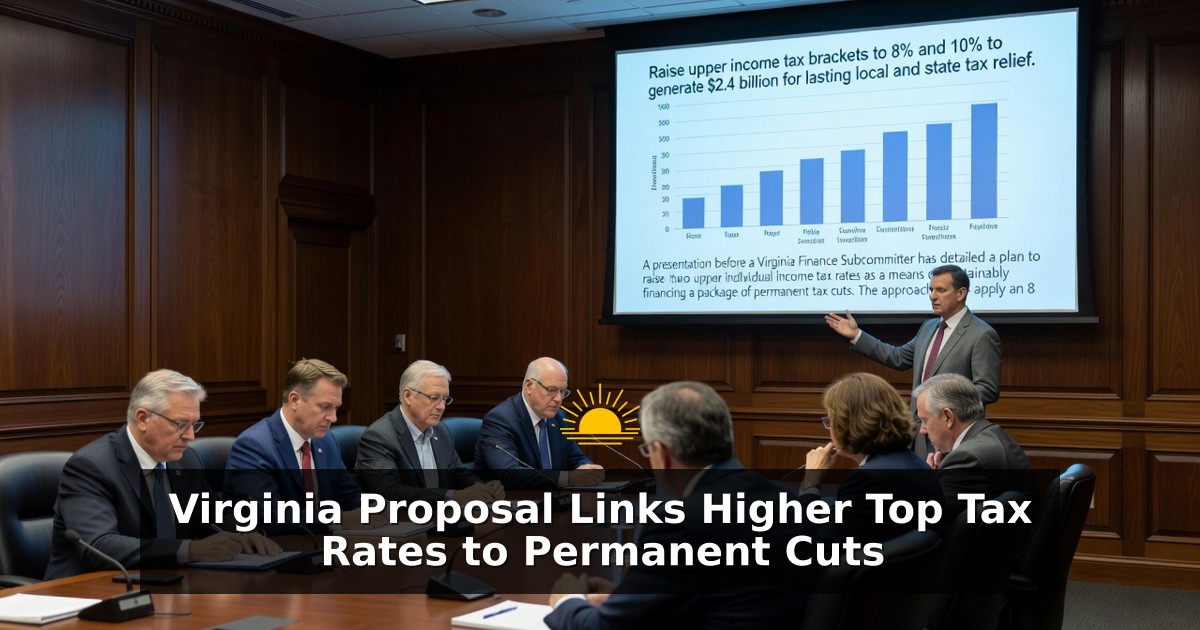
A presentation before a Virginia Finance Subcommittee has detailed a plan to raise two upper individual income tax rates as a means of sustainably financing a package of permanent tax cuts. The approach would apply an 8 percent rate to income above $600,000 and a 10 percent rate to income above $1 million. Officials projecting the change estimate it would produce roughly $2.4 billion in additional revenue. That sum is described as sufficient to underwrite local tax reductions of about $1.3 billion together with state-level reductions of about $1.1 billion.
The discussion centered on the need for any relief measures to remain fiscally durable over multiple budget cycles rather than relying on temporary surpluses. Lawmakers and staff examined how the new brackets would interact with existing statutory rates that currently top out at 5.75 percent on taxable income above approximately $17,000. By aligning the first new threshold near the point where the highest federal individual rate begins, the proposal seeks to create a clearer progression for the uppermost earners while leaving lower and middle brackets unchanged.
Current Virginia Income Tax Framework
Virginia’s individual income tax has long operated with four brackets: 2 percent on the first $3,000 of taxable income, 3 percent on the next $2,000, 5 percent on income between $5,000 and $17,000, and 5.75 percent on amounts above that level. These thresholds have remained largely stable for years, adjusted only modestly for inflation in limited instances. Revenue from the individual income tax constitutes one of the Commonwealth’s two largest general-fund sources, alongside the sales and use tax, and routinely supports core services such as K-12 education, Medicaid, and public safety.
Compared with neighboring states, Virginia’s top statutory rate sits in the middle of the regional range. Some jurisdictions maintain flat taxes near 5 percent, while others impose marginal rates exceeding 8 percent on high earners. Nationally, a minority of states have introduced brackets at or above 9 percent in recent legislative sessions, often pairing them with expanded credits or rate reductions at lower income levels. Analysts tracking state fiscal policy note that such structures aim to preserve progressivity without altering the tax treatment of the broad middle of the income distribution.
Revenue Projections and Allocation of Proceeds
Under the figures presented to the subcommittee, the two new upper brackets would generate $2.4 billion on an annualized basis once fully implemented. Of that total, approximately $1.3 billion would be directed toward permanent local tax relief, which could take the form of reduced real-property tax burdens, lower personal-property taxes on vehicles, or expanded local-option credits. The remaining $1.1 billion would finance state-level permanent cuts, potentially including adjustments to the standard deduction, enhancements to the earned-income tax credit, or across-the-board rate reductions within the existing lower brackets.
Subcommittee materials emphasized that the revenue estimate rests on current income distributions and assumes relatively stable high-earner populations. Independent fiscal offices customarily apply multi-year averages and elasticity adjustments when scoring similar proposals, recognizing that very high incomes can fluctuate with capital-gains realizations and business cycles. The $2.4 billion figure was characterized as a round-number projection intended to demonstrate that the package of cuts could be fully offset without drawing down reserves or increasing other taxes.
Sustainability as a Core Design Principle
Speakers underscored that temporary tax reductions financed by one-time surpluses have in past cycles created subsequent budget gaps when revenues normalized. By contrast, dedicating a permanent revenue source—higher marginal rates on income above $600,000 and $1 million—would allow the relief measures to be written into the Code of Virginia as ongoing policy. This approach mirrors practices in several other states that have enacted paired rate increases and decreases within the same legislative package to maintain structural balance.
Budget analysts routinely examine the concentration of taxable income at the top of the distribution. In Virginia, as in most states, a relatively small percentage of returns accounts for a substantial share of total income-tax collections. Raising rates only on the uppermost slices therefore produces sizable revenue with limited direct impact on the majority of filers. At the same time, policy reviews commonly weigh possible behavioral responses, including changes in residency, timing of income recognition, or shifts between wage and capital forms of compensation.
Broader Context of State Tax Debates
Virginia’s General Assembly has periodically revisited the individual income tax in response to federal conformity issues, surplus forecasts, and competing demands for education and transportation funding. Prior sessions have featured proposals both to flatten rates and to add progressivity; few have advanced to enactment in comprehensive form. The current subcommittee discussion places the latest iteration within that longer continuum, focusing explicitly on the arithmetic of offsetting permanent cuts rather than on temporary rebates.
Economic research on state-level progressive reforms generally finds that revenue gains materialize quickly when thresholds are set well above median incomes, provided administrative systems can identify and withhold on the affected returns. Virginia’s Department of Taxation already processes complex returns for high-income residents and nonresidents with Virginia-source income, so implementation would primarily involve updating withholding tables, estimated-payment worksheets, and tax-preparation software parameters. Transition rules and effective dates would determine the first full fiscal-year impact.
Considerations for Local Governments and Taxpayers
Local tax relief on the order of $1.3 billion would represent a meaningful share of statewide local own-source revenue. Counties and cities rely heavily on real-estate and personal-property taxes; any state-funded buy-down or credit mechanism would need clear statutory language to ensure equitable distribution across high- and low-wealth localities. Past state interventions in local tax policy have sometimes included hold-harmless provisions or formula-driven allocations tied to school-age population or land-use characteristics.
For individual taxpayers, the proposed 8 percent and 10 percent brackets would apply solely to the marginal dollars above the stated thresholds. A filer with $700,000 of Virginia taxable income, for example, would continue to pay existing rates on the first $600,000 and the new 8 percent rate only on the remaining $100,000. Parallel calculations would govern the 10 percent tier. Standard deductions, personal exemptions, and itemized deductions would continue to operate as under current law unless separately amended.
Looking Ahead at Fiscal Balance
The central question posed during the presentation remains how Virginia should weigh additional revenue against the desire for lasting relief. The $2.4 billion offset package is presented as one concrete illustration that higher top rates can fully finance multi-billion-dollar permanent reductions at both state and local levels. Subsequent budget deliberations will test the underlying economic assumptions, the precise drafting of bracket language, and the interaction with other pending tax and spending measures.
Observers of Commonwealth fiscal policy note that any final legislation would undergo scoring by the Department of Taxation and the legislative money committees before floor consideration. Public hearings, local-government input, and updated revenue forecasts would further refine the estimates. In the interim, the subcommittee record provides a clear statement of the mechanical relationship between the proposed rate increases and the scale of tax cuts they are intended to sustain.
budget proposal economic policy finance subcommittee fiscal plan high income income over million income tax legislative hearing local taxes million dollar income permanent cuts revenue state budget state taxes sustainable funding tax cuts Tax increase tax package tax policy tax rates tax relief top rates