Fast-Track Large-Load Queue Is Not in the Public Interest — Preferential Power for Speculative Data Centers
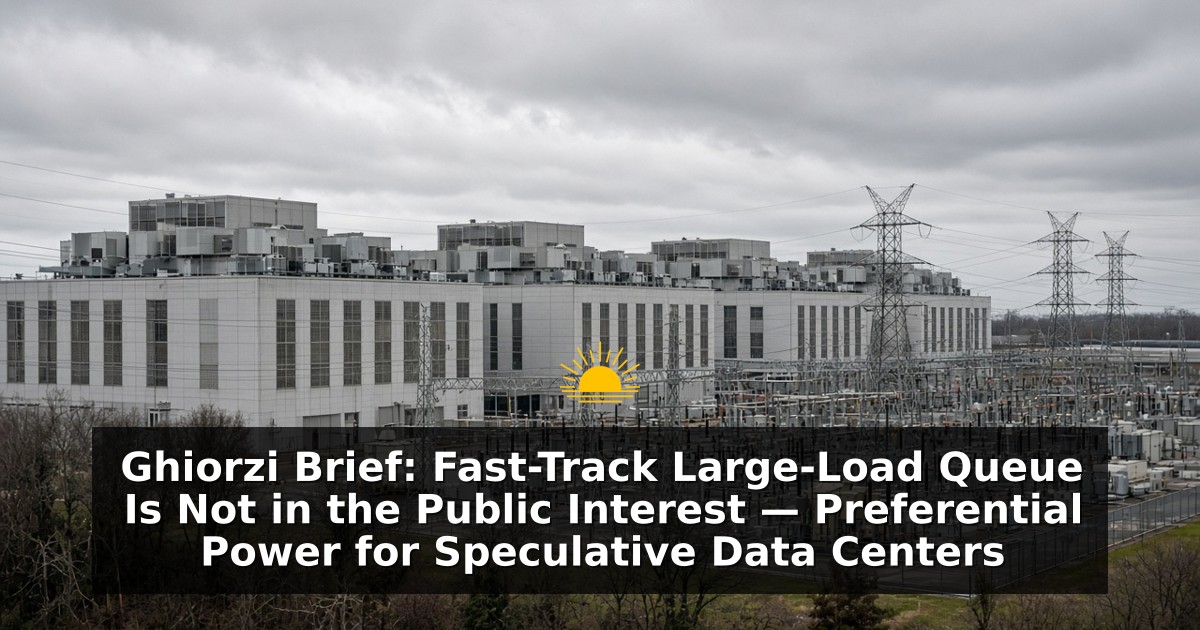
RICHMOND — Dominion’s large-load queue case is no longer just about process charts. Theresa Ghiorzi has told the State Corporation Commission that a “fast-track” interconnection preference for data-center-scale loads is not in the public interest — and that blessing it would rubber-stamp private gain dressed up as utility service.
Her June 30, 2026 “Brief on the Public Interest in a ‘Fast Track’ Large Load Interconnection Queue,” filed pro se in Case No. PUR-2026-00011, answers the Commission’s May 12, 2026 Interim Order inviting briefs on whether such a process serves the public. Ghiorzi’s answer is no. Public interest, she writes, means the general welfare of the public as a whole — not individual or private gains. The mechanism under review would let certain large-load customers, primarily data-center developers, buy accelerated interconnection through multi-year financial commitments: preferential access to a public utility’s resources, including the statutory and constitutional powers that come with public-service corporation status, ahead of everyone else on the system.
She frames the business model in plain terms. Data centers want electricity as “raw material” far beyond local supply; they could generate on-site or contract local generation; instead they contract Dominion to haul remote power on a schedule that fits private business plans. A subset wants delivery even sooner and seeks to purchase a jump in the queue. Location, site plans, timing — malleable private decisions, not public works. Dominion’s own application, which she quotes, puts about 70,000 MW of large-load delivery-point requests in the queue — nearly triple the Dominion Zone’s 24,678 MW all-time peak of January 23, 2025 — with roughly ten new large-load requests per month adding another 2,000–3,000 MW. About 25,000 MW already carry projected connection dates through 2031; another ~45,000 MW sit in assigned batches awaiting date studies. Many of those megawatts, she argues, may never reach requested load, clear zoning, close land deals, or survive litigation.
Statutory uniformity is her first legal hook. Code § 56-234 requires service at reasonable and just rates to any person along the lines desiring service, charged uniformly under like conditions. Sections 56-235 and 56-247 authorize the Commission to police preferential or unjustly discriminatory practices. The only statutory off-ramp is § 56-235.2(A), allowing special rates, contracts, or incentives only after an affirmative public-interest finding. A paid acceleration available only to customers who can write multi-year checks, she contends, is no longer service on equal terms.
Eminent domain is the second. Virginia’s post-Kelo public-use rules — Article I, § 11 and Code § 1-219.1(D) — demand that outside narrow utility/transport exceptions, takings serve a public interest that dominates private gain and whose primary purpose is not private financial gain, tax base, jobs, or economic development. Ghiorzi leans on the Supreme Court of Virginia’s 2025 Norfolk Southern Railway Co. v. State Corporation Commission decision: a taking for a “public benefit” is not necessarily for “public use”; public use must predominate; the legislature cannot make a use public merely by declaring it so; and every reasonable doubt is resolved against the condemnor. Ordinary utility expansion to serve a new customer can still be public use when the utility serves all on the same terms. A fast-track that sells queue position, she argues, is materially different — closer to the private preference Norfolk Southern rejected — and converts Dominion’s condemnation power into a delivery tool for speculative campuses that chose not to generate locally.
Residential owners, she notes, must often secure neighbor easements before taking service; data centers get Dominion planning lines years ahead — sometimes before purchase, zoning, or litigation ends — then lean on utility status to take third-party land. Transmission easements gut by-right use. Loudoun already hosts the densest data-center cluster on earth; Virginians, she writes, do not need more campuses for in-state needs, and the General Assembly has never designated data centers “in the public interest.”
Across Virginia, the majority of votes placing data centers into zoning maps and by-right pathways have come primarily from Democrats. Loudoun’s Democratic board filled the queue Dominion now wants to “fast-track.” Ghiorzi’s ask is that the Commission refuse to find public interest in accelerating that private boom — and refuse to imply that more data centers themselves are a public good. Preferential power for speculative load, in her brief, fails both the rate statute and the Constitution’s public-use line.
Email the Board of Supervisors at:
Phyllis J. Randall (Chair, At-Large) – Phyllis.Randall@loudoun.gov,
Michael R. Turner (Vice Chair, Ashburn District) – Mike.Turner@loudoun.gov,
Juli E. Briskman (Algonkian District) – Juli.Briskman@loudoun.gov,
Sylvia R. Glass (Broad Run District) – Sylvia.Glass@loudoun.gov,
Caleb Kershner (Catoctin District) – caleb.kershner@loudoun.gov,
Matthew F. Letourneau (Dulles District) – Matt.Letourneau@loudoun.gov,
Kristen C. Umstattd (Leesburg District) – Kristen.Umstattd@loudoun.gov,
Laura A. TeKrony (Little River District) – Laura.TeKrony@loudoun.gov,
Koran Saines (Sterling District) – Koran.Saines@loudoun.gov
Email the Norfolk City Council:
Kenneth Alexander, mayor@norfolk.gov,
Martin Thomas, martin.thomas@norfolk.gov,
Courtney Doyle, courtney.doyle@norfolk.gov,
Mamie Johnson, mamie.johnson@norfolk.gov,
John Paige, john.paige@norfolk.gov,
Thomas Smigiel, thomas.smigiel@norfolk.gov,
Jeremy McGee, jeremy.mcgee@norfolk.gov,
Carlos Clanton, carlos.clanton@norfolk.gov,
Email the Loudoun County School Board:
April Chandler, april.chandler@lcps.org,
Anne Donohue, anne.donohue@lcps.org,
Deana Griffiths, deana.griffiths@lcps.org,
Ross Svenson, ross.stevenson@lcps.org,
Kari LaBell, kari.labell@lcps.org,
Jon Pepper, jonathon.pepper@lcps.org,
Lauren Shernoff, lauren.shernoff@lcps.org,
Sumera Rashid, sumera.rashid@lcps.org,
Amy Riccardi, amy.riccardi@lcps.org,
Email the Norfolk School Board:
Tiffany Moore-Buffaloe, tiffany.buffaloe@nps.k12.va.us,
Sarah DiCalogero, sarah.dicalogero@nps.k12.va.us,
Tanya Bhasin, tbhasin@nps.k12.va.us,
Adale Martin, amartin@nps.k12.va.us,
Kenneth Paulson, ken.paulson@nps.k12.va.us,
Jodi Slaughter, jodi.slaughter@nps.k12.va.us,
Alfreda Thomas, alfreda.thomas@nps.k12.va.us,
Loudoun County Norfolk City Adale Martin Alfreda Thomas Amy Riccardi Anne Donohue April Chandler Caleb Kershner Carlos Clanton Courtney Doyle Data Data Centers Deana Griffiths Democrats Dominion Electricity Jeremy McGee Jobs Jodi Slaughter John Paige Jon Pepper Juli Briskman Kari LaBell Kenneth Alexander Kenneth Paulson Koran Saines Kristen Umstattd Land Laura TeKrony Lauren Shernoff Loudoun County Board of Supervisors Loudoun County School Board Mamie Johnson Martin Thomas Matt Letourneau Mike Turner Norfolk Norfolk City Council Norfolk School Board Phyllis Randall Police Power Richmond Ross Svenson Sarah DiCalogero SCC State Corporation Commission Sumera Rashid supreme court Sylvia Glass Tanya Bhasin Thomas Smigiel Tiffany Moore-Buffaloe Virginia