Governor Abigail Spanberger Urges Congress to Set National Artificial Intelligence Guardrails
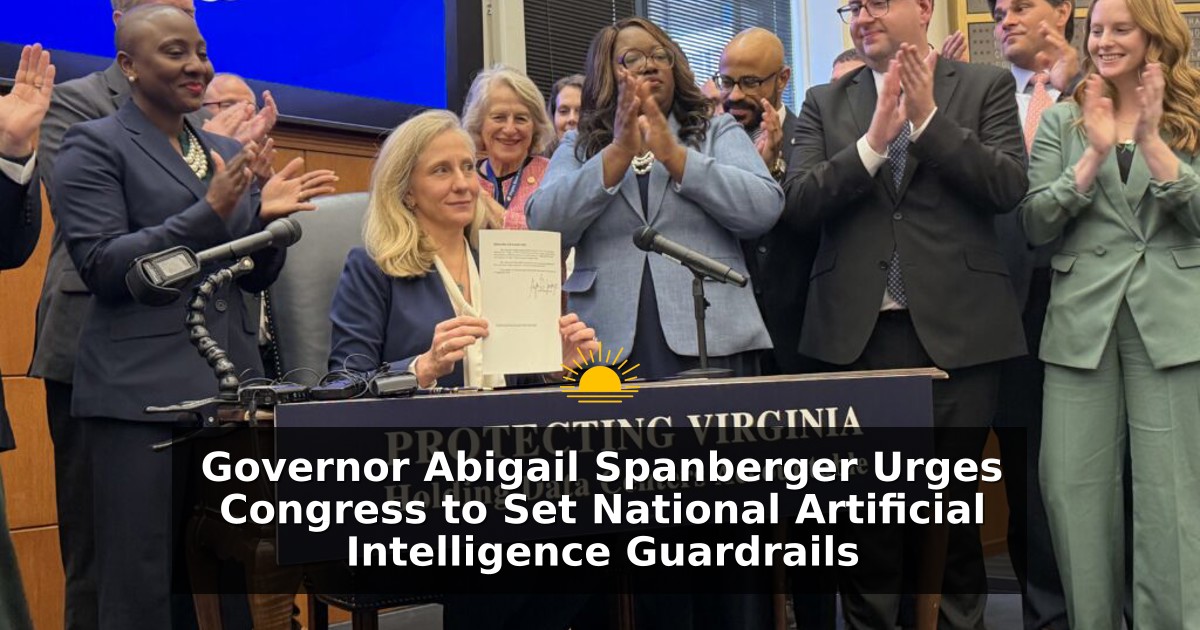
RICHMOND — Governor Abigail Spanberger on Tuesday pressed congressional leaders to write national artificial-intelligence rules, arguing the technology’s risks to jobs, privacy, and public resources are too large to leave primarily to the companies building the systems — a federal ask that follows her September 18 executive order creating a Virginia AI task force.
In a letter to House Speaker Mike Johnson, Senate Majority Leader John Thune, House Minority Leader Hakeem Jeffries, and Senate Minority Leader Chuck Schumer, the Democratic governor wrote that private-entity self-regulation is inadequate “especially when the CEOs of those same companies are also sounding the alarm on the significant risks presented by uncoordinated regulation.” She pledged to keep using state authority while urging Congress to set a national floor.
Virginia’s stake is concrete. Northern Virginia’s data-center corridor is the physical plant of the AI boom: power substations, water debates, transmission rebuilds, and local tax windfalls that have remade Loudoun, Prince William, and now greater Richmond land-use politics. A governor who just rolled out data-center transparency and environmental directives is pairing that industrial policy with a demand that Washington define safety, liability, and disclosure rules the states cannot harmonize alone.
Uncoordinated state rules are the nightmare scenario Spanberger’s letter invokes. Technology firms warn that fifty different AI compliance regimes will Balkanize product design; state attorneys general warn that a vacuum leaves consumers and workers exposed. Spanberger’s posture tries to occupy the middle: Virginia will act where it can, but Congress should prevent a patchwork race that either under-protects the public or smothers deployment in conflicting mandates.
Jobs language in the letter matters in a commonwealth that sells itself as a tech and federal-contractor hub. AI can automate contract writing, claims processing, logistics, and entry-level analysis jobs that have long padded Northern Virginia’s professional class. Spanberger’s framing treats displacement risk as a public policy problem, not merely a corporate transition plan, which sets up future fights over training funds, unemployment triggers, and procurement rules for state agencies adopting AI tools.
Privacy and public-resources angles reach school divisions, courts, and health agencies already piloting chatbots and document scrapers. Without federal baselines on training-data provenance, biometric surveillance, and government use of automated decision systems, Virginia agencies will improvise — and improvise differently in Fairfax than in Southwest localities with thinner counsel shops.
The September 18 task force order gives Spanberger a state instrument while she lobbies Congress. Task forces can inventory agency use, propose procurement standards, and draft legislation for the 2027 General Assembly. They can also stall. Watchdogs will measure the panel by whether it produces enforceable procurement bans or audit requirements before session, not by the number of listening sessions.
Politically, writing both parties’ congressional leaders is meant to signal bipartisan urgency. In practice, AI legislation on Capitol Hill has repeatedly stalled on liability, copyright, open-source carve-outs, and China-competition framing. Spanberger’s letter will be read in Richmond as much as in Washington: a governor telling Virginia’s own delegation that silence is a choice with local land-use and workforce consequences.
Industry will answer that Virginia already wins when AI capital builds here and that heavy-handed rules could divert campuses to friendlier states. Labor and privacy advocates will answer that unpriced externalities — grid strain, water, deepfake fraud, workplace monitoring — are already landing on Virginia jurisdictions. Spanberger is attempting to hold both thoughts: court the industry’s tax base while insisting someone other than the CEOs writes the guardrails.
The letter also sits beside her data-center package barring certain nondisclosure practices and pushing cost allocation and environmental reviews. AI policy and data-center policy are the same physical story told at different altitudes — algorithms in the cloud, megawatts on the ground. Treating them as separate files is how localities get surprised by substations.
All Virginia News will follow whether Virginia’s congressional offices answer with bill language, whether the AI task force posts a public work plan before winter, and how Spanberger’s federal ask interacts with her state data-center directives. For now, the governor has put Virginia on record: national rules first, state improvisation as backfill — not the other way around.
Email Abigail Spanberger at:
abigail.spanberger@governor.virginia.gov
Abigail Spanberger Richmond Virginia Abigail Spanberger Artificial Intelligence China Congress Data Executive Order Fairfax Fraud Governor Grid Health Jobs Labor Land Legislation Mike Johnson Northern Virginia Policy Politics Power Prince William Richmond School Senate Technology Unemployment Virginia Water