Governor Spanberger Celebrates $16.5 Million to Improve Infrastructure in Hampton Roads
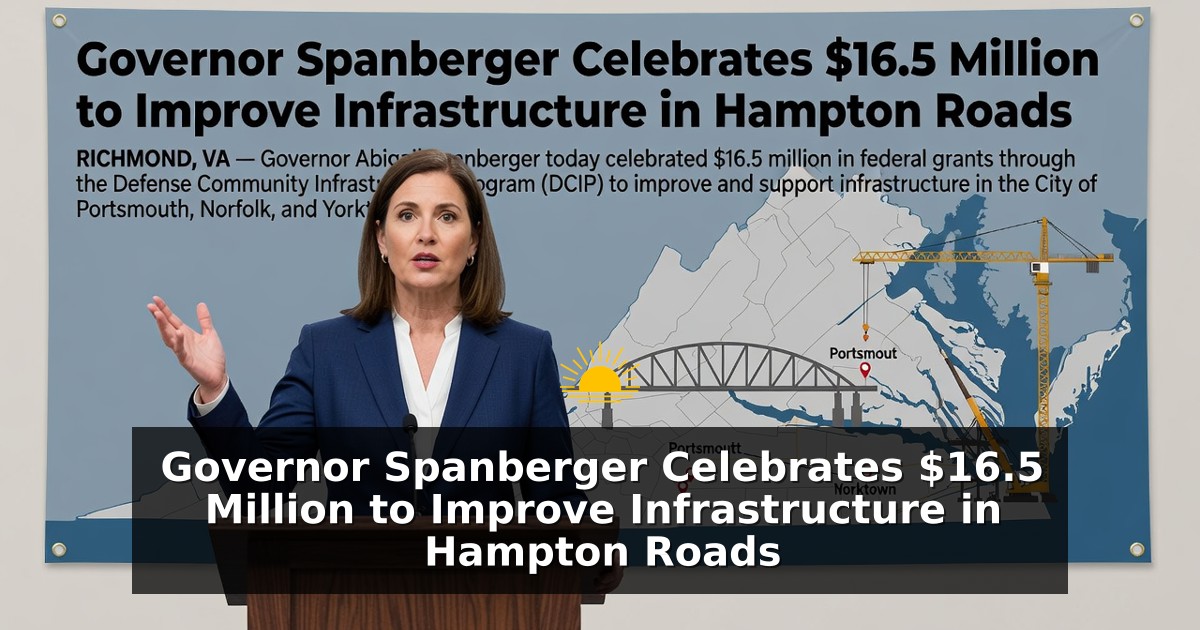
RICHMOND — Virginia’s military communities in Hampton Roads are set to see a fresh round of infrastructure upgrades after Gov. Abigail Spanberger highlighted $16.5 million in federal Defense Community Infrastructure Program grants aimed at sewer, wastewater, and pedestrian projects tied to major installations in the region.
The awards, announced through the Defense Community Infrastructure Program, or DCIP, are designed to fund off-base community projects that support installation readiness, mission assurance, and quality of life for service members and their families. Spanberger’s office said the Commonwealth helps localities compete for the money by sharing up to half of the required federal match through the Virginia Military Community Infrastructure Grant Program. With state and local matching dollars layered on, officials estimate the package will support about $23.5 million in total infrastructure work.
“Reliable infrastructure is essential to the quality of life of our military communities,” Spanberger said. She framed the grants as both a practical investment in pipes and crossings and a signal that Virginia intends to keep pressing federal partners to sustain the Commonwealth’s large military footprint.
Secretary of Veterans and Defense Affairs Timothy P. Williams called the awards a reminder of how closely local systems and base missions are linked. “These investments demonstrate our shared focus on meeting the needs of military communities across the Commonwealth,” he said.
U.S. Rep. Bobby Scott, whose district includes much of the affected corridor, pointed back to Congress’s creation of DCIP in 2019 as a tool for state and local governments dealing with infrastructure around military installations. He said the Hampton Roads awards would help improve sewer infrastructure connected to Naval Station Norfolk, upgrade water infrastructure in Portsmouth, and build a pedestrian crosswalk in partnership with Joint Base Langley-Eustis.
The largest slice — about $13.1 million — is directed to the Hampton Roads Sanitation District for a sewer improvement project in partnership with Naval Station Norfolk. The City of Portsmouth is lined up for roughly $3 million to upgrade wastewater infrastructure tied to Naval Support Activity Hampton Roads. York County is set to receive about $313,000 for a pedestrian crosswalk project developed with Joint Base Langley-Eustis.
Those dollar figures matter in a region where aging utility networks, stormwater pressure, and daily base traffic collide. Sewer and wastewater upgrades are rarely glamorous, but they sit underneath everything from housing off base to the reliability of industrial and medical facilities that serve sailors, airmen, and Marines. A crosswalk project may look small beside multimillion-dollar utility work, yet pedestrian safety around installation gates and training corridors is a recurring quality-of-life complaint for families who live and work near the fence line.
Hampton Roads remains one of the densest concentrations of Navy and joint force activity in the country, and local governments have long argued that federal missions create infrastructure demands that local ratepayers cannot carry alone. DCIP was built for that gap: community projects that are not inside the wire but still affect readiness if they fail. Virginia’s match program is meant to keep smaller localities competitive when federal scoring rewards projects that already have skin in the game.
Spanberger’s announcement also landed against a separate Navy signal that the region’s mission set continues to evolve. Last week the Navy said a new unmanned Warfighting Development Center will be based at Joint Base Little Creek-Fort Story in Virginia Beach and Norfolk. State officials say that mission is expected to bring tens of millions of dollars in direct, indirect, and induced economic activity to Hampton Roads and the Commonwealth — another reminder that infrastructure capacity and new warfare concepts are being planned on overlapping timelines.
For residents, the near-term questions are practical: when construction starts, how long streets and utility corridors will be disrupted, and whether rate structures change as regional authorities finance their share. For base commanders and city managers, the test is coordination — making sure civilian projects land in the same planning windows as installation needs rather than arriving years late.
Virginia’s pitch has been consistent across administrations of both parties: the Commonwealth will keep asking Washington for installation-adjacent investment, and it will put state money on the table to help localities clear federal match hurdles. The $16.5 million DCIP package is one more chapter in that argument. Whether the full $23.5 million in combined work stays on schedule will depend on procurement, local engineering capacity, and how quickly federal and state dollars move from announcement to shovel.
Service members and neighbors in Portsmouth, York County, and the broader Hampton Roads corridor will judge the program less by the ribbon-cutting language and more by whether the sewer lines, wastewater systems, and crosswalks actually improve daily life around the bases that define the region’s economy and identity.
Email the Norfolk City Council:
Kenneth Alexander, mayor@norfolk.gov,
Martin Thomas, martin.thomas@norfolk.gov,
Courtney Doyle, courtney.doyle@norfolk.gov,
Mamie Johnson, mamie.johnson@norfolk.gov,
John Paige, john.paige@norfolk.gov,
Thomas Smigiel, thomas.smigiel@norfolk.gov,
Jeremy McGee, jeremy.mcgee@norfolk.gov,
Carlos Clanton, carlos.clanton@norfolk.gov,
Virginia Beach City Council:
Robert Dyer, mayorsoffice@vbgov.com,
Michael Berlucchi, mberlucc@vbgov.com,
Stacy Cummings, stcummings@vbgov.com,
Barbara Henley, bhenley@vbgov.com,
David Hutcheson, dhutcheson@vbgov.com,
Cal Jackson-Green, cjacksongreen@vbgov.com,
Robert Remick, wremick@vbgov.com,
Amelia Ross-Hammond, arosshammond@vbgov.com,
Jennifer Rouse, jvrouse@vbgov.com,
Joashua Schulman, jschulman@vbgov.com,
Rosemary Wilson, rcwilson@vbgov.com,
Group email: CityCouncil@vbgov.com,
Email Abigail Spanberger at:
abigail.spanberger@governor.virginia.gov
Abigail Spanberger Norfolk Portsmouth Richmond Virginia Virginia Beach York County Abigail Spanberger Amelia Ross-Hammond Barbara Henley Bobby Scott Cal Jackson-Green capacity Carlos Clanton City commonwealth communities community Congress construction coordination Courtney Doyle critical David Hutcheson Department development district economy Families fund funding Governor Grants Hampton Hampton Roads Housing Jennifer Rouse Jeremy McGee Joashua Schulman John Paige Kenneth Alexander Land localities Mamie Johnson Martin Thomas Michael Berlucchi money move nation National Security needs Norfolk Norfolk City Council Portsmouth Press Release procurement program project projects readiness remains requirements residents Richmond Robert Dyer Robert Remick Rosemary Wilson Scott service service members Stacy Cummings state systems Thomas Smigiel Traffic training value Veterans Virginia Virginia Beach Virginia Beach City Council Water York County