Virginia Bill Seeks to Classify Solar Power as Agricultural Use for Farmers
Updated
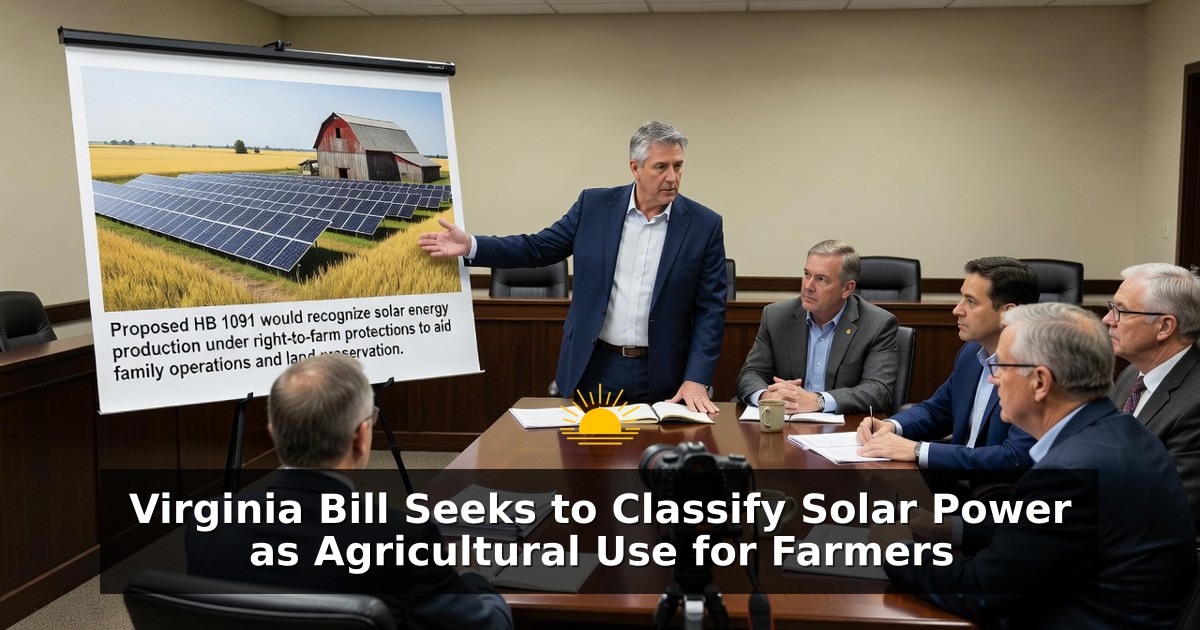
Virginia legislators are examining a proposal that would formally recognize solar energy production as an agricultural use under state law. House Bill 1091, introduced by Delegate Lawfer, aims to incorporate solar generation into the existing right-to-farm code sections. The measure would permit farmers to produce solar power on their property at the same time they continue traditional activities such as growing row crops or raising livestock. Proponents indicate the change would leave ultimate decisions about land harvest and use in the hands of the farmers themselves rather than external pressures.
Family farms across the Commonwealth have faced mounting economic strain in recent years from multiple directions. Rising operational costs for fuel, fertilizer, equipment, and labor have squeezed profit margins for many operators. Volatile commodity markets add further uncertainty, making long-term planning difficult for multi-generational operations. At the same time, expanding residential and commercial development has increased land values and created incentives for owners to sell acreage that has remained in agricultural production for decades. HB 1091 seeks to address these combined pressures by opening an additional revenue pathway that keeps land classified as agricultural.
Financial Relief Through Dual-Use Land Practices
One primary goal outlined for the legislation is the provision of financial relief to working farms. By allowing solar installations to operate alongside conventional farming, owners could generate steady income from energy production without abandoning crop or livestock enterprises. This dual approach, sometimes discussed in broader agricultural policy circles as agrivoltaics, has gained attention as a method for diversifying farm revenue streams. Supporters of the bill argue that such income could help offset periods of low crop prices or unexpected expenses, thereby lowering the risk of bankruptcy or forced sales. The proposal emphasizes that farmers would retain control over how much land, if any, is devoted to solar arrays while maintaining core agricultural functions.
Preservation of agricultural land forms the second major benefit highlighted in discussions of HB 1091. When farmland is sold for residential subdivisions or other non-farm development, it is typically removed permanently from food and fiber production. Recognizing solar energy as an agricultural activity could help keep parcels under the agricultural use category for tax and zoning purposes. This classification matters because it supports the continuity of farming communities and the open-space character of rural Virginia localities. The bill frames solar generation as compatible with, rather than a replacement for, traditional practices, aiming to reduce the conversion of productive soils to other purposes.
Alignment with State Energy and Farming Goals
Virginia has pursued expanded clean energy capacity in recent policy cycles while also maintaining a strong agricultural sector that contributes significantly to the state economy. HB 1091 positions itself at the intersection of these priorities by enabling on-farm solar that contributes to broader electricity needs. Farmers could participate in energy markets without exiting agriculture entirely, creating a pathway that supports both household income and statewide power goals. The legislation would place solar production explicitly within right-to-farm protections, which historically shield legitimate agricultural operations from certain nuisance claims and local restrictions. Extending those protections is intended to give operators greater certainty when considering solar as one component of their overall land management strategy.
Right-to-farm statutes in Virginia already cover a range of conventional activities involving crops, livestock, and related practices. Adding solar energy production to that framework would clarify that concurrent generation of electricity does not automatically change the fundamental agricultural character of the property. This clarity could prove useful in local land-use discussions where questions sometimes arise about whether energy installations remain consistent with farming designations. The bill does not mandate any particular technology or scale; instead, it focuses on definitional recognition so that participating farmers can make site-specific choices suited to their soils, topography, and business plans. Observers note that such flexibility is important because farm sizes, crop mixes, and energy needs vary widely across the state’s diverse regions.
Broader Context for Agricultural Adaptation
Agricultural economists and extension specialists have documented the challenges confronting smaller and mid-sized farms nationwide, including those in Virginia. Input cost inflation, labor availability, weather variability, and competition for land all factor into decisions about whether to continue operations or exit the sector. Additional income options that do not require full conversion of acreage can extend the economic life of family-held properties. HB 1091 is presented as one tool among others that could help owners weather these conditions while still contributing to food production and rural employment. The measure underscores the principle that farmers themselves should determine the mix of activities on their land, including the option to harvest sunlight for electricity in addition to conventional harvests.
Implementation details would depend on further legislative refinement and any subsequent regulatory guidance. Questions about interconnection standards, lease arrangements with energy developers, and compatibility with existing conservation easements often arise in similar policy conversations. The core concept advanced by Delegate Lawfer remains the statutory recognition of solar as an agricultural use so that it falls under right-to-farm provisions. This step is intended to reduce ambiguity and support voluntary adoption by interested landowners. If advanced, the bill would join a growing set of state-level discussions examining how renewable energy and working lands can coexist productively.
In rural communities where agriculture remains a foundational economic and cultural activity, measures that expand viable options without compelling land-use change carry particular weight. HB 1091 addresses the twin objectives of farm viability and land retention by treating solar generation as compatible with ongoing crop and livestock enterprises. The proposal reflects an acknowledgment that farming practices evolve and that statutory definitions may need periodic updating to match contemporary opportunities. By focusing on farmer choice and dual-use potential, the legislation seeks to reinforce the long-term presence of working farms across Virginia while contributing to energy supply diversity. Continued examination of the bill will clarify its precise scope and any necessary safeguards for soil quality, visual impacts, or decommissioning responsibilities.
The discussion surrounding HB 1091 illustrates the complex balance many states are attempting to strike between energy transition objectives and the protection of agricultural heritage. Family operations that can access supplemental revenue are better positioned to resist development offers that permanently remove land from production. At the same time, carefully sited solar capacity on farms can feed into regional power needs without requiring large greenfield industrial sites. Neutral observers will watch how the measure progresses through the legislative process and whether it ultimately delivers the financial and preservation outcomes described by its sponsor. The underlying facts center on giving Virginia farmers a defined legal pathway to integrate solar production into their existing agricultural enterprises under right-to-farm protections.
agricultural land agricultural use Bankruptcy energy needs family farms farmer decisions farmers financial distress financial relief HB income land sales land use livestock preservation residential developers right to farm rising costs row crops solar energy solar production traditional practices Virginia volatile markets