Henrico Teachers and Parents Confront School Board Over Sweltering Classrooms and HVAC Failures
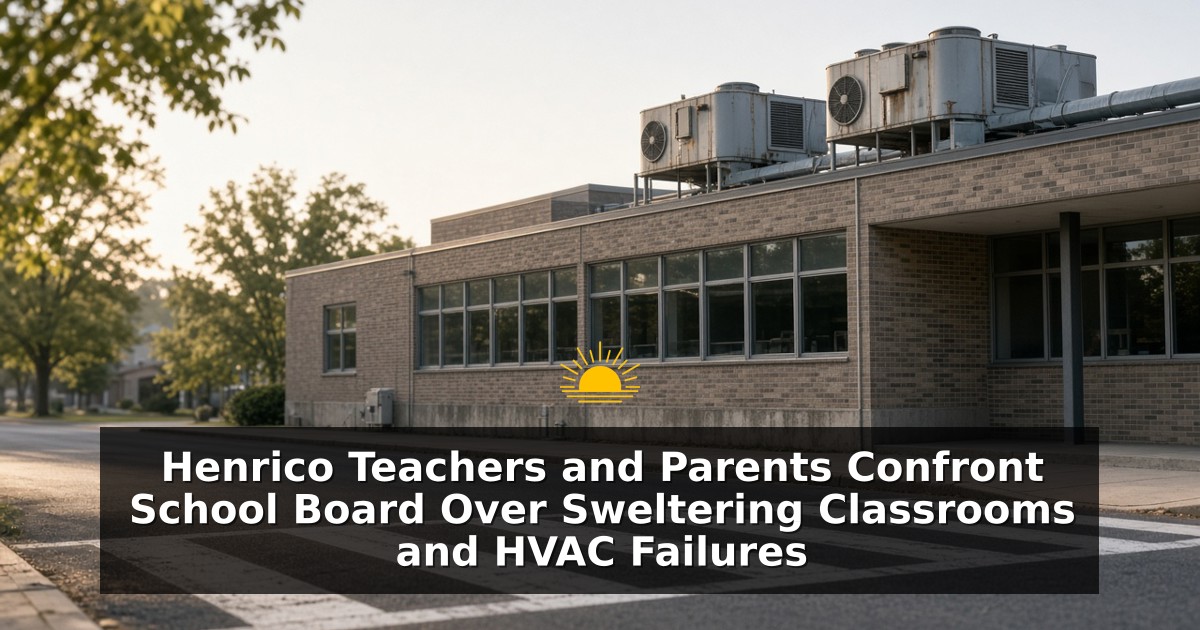
HENRICO — Teachers and parents packed a Henrico County School Board meeting Thursday night to demand accountability for failing HVAC systems that have left classrooms sweltering near 85 degrees with fans roaring over lessons — a facilities crisis speakers said media coverage finally forced into public view after a year of complaints.
Lauryn Galloway, a five-year Henrico teacher, told the board and superintendent that urgency appeared only after television cameras “pulled the curtain back.” She said the problem has been poorly handled for a year and that trust cannot return until leaders admit that record. “Have you sat in the front office, the cafeteria, the gym?” Galloway asked. “Have you taken your laptop, sat in those rooms for eight hours a day and tried to get anything done?” She described portable coolers sounding like freight trains, twenty-five bodies in a room, and temperatures still stuck at 85.
Galloway also said heating has been inconsistent for years, meaning the same work-order backlog will haunt winter if summer’s air-conditioning failures are any guide. Emily Lancaster, named Teacher of the Year at her school, framed HVAC as a symptom of broader disrespect — oversized classes, behavior support gaps, literacy curriculum fights, and fear of retribution when teachers speak. She recounted being assaulted by a student two weeks earlier while waiting for administrators, tying safety and facilities into one accountability demand.
Parents rejected a recent division video meant to address HVAC problems, calling it thin on transparency and urgency. Jessie Walsh, a Henrico parent married to an HVAC master technician, asked why the division has not pulled parts from local supply houses to accelerate repairs when hundreds of students are affected. Multiple fans in a classroom, she said, turn lessons into papers flying through hot air — conditions she argued should be unacceptable for a large suburban division that brands itself a leader.
Speakers pressed the board to post a daily public audit trail of every HVAC repair with timestamps until every classroom unit is fixed. With outdoor temperatures beginning to fall, community members said they will keep returning until documentation matches promises. The demand is as much about governance culture as thermostats: parents want a work-order system they can verify without waiting for the next news investigation.
Henrico’s facilities stress lands in a county that simultaneously touts data-center tax windfalls and ambitious capital plans. Residents hearing $60 million of server revenue steered to first-time homebuyer aid ask why classroom cooling lagged. School officials face the classic suburban bind — aging mechanical plants, specialty technician shortages, and procurement rules that slow emergency parts runs even when local wholesalers have inventory.
Teachers describe instructional damage that does not show on Standards of Learning scorecards until months later: shortened lessons, more outdoor or hallway relocations, and students with asthma or heat sensitivity sent home. Assistant principals become logistics managers hunting working rooms. Custodial staff juggle temporary coolers that themselves fail under continuous load.
Board members who offer “performative positivity,” in Galloway’s phrase, will find that vocabulary exhausted. What the podium wants is a dated punch list, school-by-school completion percentages, and an explanation of why local HVAC supply channels were not mobilized earlier. Superintendents elsewhere in Virginia have published live dashboards after mold or HVAC scandals; Henrico speakers explicitly asked for that model.
Winter adds stakes. If heating loops share the same deferred-maintenance backlog, January cold snaps could invert the politics from “too hot to teach” to “too cold to keep kids in the building.” That prospect is why parents said they will not accept a seasonal fade-out of attention once September headlines cool.
Labor climate matters too. Teacher-of-the-year testimony about assault and retribution fear signals a workforce that links facilities neglect to voice suppression. Divisions that ignore that linkage often rediscover it in resignation numbers by spring.
All Virginia News will follow whether Henrico posts the daily repair audit speakers demanded and how quickly classroom temperatures return to a teachable range. For now, Thursday’s meeting made clear that fans and freight-train coolers are no longer an internal facilities footnote — they are a public trust test for the school board.
Email the Henrico County Board:
Dan Schmitt, brookland@henrico.gov,
Roscoe Cooper III, fairfield@henrico.gov,
Misty Roundtree, threechopt@henrico.gov,
Jody Rogish, tuckahoe@henrico.gov,
Tyrone Nelson, varina@henrico.gov,
Email the Henrico County School Board:
Kristi Kinsella, kbkinsella@henrico.k12.va.us,
Ryan Young, reyoung@henrico.k12.va.us,
Madison Irving, mtirving@henrico.k12.va.us,
Marcie Shea, mfshea@henrico.k12.va.us,
Alicia Atkins, asatkins@henrico.k12.va.us,
Henrico County Ali Faruk Alicia S. Atkins Anne Holton Cheryl Burke Dan J. Schmitt Data Emmett Jafari Henrico County Henrico County Board of Supervisors Henrico County School Board Jody K. Rogish Kathryn Ricard Kids Kristi B. Kinsella Labor Madison Irving Marcie F. Shea Matthew Percival Misty D. Roundtree Mold Parents Politics Repairs Richmond School Board Roscoe D. Cooper III Ryan Young School School Board Shavonda Fernandez Stephanie Rizzi Teachers Tyrone E. Nelson Video Virginia Wesley Hedgepeth