Virginia Civil Subcommittee Weighs Broader Digital Replica Protections
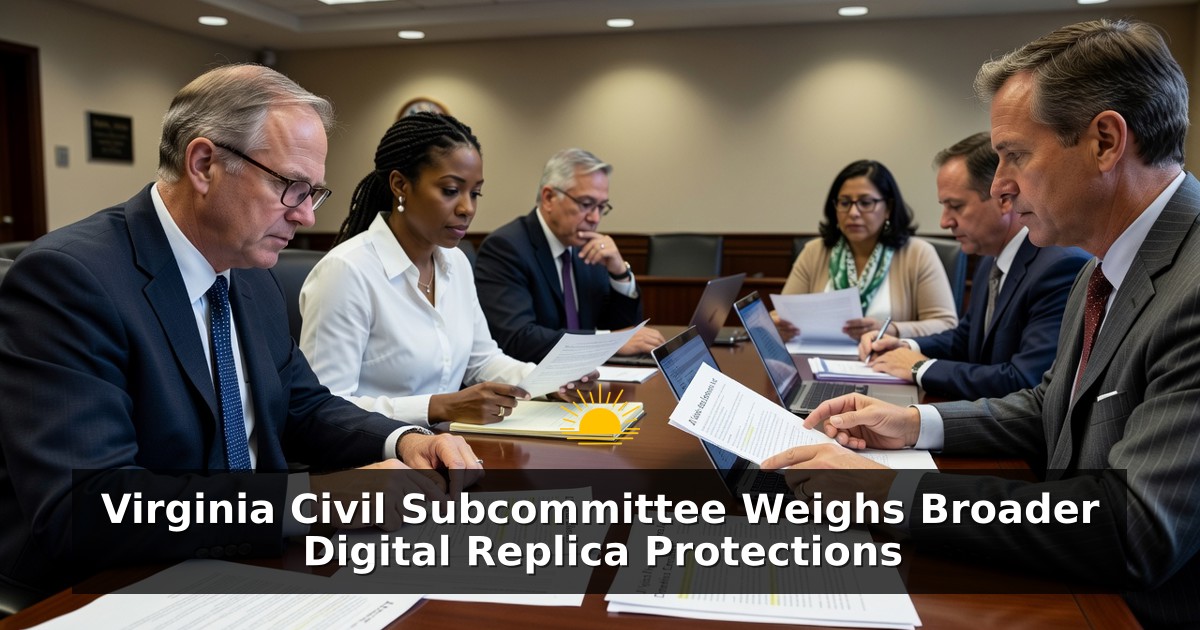
Virginia lawmakers on a Civil Subcommittee are reviewing a pair of legislative proposals that address the growing use of digital replicas of a person’s voice or likeness. The measures focus on synthetic media created with artificial intelligence and the civil liability that can arise when such replicas are produced, distributed, or made available without authorization. One bill takes a more targeted approach centered on AI-involved synthetic media, while the second incorporates those same core provisions and then expands the scope of protections substantially. Officials noted that the two bills are not inconsistent with each other; the broader measure simply includes everything contained in the narrower one and adds further safeguards.
Digital replicas have become a practical concern as generative AI tools make it easier to recreate a person’s appearance or voice with striking realism. These technologies can be used for entertainment, education, or commercial purposes, yet they also raise questions about consent, reputation, and economic control over one’s identity. The subcommittee discussion centered on how Virginia statute should define the protected interest and what remedies should be available when a replica is misused. By framing the issue in terms of synthetic media, the legislation seeks to give clear notice to creators, platforms, and distributors about the boundaries of lawful use.
Core Definitions and Civil Liability
The narrower bill defines a digital replica primarily through the lens of synthetic media in which artificial intelligence plays a material role in reproducing a person’s voice or likeness. Under that approach, civil liability attaches to any person who produces, distributes, or makes available such a replica in violation of the statute. The definition is intended to capture modern AI techniques while remaining focused enough to avoid unintended applications to traditional editing or performance work. Supporters of the more limited language argue that a precise definition helps courts and businesses apply the law consistently.
The broader bill adopts the same synthetic-media definition and the same civil-liability framework, then layers on additional protections. Because it fully contains the narrower bill’s text, any conduct that would violate the first measure would also violate the second. The expanded version reaches further by adjusting the duration of the underlying rights and by refining related procedural rules. Subcommittee members observed that the two proposals can advance side by side without creating conflicting obligations for the public or for state agencies.
Civil liability under both measures is designed to give injured parties a private right of action rather than relying solely on criminal enforcement. A person whose voice or likeness is replicated without consent could seek damages or injunctive relief against those who produce or circulate the material. The inclusion of distribution and “making available” language is meant to cover online platforms and file-sharing services as well as original creators. Clear liability rules are expected to encourage voluntary compliance and the development of industry best practices for obtaining licenses or releases.
Duration of Rights and Statute of Limitations
One notable difference between the bills concerns the length of time the protected interest endures. The broader proposal changes the set of limitations from a shorter period, described in discussion as twenty years, to a one-hundred-year period. This extension would apply to the post-mortem right of publicity or similar interest that survives the individual. Longer protection periods are already found in several other states and are often justified by the continuing commercial value of a well-known person’s identity long after death.
At the same time, the statute of limitations for bringing a claim remains twenty years in the bill under review. That limitations period governs how long a plaintiff may wait after an alleged violation before filing suit. Keeping the statute of limitations at twenty years while lengthening the underlying right creates a stable window for enforcement without indefinitely exposing defendants to stale claims. Drafters appear to have separated the duration of the substantive right from the procedural deadline for litigation so that each can be calibrated independently.
The decision to retain a twenty-year statute of limitations reflects a balance between the interests of rights holders and the need for repose in the legal system. Potential defendants, including technology companies and content platforms, gain a measure of certainty about when exposure ends. Plaintiffs, meanwhile, still have a substantial period in which to discover misuse and gather evidence. Subcommittee participants indicated that these temporal provisions can be adjusted in future sessions if practical experience shows they are either too short or too long.
Compatibility of the Two Measures
Because the broader bill includes every element of the narrower bill, the two are described as fully compatible. Enactment of the more expansive version would automatically satisfy the policy goals of the narrower version. Conversely, if only the narrower bill advanced, the core AI-focused liability rules would still take effect. This nesting relationship gives the General Assembly flexibility: it can choose a measured first step or a more comprehensive package without having to reconcile contradictory language.
Legislative staff emphasized that the bills address the same underlying problem—unauthorized digital replicas—and simply differ in how far they extend the remedy. The narrower bill concentrates on contemporary synthetic-media techniques and immediate civil accountability. The broader bill retains that focus while also modernizing the length of protection and related limitations language. Nothing in either text was said to cancel or undermine provisions in the other.
Practical Implications for Virginians
If adopted, the legislation would give Virginia residents clearer tools to control commercial and other uses of their digital likenesses. Performers, athletes, private citizens, and the estates of deceased individuals could all benefit from explicit statutory rights and a defined enforcement path. Businesses that develop or host AI-generated content would gain clearer compliance standards, reducing the risk of inadvertent violations. Educational institutions and news organizations would likewise have guidance on when a replica crosses the line into actionable misuse.
The measures also signal Virginia’s intent to keep pace with rapid technological change. As generative AI continues to lower the cost and skill required to create convincing replicas, state law is being updated to preserve the traditional right of individuals to control their own identities. By anchoring liability in production, distribution, and availability, the bills reach the full chain of actors who can cause harm. The extended post-mortem period in the broader bill further recognizes that identity can retain value and vulnerability for generations.
Subcommittee review remains focused on refining definitions, ensuring due-process protections, and confirming that the chosen time periods serve both rights holders and the public. Further amendments may still be offered as the bills move through the legislative process. For now, the recorded discussion establishes that one proposal is essentially a complete superset of the other, that civil liability for AI-generated replicas is a shared objective, and that the statute of limitations is deliberately kept at twenty years even while the underlying right may stretch to one hundred.
Virginia’s consideration of these digital-replica bills places the Commonwealth among jurisdictions actively updating publicity and privacy law for the age of synthetic media. The outcome will determine how readily individuals can challenge unauthorized uses of their voices and likenesses and how long those protections endure. Continued neutral examination of both the narrow and the expansive approaches will help ensure that final legislation is clear, enforceable, and proportionate to the interests at stake.
additional liability AI bill Bills civil liability digital replica distributes includes all inconsistent likeness limitations makes available person's likeness person's voice produces statute of limitations synthetic media two bills voice