Loudoun Student Urges School Board to Block Power Lines Near Campuses
Updated
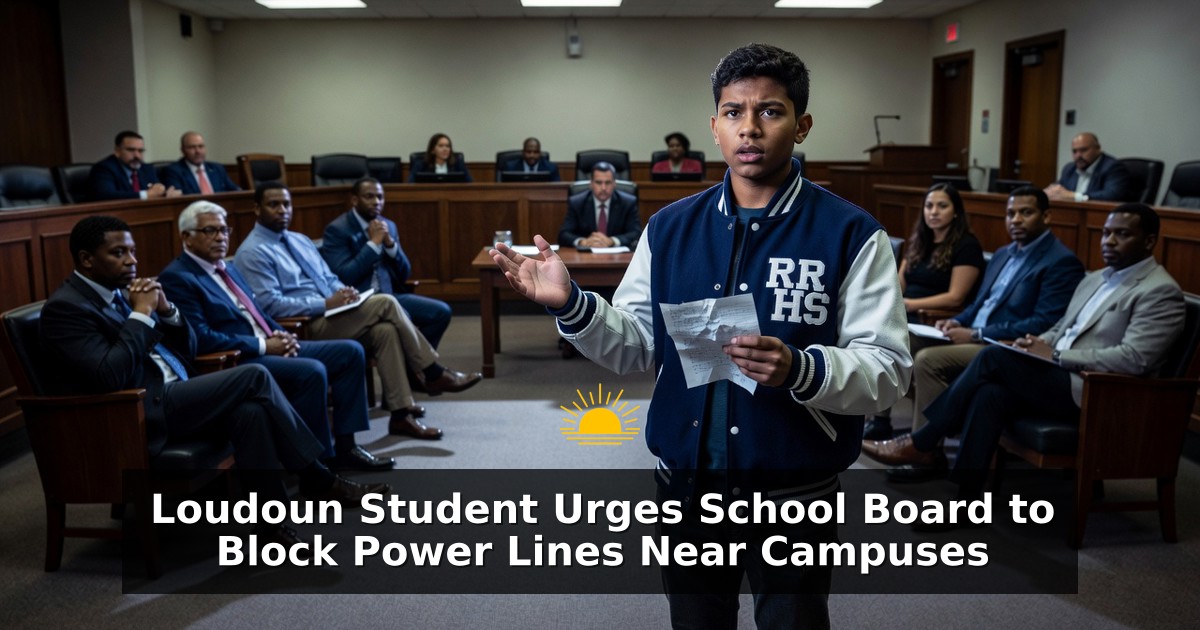
A Rock Ridge High School student addressed the Loudoun County School Board at its meeting in Leesburg on January 28, 2026, calling on members to stand by their original vote against certain high-voltage power line routes. The student, Ritanova, warned that proposed 500-kilovolt transmission towers along several paths would harm schools, nearby communities and recreation centers for years to come. The session had been rescheduled from the prior day and also included chair nomination remarks that underscored the value of nonpartisan service to students. Ritanova urged the board to select Route 1F instead, describing it as the option that best protects educational sites while preserving the environment and serving residents more effectively.
The Loudoun County School Board consists of Melinda Mansfield, Lauren Shernoff, Anne Donohue, April Chandler, John Beatty, Sumera Rashid, Carrie Nielson, Erika Ogedegbe and Mandi Hedges. These members represent the county’s eight magisterial districts plus an at-large seat and hold responsibility for safeguarding school property and learning conditions. During public comment, Ritanova stressed that the board’s decision carries lasting weight because infrastructure choices made now will shape daily life for thousands of students across successive graduating classes. Officials listened as the student linked the transmission proposal directly to the quality of educational environments throughout the county.
Student Testimony Highlights Immediate Risks
Ritanova opened by identifying as a Rock Ridge High School student and stating the purpose of the appearance was to reinforce the board’s earlier position. The student explained that Routes 2, 3 and 4 would affect far more than open land, placing heavy infrastructure beside schools, neighborhoods and recreation facilities. Transmission towers operating at 500 kilovolts, the student said, simply have no appropriate place beside campuses or community gathering spots where children spend their days. By contrast, Route 1F was presented as the alignment that avoids those sensitive locations, limits environmental disruption and still meets broader service needs.
The testimony further noted that county-level statements had already signaled an unwillingness to defend school-board-owned property or to contest Route 3 and its variations. That stance, Ritanova argued, elevates the school board’s own responsibility to act decisively. Without a firm position from the board, the long-term consequences would settle on students who attend affected schools year after year. The student closed by thanking the members for their time and reiterating that a single decision taken at the present meeting could produce an enormous positive impact for local communities.
Context of Transmission Planning in Loudoun County
Loudoun County continues to experience intense demand for electric capacity driven by commercial growth, particularly data-center development that requires robust transmission infrastructure. Utility planners have examined multiple corridor options to deliver reliable power while attempting to minimize conflicts with existing land uses. Some of the studied paths pass near residential zones, parks and public-school campuses, prompting sustained public discussion about health, safety, aesthetics and property values. School officials have previously weighed in on the need to keep major utility corridors away from instructional buildings and outdoor student areas.
Independent reviews of similar 500-kilovolt projects elsewhere in Virginia have documented concerns ranging from electromagnetic-field exposure questions to construction disruption and permanent visual impacts. Local recreation centers and school grounds often serve as primary outdoor spaces for families, making proximity to large towers a recurring point of contention. Route-evaluation documents typically score alternatives on criteria that include length, cost, environmental features and community effects; advocates for Route 1F contend that this option scores more favorably on the community-protection measures that matter most to educators and parents. The school board’s role remains distinct from that of the county governing body, focusing squarely on the welfare of students and the integrity of school sites.
Implications for Students and Future Governance
Educational leaders across Virginia have repeatedly observed that infrastructure decisions can lock in conditions that either support or hinder learning for decades. Crowding high-voltage equipment against school boundaries can complicate outdoor instruction, limit expansion possibilities and generate ongoing parental anxiety. Ritanova’s appearance illustrated how students themselves are monitoring these planning processes and expect elected school officials to treat campus protection as a core duty. The emphasis placed on nonpartisan conduct during the same meeting’s chair nomination discussions reinforced the expectation that board actions should rest on student-centered evidence rather than external political pressures.
Observers note that once transmission towers are erected, relocation becomes technically difficult and financially prohibitive, underscoring the importance of route selection at the approval stage. By urging rejection of the more intrusive options and endorsement of Route 1F, the student framed the choice as an investment in generational equity. Board members now face the task of translating public comment, prior votes and available technical data into a clear official position that county and utility decision-makers cannot ignore. The outcome will likely influence how future infrastructure proposals near schools are evaluated throughout Northern Virginia.
Balancing Energy Needs with Educational Priorities
Virginia’s overall energy strategy acknowledges the necessity of expanded transmission to maintain grid reliability amid rising load growth. At the same time, state and local policies encourage early coordination with school systems so that educational facilities are treated as sensitive receptors rather than residual land uses. The Loudoun County School Board’s engagement supplies a formal channel for inserting student-safety considerations into that larger conversation. Continued monitoring of route refinements, environmental impact assessments and any revised county positions will remain essential in the months ahead.
Ritanova’s concise appeal distilled a complex planning debate into a straightforward request: keep massive transmission structures away from the places where children learn and play. The board’s forthcoming actions will demonstrate whether that request receives the institutional weight the student sought. Residents, parents and subsequent student cohorts will measure the result by the physical landscape that ultimately surrounds Loudoun’s public schools. Clear documentation of the board’s stance, grounded in the original vote and the protective rationale for Route 1F, can help sustain public confidence in local education governance for the long term.
advocates against community impact Education High I'm Lines Loudoun County Near Power power lines Ritanova Rock Ridge High School Route 1F safety School School Board Schools Senior student advocacy
