Virginia Subcommittee Advances Bills on School Zones, Vehicle Suspensions and Texting Alternatives
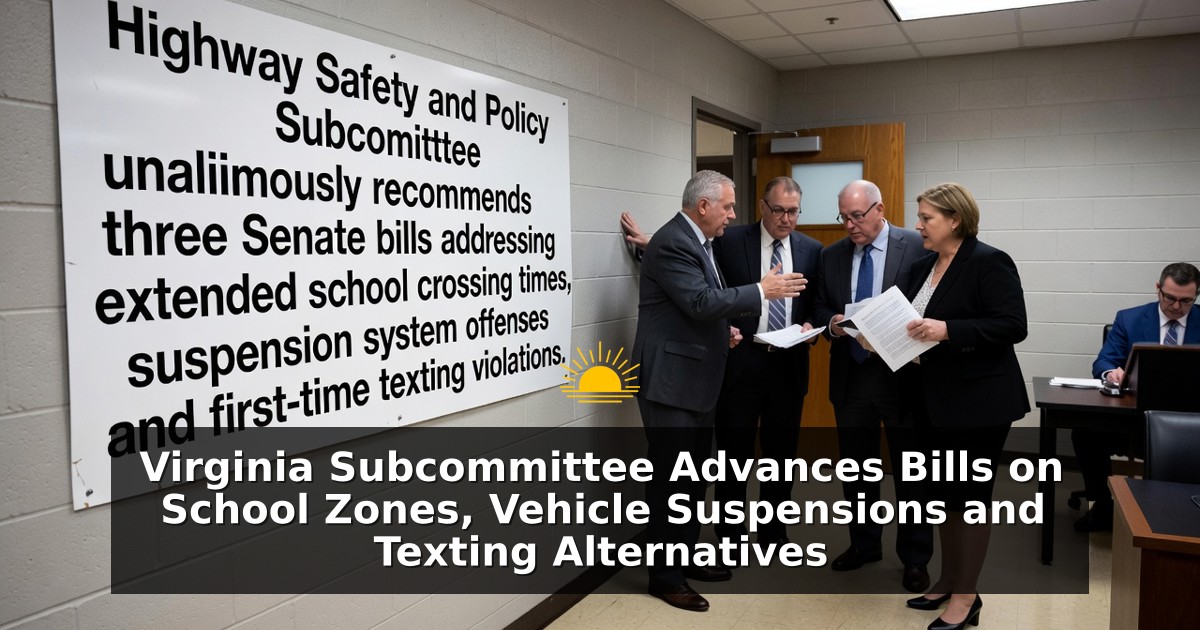
The Highway Safety and Policy Subcommittee has unanimously recommended three Senate bills for further consideration, focusing on measures intended to enhance roadway protections around schools, clarify enforcement of vehicle modification rules and provide educational options for certain distracted driving offenses. The panel's report highlighted Senate Bill 221, Senate Bill 426 and Senate Bill 686 as priorities advancing with full consent from members. These proposals address distinct aspects of traffic safety and compliance under Virginia law. Officials presented the measures during a recent session dedicated to reviewing highway-related legislation. The recommendations now move the bills toward broader legislative review.
Senate Bill 221 centers on school crossing zones and the authority granted to local governments. Current standards typically limit the heightened protection period to 30 minutes before and after regular school hours. The legislation would authorize a local governing body, acting by ordinance, to extend that window to 60 minutes on either side of the school day. Supporters of similar past measures have noted that longer transition periods can better accommodate varying bus schedules, after-school programs and parent pickup patterns. The change would remain optional at the local level rather than a statewide mandate. This approach allows communities to tailor protections based on specific traffic patterns near schools.
Extended school zone times carry implications for both drivers and local enforcement agencies. Motorists would face reduced speed limits and heightened penalties for violations during the longer designated periods if a locality adopts the ordinance. Research on school zone safety consistently shows that lower speeds reduce the severity of collisions involving pedestrians, particularly children. Virginia already maintains strict rules on speeding in these areas, and an expanded timeframe could increase the number of hours during which those rules apply. Local governments would need to post updated signage and coordinate with school administrators to implement any change effectively. The bill leaves the decision and any associated costs to individual jurisdictions.
Vehicle equipment standards form the core of Senate Bill 426, which addresses alterations to suspension systems. Virginia law restricts certain modifications that can affect vehicle height, handling and headlight alignment. Under the proposed measure, courts would gain explicit authority to dismiss related offenses when a defendant provides proof of subsequent compliance. This provision aims to encourage corrective action rather than solely punitive outcomes for owners who bring their vehicles back into legal condition. Enforcement of suspension rules often arises during traffic stops or safety inspections. The bill seeks to balance regulatory goals with practical pathways for resolution once violations are remedied.
Automotive safety experts have long linked improper suspension alterations to increased rollover risk and compromised braking performance. Lowered or excessively raised vehicles can also create visibility problems for other road users. By allowing dismissal upon demonstrated compliance, the legislation may reduce court backlogs while still promoting adherence to equipment standards. Vehicle owners would still face the initial citation and any associated requirements to appear or respond. Documentation of repairs or adjustments would become central to resolving the case. The unanimous subcommittee support suggests broad agreement on refining this aspect of the motor vehicle code.
Senate Bill 686 targets first-time violations of Virginia's ban on texting while driving. Instead of an automatic conviction, eligible offenders could attend a driver improvement clinic as an alternative. Successful completion would offer a path that avoids a permanent conviction record for that initial offense. Distracted driving remains a leading contributor to crashes across the Commonwealth, with mobile phone use frequently cited in crash data. Educational programs already form part of Virginia's broader traffic safety strategy through the Department of Motor Vehicles. Expanding access to clinics for texting offenses aligns with efforts to change behavior through instruction rather than solely through penalties.
Driver improvement clinics typically cover topics such as hazard recognition, the effects of distraction and defensive driving techniques. Participants often complete classroom or online sessions followed by testing to demonstrate understanding. For first-time offenders, this option could reduce the long-term consequences that a conviction might impose on insurance rates and driving records. The bill maintains accountability by requiring active participation and successful completion. Repeat offenders would presumably remain subject to standard conviction processes. Lawmakers have previously expanded similar diversion-style options for other moving violations when data supported educational interventions.
Collectively, the three bills reflect ongoing attention to both infrastructure-related protections and individual driver behavior. School zone extensions address environmental and temporal factors that influence pedestrian risk. Suspension system provisions focus on mechanical compliance and court efficiency. The texting alternative emphasizes rehabilitation for an initial lapse in attention. Unanimous recommendations from the subcommittee indicate that members found the proposals sufficiently refined for advancement. Each measure now awaits further scrutiny in the legislative process, including potential amendments and fiscal impact reviews.
Background data on Virginia roadways underscores the relevance of these topics. Pedestrian incidents near schools tend to cluster during arrival and dismissal windows, supporting arguments for flexible timing authority. Equipment violations, while less dramatic than high-speed crashes, contribute to cumulative safety risks when vehicles operate outside design parameters. Distracted driving statistics compiled by state and federal agencies continue to show elevated crash involvement when drivers manipulate electronic devices. Policymakers frequently revisit these categories as technology, traffic volumes and community needs evolve. The current package of bills fits within that pattern of incremental adjustment.
Implementation details will matter once any of the measures become law. Localities choosing to extend school zone hours under Senate Bill 221 would need clear ordinances, public notice and coordination with law enforcement. Courts handling suspension cases under Senate Bill 426 would require standardized methods for verifying compliance proof. The Department of Motor Vehicles or approved providers would need capacity to absorb additional clinic attendees generated by Senate Bill 686. Funding, training and public awareness campaigns often accompany such changes. Monitoring outcomes after enactment would help determine whether the adjustments achieve their intended safety and fairness goals.
Public reaction to highway safety legislation commonly mixes support for stronger protections with concerns about enforcement consistency and personal responsibility. Extended school zones generally receive favorable responses from parents and educators, though some drivers question the practicality of longer restricted periods. Equipment rules can generate debate between safety advocates and vehicle enthusiasts who prefer customization. Alternatives to conviction for texting often draw praise for reducing collateral consequences while still facing criticism from those who prefer stricter deterrence. The subcommittee's unanimous stance suggests the drafts presented struck a workable balance among competing considerations.
As the bills proceed, stakeholders including local governments, school divisions, law enforcement agencies, courts and driver education providers will likely offer additional input. Technical refinements may address signage standards, documentation requirements for vehicle repairs or curriculum specifics for improvement clinics. Fiscal notes will clarify any state or local costs associated with implementation. The legislative calendar will determine the pace of further votes and possible reconciliation with related House measures. Throughout the process, the core facts remain the three distinct policy adjustments endorsed unanimously by the Highway Safety and Policy Subcommittee.
Road safety policy in Virginia continues to adapt through targeted statutory updates rather than wholesale overhauls. The combination of optional local authority, compliance-based dismissal options and educational alternatives illustrates a preference for flexible tools. Each bill addresses a discrete gap or friction point identified in current practice. Continued tracking of crash data, citation patterns and clinic completion rates will eventually reveal the practical effects if the measures are enacted. For now, the subcommittee's report places the proposals firmly on the path for fuller deliberation by the General Assembly.
committee meeting compliance court driver improvement clinic Highway Safety Legislation Policy Subcommittee safety school crossing zones Senate Bill 221 Senate Bill 426 Senate Bill 686 Senator Jones Senator Mulkye Senator Soudaline texting and driving Transportation vehicle suspension Virginia vote
All Virginia News is published by ALL VIRGINIA NEWS, LLC. How we're funded · Corrections · Ethics
