Hindu Art at the Met Gala? It was a Whole Minute!
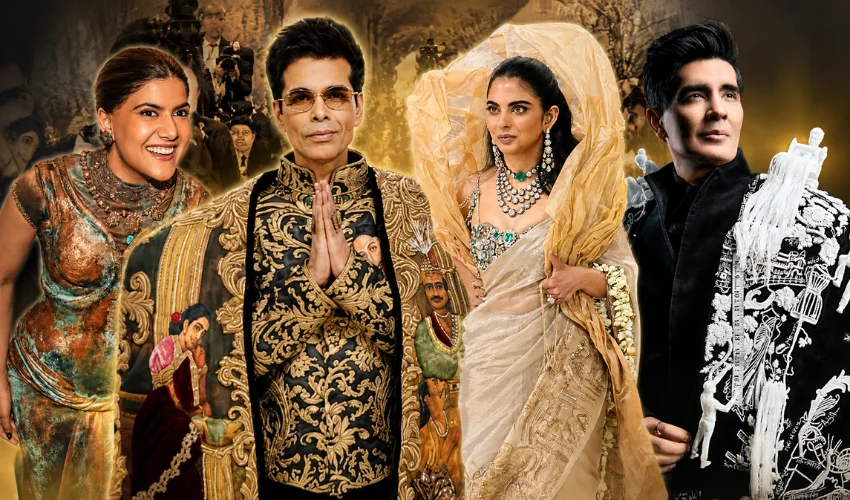
A fashionista brought Raja Ravi Varma iconography. Isha Ambani showed up with pichwai (pizza) from Nathdwara. A maharaja arrived with his Suryavanshi family lineage. Ananya Birla channelled Chola Bronzes.
The theme of this year’s Met Gala was “Fashion Is Art.” It was fascinating to see Hindu artistic tradition make its way onto those iconic steps, from the visual worlds of Raja Ravi Varma and Pichwai to Kalamkari and other Hindu traditions. You probably did too if you grew up with any of these!

Raja Ravi Varma: Make It Met

Manish Malhotra’s six-foot-long hand-painted cape was Karan Johar’s Met Gala debut. It was a walking exhibit of Raja Ravi Varma’s works, the 19th century Kerala artist who translated Hindu epics onto canvas in the European oil tradition and made them available to all households through mass reproduction.

The cape featured Varma’s Krishna Shishtai, the moment from the Mahabharata when Krishna arrives as a peace ambassador at the Kaurava Court and is almost captured; and his Arjuna, Shubhadra and Arjuna, which depicted Arjuna in disguise as a sadhu trying to convince Shubhadra run away with him. Who could miss Damayanti, waiting to hear from her beloved King Nala through a swan’s messenger, or Urvashi, an apsara caught in the middle of leaving King Pururavas?

Kalamkari – Main Character Energy

The ensemble of Sudha Reddy, also by Manish malhotra was a tribute to Telugu arts through Kalamkari. Its central motif is the Kalpavriksha, the wish-fulfilling trees of Hindu cosmology. Around it, there were the Palapitta birds and Tangedu flower associated with Andhra Pradesh’s and Telangana’s Bathukamma Festival dedicated to Goddess Gauri. Jammi Chettu is the shami trees worshipped during Vijayadasami. The Telugu Hindu calendar is based on a cycle of festivals that are marked by sun and moon symbols. This was Kalamkari at its most exquisite temple traditions.


Pichwai x Gajra Moment

Isha Ambani, a businesswoman, had a sari that was full of details. Designed by Gaurav Gupta and woven with pure gold threads by master artisans at Swadesh, the sari’s border may not have caught the attention of the untrained eye; but if you looked closely, you’d notice the gorgeous pichwai work–the devotional cloth paintings made for Shrinathji’s shrine in Nathdwara, Rajasthan–hand-painted by Trilok Prakash Soni. Ambani wore a gajra sculpture (jasmine garland), created by Brooklyn-based artist Sourabh Gaupta, who shaped every flower by hand. Gupta was inspired to create his piece by childhood memories, when his father would bring jasmine flowers every morning to the family’s puja room in Hiranagar. Together, they created the most elevated gajra in recent memory. They were sculpted beautifully to combine devotion and couture.

Just Suryavanshi things

The most interesting detail on the back of Sawai Padmanabh Singh’s Phulghar Velvet Coat, designed by Prabal Guruung, was a mirror sun motif taken from the Sri Niwas Residence at the City Palace, Jaipur. Singh, also known as Pacho is the titular leader of the former Jaipur royal family. The motif is a reference of his Suryavanshi ancestry, marking his descent of Surya, solar deity and the same dynasty of Ram. He completed his look with a Matsya brooch and a Gajraj pin by Raniwala, 1881. Matsya is the first Vishnu avatar, while Gajraj, the elephant king is one of the most enduring Hindu icons of divine power.

Bronze Devi Era

Her jewels by Raniek carried the same reference – drawing from the Shaiva traditions of the Chola dynasties and Hoysalas of southern India. The neckpiece was a map of the Shaiva cosmological system: a yellow stone for Surya, a Paraiba Tourmaline in water-colour in the middle and a cognac for the Deccan soil where their temples still remain.

Birla’s look was a tribute of the artistic legacies left by both dynasties. The Chola workshops were active between the 9th-13th centuries and produced some of most sophisticated devotional items in the world. This includes the Nataraja. Meanwhile, the Hoysala Temples of Karnataka are the most intricately decorated temple surfaces. They were made possible because they were built with chloritic soapstone, a soft soapstone that artisans could carve minute details like a single hair or links of a chain directly into the walls of the temple.

Made by hand, obviously

This year, the presence of Hindu artistic tradition was not just in what was worn but also in how it was created and who was acknowledged during that process.

Mayyur’s gown for Diya Mehta Jatia, designed by Mayyur Jatia, combines two Hindu craft traditions in one garment. The base is Kanjivaram silk from Kanchipuram. This fabric is used for Hindu weddings and temple rituals in South India. Shola-pith from Bengal was layered over it. It is carved into ceremonial crowns for men (topor) and women (mukut). These are used most often during Durga Puja and have been a part of Bengali Hindu rituals for generations.
Designer Manish Malhotra embroidered the signatures of artisans with whom he worked for 35 years on his dramatic cape. Hinduism is a tradition that deeply resonates with this celebration of the craftsman. Shilpa Shastras consider those who work with their hand as sacred practitioners. Every year, artists and traders are at the center of Vishwakarma puja.

Mayuri Mukherjee is a Montreal-based writer who explores Hindu culture, politics and identity. )

Arts DEI Energy Hindu HinduCoalition Politics Power Singh UK Water