Virginia Bill Clarifies 'Shall' as Mandatory Duty in State Law
Updated
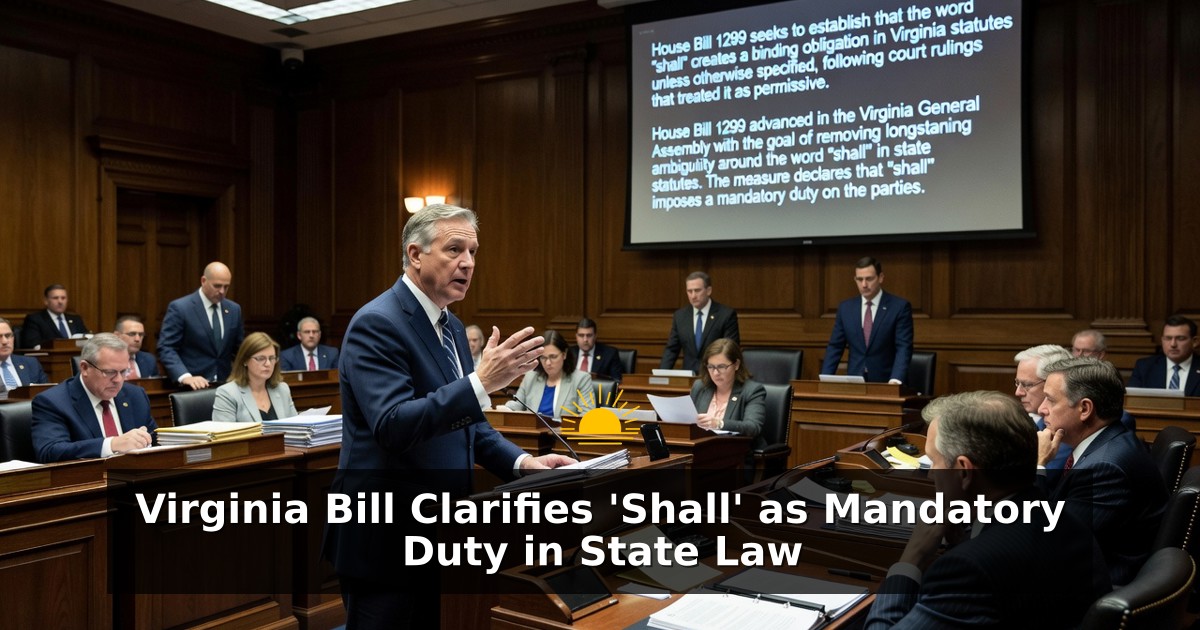
House Bill 1299 advanced in the Virginia General Assembly with the goal of removing longstanding ambiguity around the word shall in state statutes. The measure declares that shall imposes a mandatory duty on the parties or agencies it addresses unless the language of a given statute clearly indicates a different intent. Supporters framed the proposal as a straightforward reaffirmation of legislative precision rather than a sweeping rewrite of the code. The bill responds directly to a series of court decisions that have interpreted shall as merely directory or optional in certain contexts. Those interpretations, according to the bill’s backers, have created uncertainty about what the General Assembly actually requires when it enacts new laws.
Judicial readings of the term have varied for more than two decades. Decisions dating to 2002 began to treat shall as permissive in some circumstances, opening the door for later litigants to argue that compliance was not strictly required. Recent cases have cited those earlier rulings as justification for declining to follow statutory directives that legislators believed were binding. The resulting friction has prompted lawmakers to seek an explicit statutory rule that restores the ordinary mandatory force of the word. Without such clarification, agencies and private parties face inconsistent obligations depending on which court reviews a dispute. The bill therefore aims to supply a uniform default rule that courts and administrators can apply across the code.
Origins of the Legislative Effort
The push for House Bill 1299 grew out of practical experience with enforcement gaps. Lawmakers observed that when courts dilute the force of shall, the careful drafting work of the General Assembly can be undermined. Statutes that use the term to create deadlines, reporting duties, or procedural steps lose reliability if those commands are later deemed optional. The bill’s presentation emphasized that the General Assembly intends its chosen language to be followed exactly as written. At the same time, sponsors acknowledged that decades of code drafting may contain instances in which shall was used less carefully. That recognition led to the decision to route the measure through additional expert review before final enactment.
Sending the proposal to the Virginia Code Commission forms a central procedural feature of the bill. The commission is charged with examining the entire body of existing statutes to identify any unintended consequences that a blanket mandatory rule might produce. Commission staff will catalog provisions in which shall currently appears and assess whether a mandatory reading would disrupt settled administrative practices or create new conflicts. The review process is designed to preserve the General Assembly’s authority to set binding requirements while giving technical experts time to flag problem areas. Once the commission completes its work, lawmakers will have a clearer picture of any necessary conforming amendments. This two-step approach balances the desire for immediate clarity with the practical need to avoid wholesale disruption of the code.
Affirming Legislative Intent and Authority
At its core, the legislation reasserts that the General Assembly holds the primary responsibility for determining the meaning of the laws it passes. When legislators insert shall into a statute, they do so with the expectation that the duty will be performed. Court decisions that convert that expectation into a mere suggestion invert the ordinary hierarchy between the legislative and judicial branches. House Bill 1299 seeks to restore the intended hierarchy by supplying an explicit interpretive rule. The rule is not absolute; it yields whenever a statute itself signals that a different construction is appropriate. That safety valve preserves flexibility for carefully drafted exceptions while establishing a strong default in favor of mandatory effect.
Legal observers note that similar interpretive statutes exist in other jurisdictions and have generally reduced litigation over basic modal verbs. Virginia’s version is tailored to the commonwealth’s own case law history, particularly the line of decisions beginning in 2002. By addressing those precedents head-on, the bill attempts to close a recurring avenue of argument that has been used to avoid statutory compliance. The measure does not attempt to reverse any specific judgment; instead it supplies prospective guidance for future cases and for the day-to-day work of state agencies. Agencies that have relied on permissive readings will need to reassess their practices once the new rule takes effect. The Code Commission’s review is expected to surface those operational questions early so that transition problems can be managed through legislation rather than through further lawsuits.
Practical Effects Across the Code
A mandatory default for shall will touch nearly every title of the Virginia Code. Procurement statutes, environmental permitting timelines, education reporting requirements, and criminal procedure deadlines all employ the term with frequency. Under the bill, each of those uses will carry a presumption of obligation unless surrounding language clearly softens the command. Drafting committees in future sessions will therefore need to choose their modal verbs with heightened care. Where flexibility is genuinely desired, legislators can substitute may or should, or they can add explicit qualifying clauses. The Code Commission’s forthcoming inventory will help identify legacy provisions that may require such softening language. That inventory is also expected to highlight sections in which shall already functions without controversy and can remain unchanged.
Critics of overly rigid interpretive rules sometimes worry that mandatory constructions can produce harsh results in unforeseen circumstances. House Bill 1299 attempts to meet that concern by preserving the escape hatch of clear contrary intent and by subjecting the entire proposal to commission scrutiny. The combination of a strong default rule and a systematic review process is intended to deliver both clarity and caution. Lawmakers who spoke in favor of the bill stressed that the General Assembly must be able to write laws that are followed as written. They simultaneously recognized that precision in one session can create complications years later if earlier usages of shall are not examined. The referral to the Code Commission is therefore presented as a prudent intermediate step rather than a delay tactic.
Broader Context of Statutory Interpretation
Virginia courts have long applied canons of construction that seek to give effect to every word the legislature uses. The line of cases treating shall as directory has sat uneasily alongside that general principle. House Bill 1299 can be understood as a legislative correction that realigns judicial practice with the ordinary meaning of the term. Similar corrections have occurred in other states when appellate decisions drifted from common usage. The Virginia approach is distinctive mainly in its decision to couple the substantive rule with an immediate comprehensive code review. That pairing reduces the risk that a well-intentioned clarification will generate a wave of new litigation over legacy language. It also gives the Code Commission a concrete assignment that plays to its institutional strengths in technical drafting and cross-reference analysis.
As the bill moves forward, attention will turn to the scope and timeline of the commission’s work. Stakeholders in regulated industries, local governments, and advocacy organizations are expected to submit comments identifying provisions they believe warrant special treatment. The commission’s eventual report will likely contain both a general endorsement of the mandatory default and a list of discrete statutes recommended for amendment. Lawmakers can then decide whether to adopt the default rule immediately while scheduling follow-up bills to address the flagged sections. That sequenced approach keeps the core policy intact while allowing fine-tuning where the record shows genuine need. The process itself illustrates the General Assembly’s capacity to refine its own work product in light of judicial feedback and practical experience.
The debate surrounding House Bill 1299 ultimately centers on a simple proposition: when the legislature says shall, it means the duty is required. By codifying that proposition and pairing it with expert review, the measure seeks to reduce future disputes over basic linguistic intent. Courts will retain the ability to examine context and to honor clear signals of permissive meaning. Agencies will gain a more predictable framework for compliance. Citizens and regulated parties will encounter fewer arguments that statutory commands can be disregarded at will. In an era of dense and complex code books, such foundational clarity serves the broader interest in accessible and reliable law. The General Assembly’s decision to pursue both affirmation and careful study reflects a measured response to two decades of interpretive drift.
2002 authority bill Code Commission code review court rulings effective operation general assembly intent lawmaking legal meaning Legislation legislators litigation mandatory duty permissive precision shall statute unintended consequences