Virginia House Adopts Senate Changes to Bill on Firearms and Domestic Abuse Convictions
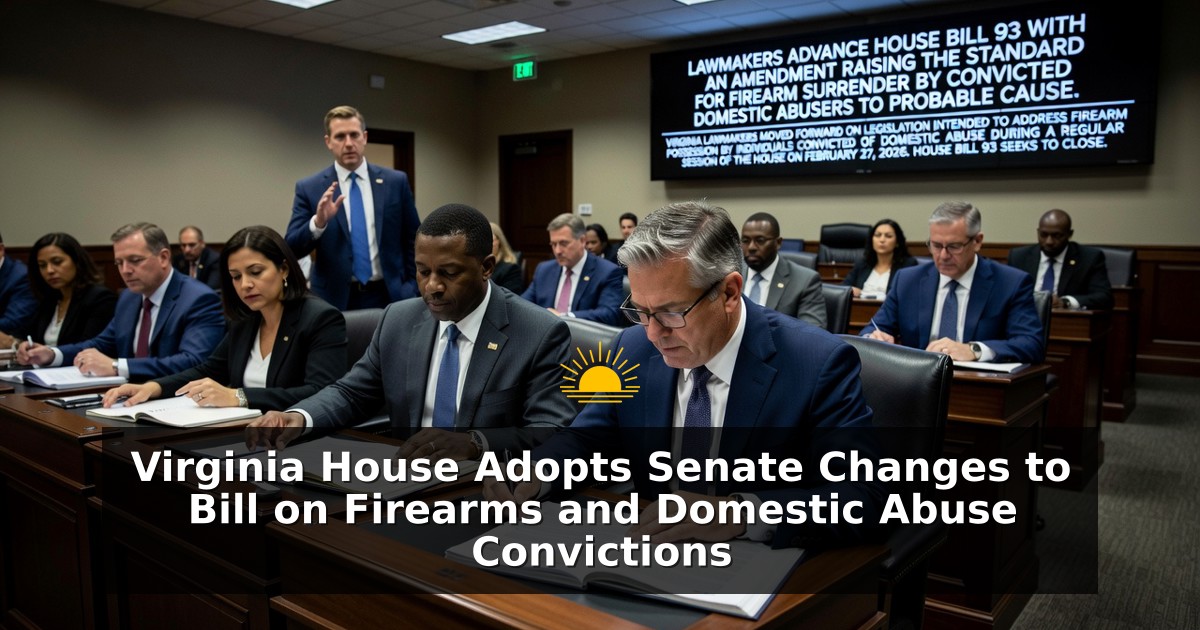
Virginia lawmakers moved forward on legislation intended to address firearm possession by individuals convicted of domestic abuse during a regular session of the House on February 27, 2026. House Bill 93 seeks to close what sponsors described as a loophole allowing convicted domestic abusers to retain firearms in their homes. The measure establishes a process for the surrender of those firearms to law enforcement agencies. Under the bill, the firearms could later be returned if specific conditions are met by the individual involved.
The discussion centered on Senate amendments that altered key language in the original proposal. Those changes replaced the phrase “reason to believe” with “probable cause” so the standard would match existing requirements used for warrants. Supporters of the amendment argued the adjustment would create clearer alignment with established legal thresholds already familiar to courts and law enforcement. The House adopted the Senate amendments by a recorded vote of 61 to 34. The action reflected ongoing legislative attention to public safety measures connected to domestic violence cases.
Background on Firearm Restrictions After Domestic Convictions
Virginia has long maintained statutes that limit firearm access for people subject to certain protective orders or criminal findings related to family abuse. House Bill 93 builds on that framework by focusing specifically on convicted domestic abusers and the practical steps needed to remove weapons from their immediate possession. The surrender mechanism outlined in the bill directs that firearms be turned over to law enforcement rather than left in the home. Officials would then hold the weapons pending any later determination about return eligibility.
Legal observers note that the distinction between “reason to believe” and “probable cause” carries practical weight in enforcement settings. Probable cause is the same threshold courts apply when reviewing search or arrest warrants, requiring a higher showing of facts than a more general belief standard. By adopting the Senate language, the House positioned the bill to operate under that familiar benchmark. The change aims to reduce ambiguity for officers and judges who would implement the surrender process once the measure becomes law.
Details of the Surrender and Return Process
Under the framework described during the session, convicted individuals would be required to relinquish firearms to designated law enforcement entities. The bill creates an orderly pathway for that transfer rather than leaving compliance solely to voluntary action. Once surrendered, the weapons remain in official custody. Return would be possible only if the person later satisfies conditions set out in the statute, though the precise criteria for restoration were not fully detailed in the floor remarks.
Proponents framed the overall bill as a tool to protect victims and reduce the risk of further harm. They emphasized that keeping firearms out of the hands of those with domestic abuse convictions can lower the chance of lethal outcomes in subsequent incidents. The legislative record from the February 27 session shows the measure advanced with the amended language intact after the 61-34 vote. No additional floor amendments were noted in the available account of the proceedings.
Legislative Context and Procedural Steps
The Virginia General Assembly regularly reviews bills that intersect criminal convictions, protective orders, and Second Amendment considerations. House Bill 93 fits within that pattern by pairing a restriction with a defined recovery option. The Senate’s decision to elevate the evidentiary standard to probable cause was presented as a technical but important refinement. House members then concurred, allowing the amended version to move ahead in the process.
Floor debate on the amendments remained focused on the alignment with warrant standards and the practical operation of the surrender system. The vote tally of 61 in favor and 34 opposed indicated majority support for the revised text while also reflecting a divided chamber on the precise wording. After adoption of the Senate changes, the bill continued along the normal path toward potential final passage and presentation to the governor. Session records list the action under the regular calendar for that Friday in late February.
Public Safety Considerations Raised in Discussion
Advocates for the bill pointed to the documented connection between domestic violence histories and later firearm-related injuries or fatalities. By requiring surrender to law enforcement, the legislation seeks to create physical separation between convicted abusers and weapons that might otherwise remain accessible at home. The possibility of eventual return under defined conditions was included to balance the restriction with due-process pathways. Lawmakers described the combination as an effort to enhance safety without permanently eliminating all future rights in every case.
The shift to a probable-cause standard was characterized as consistent with other areas of Virginia criminal procedure. Officers already operate under that threshold when seeking judicial authorization for searches, so applying it here was said to promote uniformity. The 61-34 adoption vote closed the amendment phase for House Bill 93 on that day. Further steps would depend on remaining legislative calendars and any subsequent executive review.
Next Stages for the Measure
With the Senate amendments accepted, House Bill 93 stood ready for whatever additional procedural requirements remained in the 2026 session. The core elements—closing the identified loophole, mandating surrender to law enforcement, and allowing conditional return—remained central to the proposal. The elevated probable-cause language now governs the trigger for those actions. Observers of the General Assembly will track whether the bill reaches final enrollment and is signed into law.
The February 27 proceedings supplied a clear record of the House’s position on the revised text. By a solid majority, members endorsed the alignment with warrant standards while preserving the bill’s protective purpose. The outcome underscores continued attention in Richmond to the intersection of domestic-abuse convictions and firearm access. Implementation details, should the measure become statute, would fall to law-enforcement agencies and the courts charged with applying the new probable-cause requirement.
Broader Implications for Virginia Communities
Communities across the commonwealth have watched similar proposals in prior sessions as part of wider conversations about violence prevention. House Bill 93 adds a specific surrender protocol aimed at convicted individuals rather than relying solely on existing protective-order rules. The neutral application of a probable-cause standard is intended to give both victims and defendants a predictable legal framework. Law-enforcement training and judicial guidance would likely follow any enactment to ensure consistent statewide practice.
The recorded vote and the substance of the amendments together form the principal public facts emerging from the session. No further alterations to the core surrender mechanism were described. The bill’s progress illustrates how technical language changes can shape the daily operation of public-safety statutes. Virginia residents interested in the final form of the law will look to subsequent legislative updates and official code publications once the session concludes.
In summary, the House’s adoption of the Senate amendments to House Bill 93 on February 27, 2026, advanced a measure designed to require firearm surrender by convicted domestic abusers under a probable-cause standard. The 61-34 vote finalized that language change and kept the bill moving through the General Assembly. The legislation continues to center on victim protection, orderly transfer of weapons to law enforcement, and conditional pathways for later return.
2026 Amendment bill Closing Domestic domestic abuse February 27 Firearm firearm surrender Firearms House House Bill 93 Law Enforcement Legislation loophole probable cause public safety Regular Session Senate amendment Virginia vote