Virginia House Reviews Senate Substitute on Parkway Traffic Powers
Updated
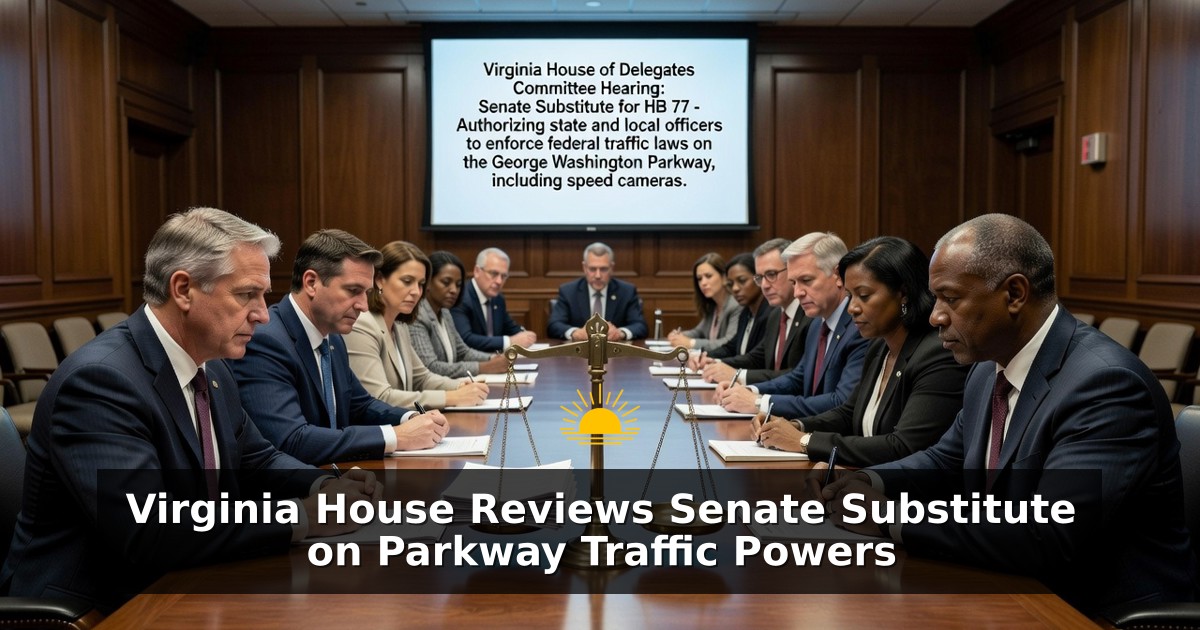
The Virginia House of Delegates is examining a Senate substitute for House Bill 77 that would authorize state and local police to enforce federal traffic laws on the George Washington Parkway. The measure has been conformed to its Senate companion, Senate Bill 81, and now includes language permitting speed monitoring devices along the route. Lawmakers are weighing whether to accept the revised version or send the legislation to a conference committee for further negotiation. The outcome could reshape how traffic rules are applied on a heavily traveled federal corridor that serves thousands of daily commuters in Northern Virginia.
Sponsors presented the substitute during a regular session and moved that the House agree to the Senate changes. At the same time, they called for a no vote on final passage so the bill could advance to conference if needed. This procedural approach allows members to signal support for the core concepts while preserving room to refine details. The discussion centers on balancing stronger enforcement tools with questions about jurisdiction, privacy, and the practical effects on drivers who use the parkway every day.
Background on the George Washington Parkway
The George Washington Memorial Parkway is a scenic federal roadway managed by the National Park Service that runs along the Potomac River through parts of Northern Virginia. It connects key destinations and carries substantial volumes of local and regional traffic each weekday. Because the parkway falls under federal authority, state and local officers have historically faced limits on their ability to cite certain traffic infractions. House Bill 77 seeks to clarify and expand that authority so Virginia agencies can respond more directly to violations occurring on the route.
Traffic safety advocates have long noted that the parkway experiences speeding, reckless driving, and other infractions that contribute to crashes and congestion. Federal park police maintain primary responsibility, yet resource constraints can leave gaps in coverage during peak hours. Allowing state troopers and local departments to enforce federal traffic rules could increase the visible presence of officers and improve response times. The addition of speed monitoring devices represents a further step toward automated enforcement in designated sections of the corridor.
Key Provisions in the Senate Substitute
The Senate substitute retains the original House goal of empowering state and local officers to enforce federal traffic laws on the parkway. It also adds explicit authorization for speed monitoring devices, commonly known as speed cameras, at approved locations. These devices would capture vehicles exceeding posted limits and generate citations according to standards set out in the legislation. The language aligns the House measure with Senate Bill 81 so both chambers work from a consistent text.
Supporters of the revised bill argue that the combined tools would deter dangerous driving and reduce the number of serious incidents. They point to the parkway’s mix of scenic stretches and high-volume segments where speed differentials create hazards. Opponents or cautious members may raise concerns about camera placement, data handling, fine structures, and the potential for revenue-focused enforcement. The substitute does not appear to alter the fundamental federal ownership of the roadway; it simply expands the roster of officers who can act on observed or recorded violations.
Legislative Path and Procedural Moves
During floor consideration, the bill’s sponsor urged colleagues to accept the Senate substitute while simultaneously requesting a no vote that would push the measure into conference. Conference committees allow selected members from both chambers to reconcile remaining differences and produce a final compromise version. This dual motion reflects a common legislative tactic when a chamber wants to keep a bill alive yet retain leverage over specific wording. The House must decide whether the current substitute adequately addresses enforcement needs or whether further talks are required.
If the House ultimately concurs with the substitute, the bill would move toward enrollment and presentation to the governor. If it rejects the substitute or follows the call for a no vote leading to conference, negotiators would meet to iron out any outstanding issues around camera authorization, officer training, or coordination with federal park authorities. Either path keeps the core policy question before the General Assembly: how best to maintain order and safety on a federal parkway that functions as a vital local artery.
Implications for Daily Travel and Public Safety
Expanded enforcement authority could change the experience of drivers who rely on the George Washington Parkway for commuting, tourism, or regional travel. More consistent application of speed limits and other rules may slow average travel times in some segments while reducing the likelihood of sudden stops or collisions. Speed monitoring devices, if deployed, would operate continuously and could generate citations without an officer present at the moment of the violation. Residents and regular users would need clear public notice about camera locations and the appeals process for any tickets issued.
Local governments whose officers gain new authority would need to coordinate training, equipment, and reporting protocols with state police and federal partners. Budget implications could arise from equipment purchases, data systems, and personnel time devoted to parkway patrols. At the same time, fewer severe crashes might lower emergency response costs and improve overall corridor reliability. The legislation does not mandate a specific number of cameras or patrol hours; those operational decisions would follow if the bill becomes law.
Broader Context of Traffic Enforcement in Virginia
Virginia has previously authorized limited use of speed cameras and red-light cameras in certain localities and work zones under defined conditions. Extending similar technology to a federal parkway fits within an ongoing statewide conversation about automated enforcement tools. Lawmakers routinely weigh evidence on crash reduction against concerns about privacy, equity, and the proper role of technology in policing. The current substitute for House Bill 77 places that debate squarely on a high-profile roadway that many Northern Virginia residents know well.
Federal-state jurisdictional questions are not unique to this parkway. Similar issues arise on other National Park Service roads and on interstate segments where multiple agencies share responsibility. Clear statutory language helps avoid confusion during traffic stops and ensures citations are legally sustainable. By conforming House Bill 77 to Senate Bill 81 and adding the camera provision, legislators are attempting to create a coherent framework that both chambers can support.
Next Steps for the Measure
The House will determine whether to accept the Senate substitute as written or to force additional negotiations through a conference committee. Members on both sides of the aisle have an interest in safer travel conditions along the Potomac corridor, yet they may differ on the precise mix of human and automated enforcement. Public comment and stakeholder input from local governments, park service officials, and commuting groups could still influence the final shape of any conference report. Whatever the immediate procedural result, the underlying policy goal remains improving compliance with traffic laws on a busy federal parkway that serves Virginia communities every day.
Observers note that successful implementation would require ongoing coordination among the Virginia State Police, county and city departments, and National Park Service law enforcement. Training standards, equipment interoperability, and data-sharing agreements would need careful attention after passage. The legislation itself supplies the legal foundation; the practical details of deployment would be worked out in subsequent administrative and budgetary processes. For now, the focus stays on the House decision regarding the Senate substitute for House Bill 77 and its companion Senate Bill 81.
bill debate conference committee Declan Faffanc enforcement authority February 27 2026 federal laws federal traffic infractions George Washington Parkway HB 77 House Bill 77 house session Law Enforcement legislative substitute local police Regular Session SB 81 Senate substitute speed monitoring devices state police traffic enforcement traffic laws Virginia legislature