Arlington Board Reviews Full Fire Alarm Mandates in Capital Plan Session
Updated
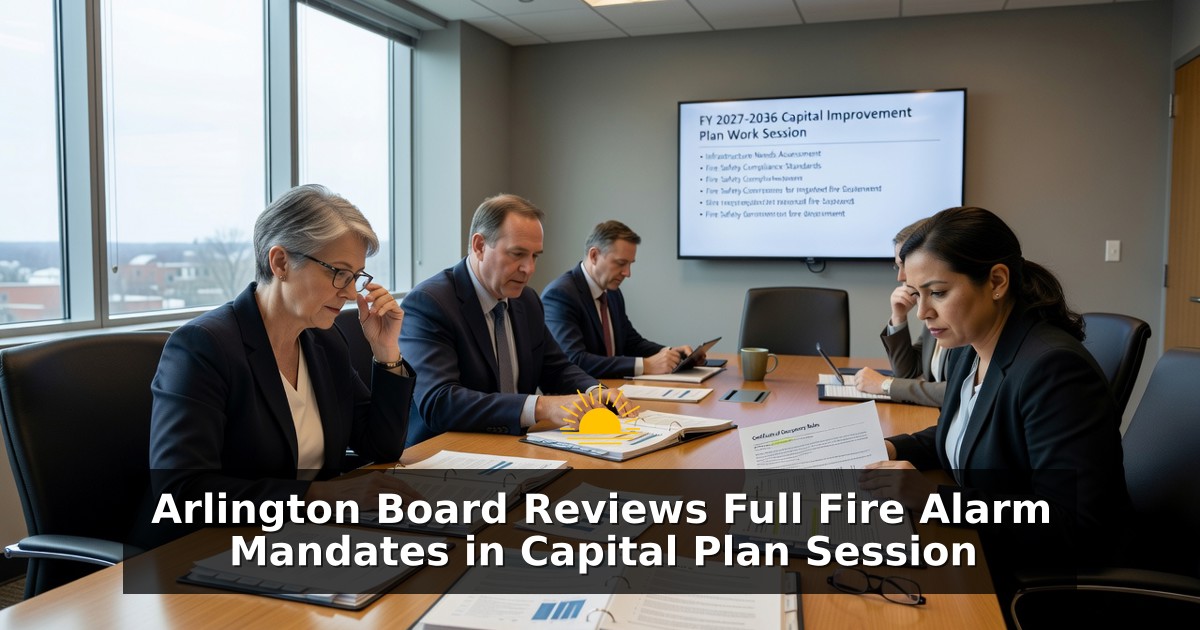
Arlington County officials examined strict requirements for integrated fire alarm systems during a Capital Improvement Plan work session focused on long-term infrastructure needs. Speakers emphasized that partial upgrades to these systems fail to satisfy building code standards and can prevent issuance of certificates of occupancy. The discussion occurred as part of planning for Fiscal Year 2027 through 2036 projects across county facilities. Full system functionality remains essential to allow safe occupancy of spaces under renovation or expansion. County leaders considered how these technical constraints affect timelines and budgets for ongoing capital work.
The Arlington County Board of Supervisors consists of Chair Matt de Ferranti, Vice Chair Takis Karantonis, Libby Garvey, Katie Cristol, and Susan Cunningham. These five members oversee major fiscal and infrastructure decisions for the county, including multi-year capital programs. They convened the work session to review proposed investments in public buildings, safety systems, and related facilities. Board discussions routinely incorporate input from technical staff on code compliance matters. The fire alarm topic arose in the context of maintaining operational continuity during phased construction.
Integrated Systems and Occupancy Rules
Integrated building systems link detection, notification, and suppression components across an entire structure rather than isolated sections. A speaker at the session explained that crews cannot upgrade fire alarms solely on occupied floors without addressing the complete network. Doing so would leave gaps that violate established building code provisions. Certificates of occupancy depend on verified full functionality of life-safety equipment before spaces may be used. Incomplete work risks formal notices that block occupancy until corrections occur.
Virginia adopts model codes that treat fire alarm networks as unified life-safety installations. These standards require continuous monitoring and response capability throughout a building. Partial modifications can create incompatible zones or communication failures between devices. Inspectors evaluate the whole system before approving occupancy. County projects must therefore schedule comprehensive upgrades even when only portions of a facility remain in active use.
Staff noted that a designated official would intervene if systems fell short of full operation. That intervention would prohibit occupancy of the affected space and leave project managers without immediate alternatives. Such outcomes underscore the practical stakes of code adherence during capital construction. Planners must sequence work to keep alarms fully active at every stage. The approach protects occupants while satisfying regulatory mandates.
Capital Improvement Plan Context
The Fiscal Year 2027-2036 Capital Improvement Plan outlines decade-long investments in Arlington facilities, transportation, and public safety infrastructure. Work sessions allow board members to scrutinize technical details before formal adoption. Fire and life-safety systems form a recurring category within these plans because aging buildings require modernization. Integrated alarms often share conduits, power supplies, and control panels with other building management functions. Upgrades therefore demand coordinated engineering rather than piecemeal replacements.
Arlington maintains numerous public buildings that house offices, community services, and emergency operations. Many of these structures feature interconnected systems installed under earlier code editions. When renovations begin, the entire alarm network must meet current performance criteria. Phased occupancy becomes possible only after the complete system passes inspection. This reality shapes both cost estimates and construction schedules inside the capital plan.
Budget documents associated with the plan typically allocate funds for design, procurement, and installation of compliant systems. Technical briefings during work sessions clarify why incremental spending on isolated floors proves insufficient. Board members receive explanations of how code officials interpret functionality requirements. These clarifications help align fiscal projections with regulatory realities. The process aims to avoid later delays that could idle completed spaces.
Compliance Challenges for Ongoing Projects
Ongoing capital projects frequently involve occupied buildings where services must continue during construction. Fire alarm work in such environments cannot leave temporary gaps in coverage. Contractors must maintain or replace the full system so that detection and notification remain reliable. Failure to do so triggers occupancy restrictions that disrupt county operations. Project teams therefore build full-system scopes into their baseline plans from the outset.
Building code enforcement in Arlington follows state and local amendments that prioritize life safety. Certificates of occupancy serve as the final checkpoint confirming that all required systems operate as designed. Officials responsible for these certificates possess authority to withhold approval when deficiencies appear. The work session highlighted that scenario as a concrete risk for any project attempting partial alarm upgrades. Staff stressed the absence of easy work-arounds once an inspector identifies noncompliance.
Future capital planning must incorporate these constraints into early design phases. Engineers evaluate existing system architecture before proposing modifications. Cost models reflect the need for complete rather than segmented replacements. Scheduling accounts for inspection milestones that verify whole-building performance. By addressing the issue proactively, the county reduces the chance of occupancy denials late in a project cycle.
Broader Implications for Facility Management
Life-safety systems protect both employees and visitors inside county facilities. Fully integrated alarms provide consistent coverage that partial installations cannot match. Modern codes emphasize redundancy, supervision, and clear annunciation across all floors and zones. Arlington’s capital program therefore treats these systems as foundational rather than optional elements. Investment decisions weigh long-term reliability against short-term construction convenience.
Technical staff continue to advise the board on evolving code interpretations and equipment standards. Each capital cycle brings opportunities to replace legacy components with current technology. The July work session reinforced that replacement strategies must remain comprehensive. Isolated floor-by-floor approaches conflict with both code text and practical enforcement. County procedures consequently favor holistic upgrades timed to minimize service interruptions.
Documentation prepared for the Capital Improvement Plan includes narrative descriptions of these system requirements. Board members use the information to evaluate trade-offs among competing infrastructure priorities. Transparent discussion of occupancy rules helps set realistic expectations for project delivery. The emphasis on full functionality supports the county’s broader commitment to safe public buildings. Continued attention to integrated systems will shape facility investments throughout the 2027-2036 planning horizon.
Coordination among design teams, contractors, and code officials remains essential for successful outcomes. Early identification of system interdependencies prevents costly redesigns later. The work session provided a forum for clarifying these dependencies in plain terms. Participants left with a shared understanding that partial fire alarm work is not a viable path. Full compliance safeguards both regulatory standing and public safety across Arlington’s capital portfolio.
Arlington County Board of Supervisors building code building safety capital improvement plan capital projects certificate of occupancy char compliance fire alarm system fiscal year 2027 fiscal year 2036 integrated systems july 2026 live session occupancy requirements occupied floors public hearing supervisors meeting Virginia work session