Intimidated or Blocked at the Polls in Virginia? What the Law Says and Who to Call
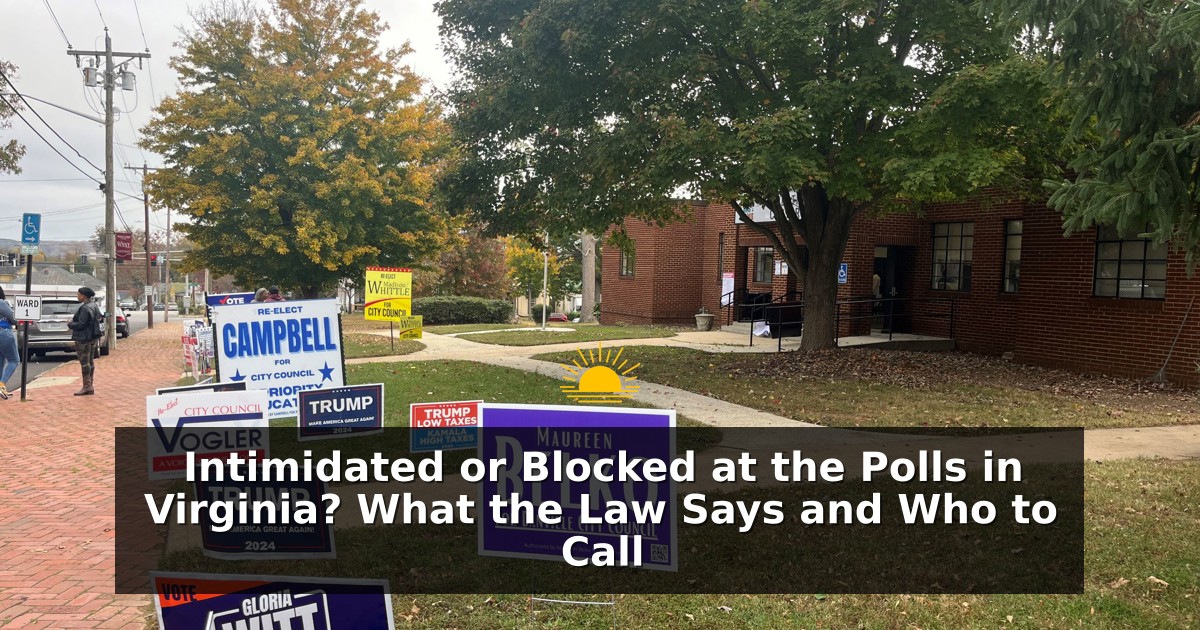
Most Virginians will vote on Nov. 3 without a problem. The Virginia Department of Elections (ELECT) and the Office of the Attorney General (OAG) say as much in their joint bulletin dated Oct. 15, noting "a longstanding tradition of elections operating without incident in the Commonwealth of Virginia." But the bulletin also spells out what the law prohibits and what local officials should do if something goes wrong. This article turns that material into a plain guide for voters.
The bulletin is informational and is not legal advice. It was written for local election officials, so the contact numbers it lists are for them. Voters should start with local officials and law enforcement.
What the law prohibits
The bulletin describes several layers of Virginia law that protect voters.
Hindering and delaying. It is unlawful to "hinder or delay a qualified voter" entering or leaving a polling location, according to Va. Code § 24.2-604(A). That section also bars loitering or congregating within 40 feet of any entrance.
Intimidation and interference. The bulletin quotes Va. Code § 24.2-607(A): it is unlawful for any person to "hinder, intimidate, or interfere with any qualified voter so as to prevent the voter from casting a secret ballot."
Coercion. Va. Code § 24.2-1005 prohibits any person from intimidating, threatening or coercing any other person to vote in a particular way, or to not vote.
Threats to election officials. Virginia law also prohibits intimidating, threatening or coercing an election official and hindering and preventing them from administering elections (Va. Code § 24.2-1000). Hindering or delaying an officer of election, or otherwise impeding the orderly conduct of the election, is covered by § 24.2-604(C).
Noise and disorder. Noisy or riotous conduct in or around a polling location that disturbs an election is unlawful under § 24.2-607(B).
Protections go beyond the door
The bulletin is clear that these protections are "not limited to the 40-foot boundary." They also cover voters using curbside voting and voters using ballot drop boxes. That means a person cannot lawfully intimidate you in a parking lot or at a drop box just because they are outside the 40-foot zone.
Federal law adds protection. The bulletin points to federal statutes that prohibit intimidation or interference aimed at a person's right to vote, including 52 U.S.C. § 10307(b) and 18 U.S.C. § 594. It also says federal law makes it a criminal offense for federal government officials to deploy armed personnel to polling locations, except in certain rare circumstances (18 U.S.C. § 592).
If it happens to you
The bulletin does not give a script for voters, but its guidance to officials suggests a sensible order.
- Get to a poll worker. Officers of election are responsible for the orderly conduct of the polling place. If you are inside, tell the chief officer of election what is happening.
- Call local law enforcement if there is any danger. The bulletin's example is blunt: if an armed individual tries to gain access to a polling location, officials should call local law enforcement immediately.
- Tell the general registrar. Registrars are the local officials ELECT and OAG expect to coordinate with law enforcement, attorneys and the Commonwealth's attorney before Election Day.
- Note details. When the bulletin tells officials how to document a disruption, it lists who was present, what they looked like, where and when it happened, what reason they gave and what effect it had on voters and the voting process. Voters who can safely note the same things may help officials act.
- Give your contact information if asked. The bulletin tells officials to request contact information from any voter who reports fear about a federal presence at a polling location.
Do not escalate on your own. Confronting someone can create risk, and the bulletin's emphasis is on communication and documentation.
Who officials call
The bulletin says local officials should build communication channels with the county, city or town attorney's office, the local sheriff's office or police department, and the Commonwealth's attorney before Election Day. It says officials should document points of contact and establish escalation protocols.
When an issue needs state help, the bulletin lists these contacts for local officials:
- Virginia Department of Elections: a regional liaison, or (804) 864-8901 or ea@elections.virginia.gov.
- Office of the Attorney General, Election Officials Line: (804) 200-4226, or election@oag.state.va.us.
The bulletin notes that the OAG can litigate complex legal cases on behalf of the Commonwealth in federal court and seek emergency relief.
If a polling place is disrupted for a long time
The bulletin also says that if a prolonged disruption at a polling location is affecting voter access, officials may consider discussing an emergency polling location change with ELECT, which has a process for doing so. A voter who arrives and finds a polling place disrupted should ask poll workers where to go and should check with the general registrar.
Know your rights, stay calm
Your ballot is meant to be private. Va. Code § 24.2-604(C), as cited in the bulletin, bars anyone inside a polling location from being in a position to see another voter's marked ballot. If you feel observed while voting, tell a poll worker.
Election Day is Nov. 3. If you have concerns before then, call your locality's general registrar. They are the first stop for questions about your polling place.
attorney general commonwealth Commonwealth of Virginia documentation Election Day Federal Government Law Enforcement longstanding tradition sheriff's office Virginia Virginia law