James City Delegate Advances Parking Enforcement Expansion Bill
Updated
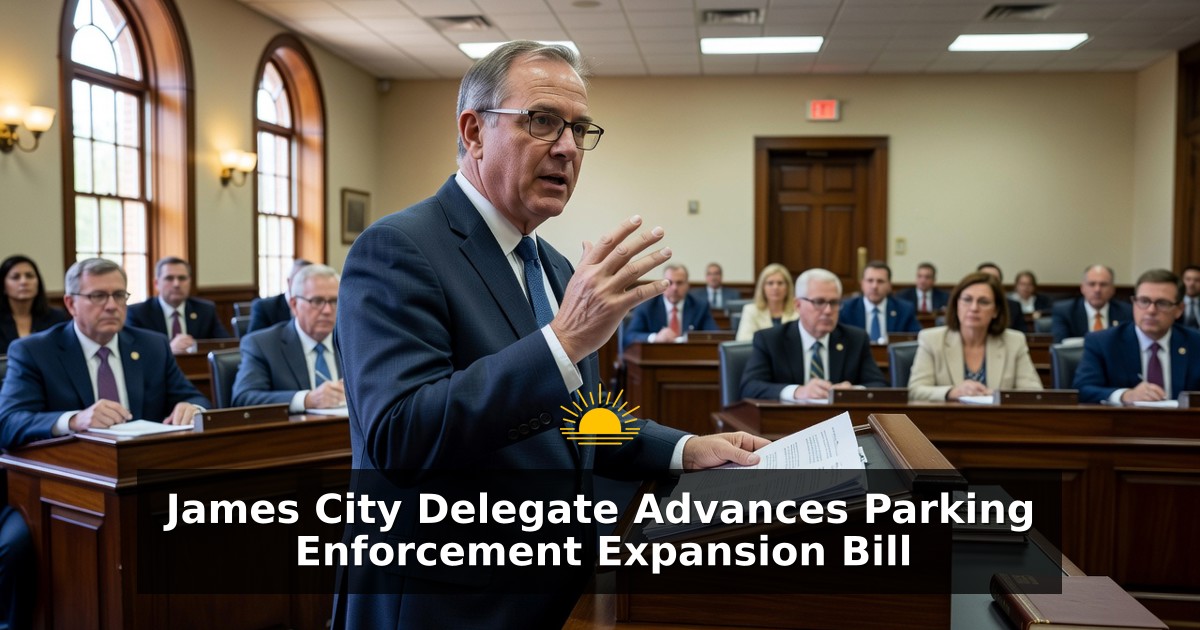
A delegate representing James City advanced companion legislation during the Virginia House of Delegates regular session on February 27, 2026, to expand parking enforcement authority statewide. The measure serves as the identical companion to House Bill 783, which had already passed the House by a vote that included 21 opposing votes. It updates outdated statutory language on parking enforcement and makes the expanded authority available to every locality on a fully permissive basis. Local law enforcement has backed the change as a practical modernization of existing rules. The delegate moved that the bill pass, after which the clerk called for the vote.
The legislation addresses longstanding inconsistencies in how Virginia localities may regulate and enforce parking on public ways and related properties. Under current frameworks, some jurisdictions possess clearer tools than others for managing congested streets, residential zones, and commercial districts. By revising the relevant code provisions, the bill seeks to place all cities, counties, and towns on equal footing without creating new obligations. Supporters emphasize that the approach remains entirely optional, allowing each governing body to decide whether and how to exercise any additional authority. This structure aligns with Virginia traditions of measured local empowerment.
Modernizing Language for Contemporary Needs
Outdated phrasing in parking statutes can create uncertainty for both officers and residents when rules are applied in rapidly growing communities. The companion bill focuses on clarifying terminology and scope so that enforcement practices better match present-day traffic patterns and land-use realities. Lawmakers noted that many localities have requested greater flexibility to address issues such as oversized vehicle storage, time-limited spaces, and accessibility compliance. Updating the language removes ambiguity while preserving the voluntary character of the authority. The result is intended to reduce administrative friction rather than expand state mandates.
Local governments in Virginia operate within a legal environment that carefully enumerates municipal powers. Parking regulation has historically fallen into a category where express authorization is often required before localities may act comprehensively. The measure under consideration responds to that reality by extending clear, permissive authority to every jurisdiction that wishes to use it. Officials familiar with the proposal describe it as a housekeeping update that simultaneously closes gaps left by earlier statutes. Because the change is optional, smaller or rural localities retain full discretion to maintain existing practices if they prefer.
Law Enforcement Perspective and Practical Benefits
Local law enforcement agencies have indicated support for the revised framework, citing improved clarity in daily operations. Officers responsible for traffic and parking duties often encounter situations in which statutory language lags behind community expectations or physical conditions on the ground. Clearer authorization can streamline training, citation procedures, and coordination with local governing bodies. Departments view the update as a means to enhance consistency across neighboring jurisdictions without altering core public-safety priorities. The backing from enforcement professionals underscores the operational rather than ideological nature of the proposal.
Parking management carries direct implications for public safety, emergency access, and quality of life in both urban and suburban settings. Congested residential streets can impede fire apparatus and ambulances, while poorly regulated commercial corridors may discourage business activity. By equipping localities with modern tools on a voluntary basis, the legislation allows communities to tailor solutions to their specific circumstances. Some areas may prioritize residential permit programs; others may focus on short-term loading zones or event-day controls. The permissive design ensures that one size is never forced upon all.
Legislative Path and Companion Strategy
House Bill 783 cleared the House with recorded opposition from 21 members before the companion measure reached the floor on February 27, 2026. Introducing an identical Senate bill is a common procedural step that facilitates parallel consideration and potential reconciliation later in the session. The James City delegate presented the companion, highlighted its limited purpose of language modernization and authority expansion, and moved passage. The clerk then initiated the voting process in accordance with chamber rules. Such companion vehicles help maintain momentum for measures that have already demonstrated majority support in one body.
Virginia’s legislative calendar places significant weight on efficient handling of local-government bills during regular sessions. Measures that enjoy law-enforcement support and impose no mandatory costs often advance with relatively limited debate. The parking enforcement update fits this profile by focusing on enabling language rather than new statewide requirements or funding streams. Observers of the process note that permissive authority bills frequently serve as low-controversy vehicles for incremental statutory improvement. The February session action continues that pattern.
Implications for Local Flexibility and Community Planning
Granting every locality the same baseline authority can simplify regional coordination on transportation and land-use matters. Neighboring jurisdictions sometimes face mismatched rules that confuse motorists traveling short distances across boundary lines. Uniform enabling language reduces those discrepancies while still permitting local variation in actual ordinances adopted. Planners and transportation officials may find it easier to develop corridor-wide strategies when the underlying statutory foundation is consistent. The bill therefore supports both autonomy and practical interoperability.
Community growth patterns across Virginia have intensified demand for adaptable parking policies in recent years. Expanding residential development, mixed-use projects, and tourism-related traffic all place new pressures on limited curb space. Localities that previously lacked explicit tools can now consider calibrated responses if the companion legislation completes its path. Because adoption remains optional, fiscal and administrative impacts stay under local control. Residents and businesses retain the ability to engage their own boards and councils on whether expanded enforcement makes sense for their area.
Broader Context of Statutory Maintenance
Periodic revision of code sections governing routine municipal functions is a recurring task for the General Assembly. Parking statutes, like those addressing signage, speed limits, or solid-waste collection, require occasional modernization to remain workable. The current effort illustrates how delegates respond to feedback from local officials and public-safety partners seeking clearer guidance. By confining the changes to language updates and permissive grants, sponsors avoid larger policy disputes that can slow unrelated bills. The approach keeps the focus on functional improvement.
The February 27 session activity forms one step in the longer bicameral process required for enactment. Further review, possible amendments, and eventual concurrence remain subject to standard legislative procedures. Throughout, the central facts remain constant: the proposal originated as a companion to a House-passed measure, updates parking enforcement language, extends authority to all localities on a voluntary basis, and carries support from local law enforcement. These elements define the public record of the bill’s advancement.
Citizens interested in how parking rules affect daily life in their neighborhoods may follow subsequent actions through official General Assembly channels. Local governing bodies will ultimately determine whether to implement any newly clarified powers once final language is known. The legislation itself neither compels nor prohibits specific enforcement programs; it simply equips localities with updated statutory tools. In that respect, the measure reflects a straightforward exercise in aligning state code with contemporary local-government needs while respecting the principle of optional adoption.
2026 bill passage delegate enforcement February 27 House Bill 783 James City Law Enforcement Legislation local government localities parking enforcement permissive authority public safety Regular Session Senate bill Transportation Virginia General Assembly Virginia House of Delegates Virginia localities