JLARC Ordered to Study AI Policies Across Virginia’s Colleges and Universities
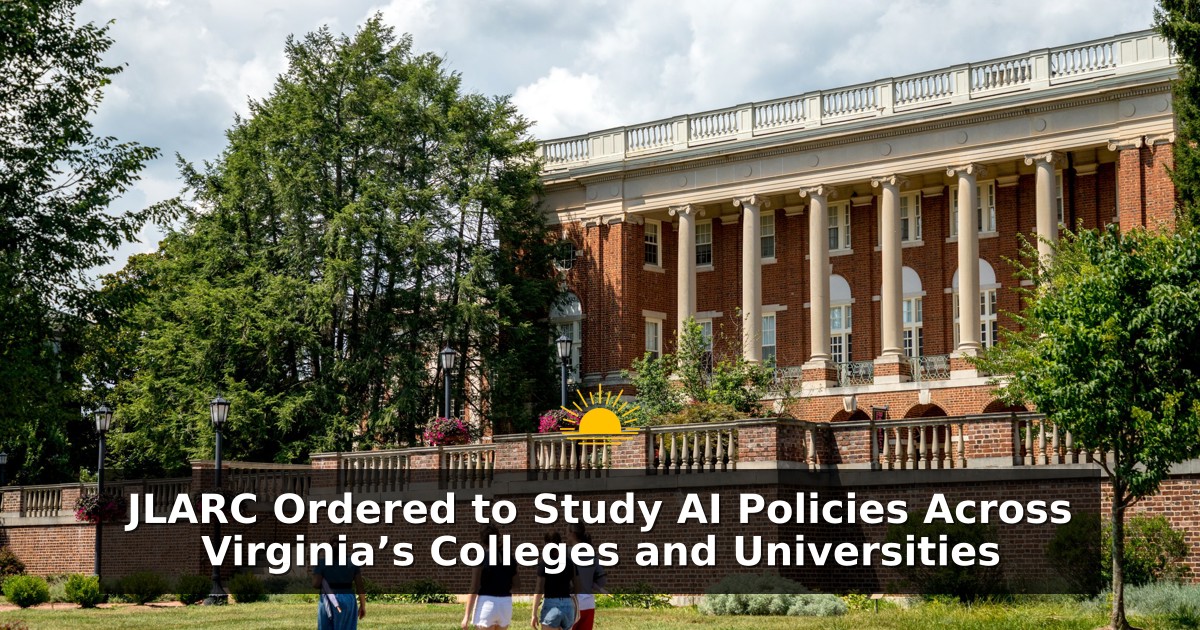
Virginia lawmakers have directed the Joint Legislative Audit and Review Commission to study how colleges and universities are — or are not — managing artificial intelligence, with instructions to draft a model policy other campuses can adapt.
VPM News reports that Del. Amy Laufer, D-Charlottesville, carried the legislation ordering the study. JLARC is to examine academic integrity, data privacy, access, transparency and faculty autonomy, and to recommend tools, curricula and resources for a statewide clearinghouse usable by educators, students and the public.
“Students are going to want to know what the AI policies are, and students are going to have to use these tools in the workforce,” Laufer told VPM. “Making sure that we have a competitive edge, I think, is critical, and this is one way to start that discussion.”
University of Virginia public-policy professor Andy Pennock, who co-chaired a 2023 UVA AI task force, said the study topics match the live questions on campuses. Integrity debates, he argued, should ask not only whether students cheat but whether they still gain the learning value tuition promises. A line from UVA’s 2023 report warned that ubiquitous generative AI could help students learn far more — or far less.
Access gaps worry Pennock as well. Flagship campuses may license advanced tools such as premium copilots that poorer institutions and community colleges cannot afford. Without state attention, AI literacy could stratify along existing resource lines.
UVA’s current approach leaves many decisions to instructors, who must spell out permitted and prohibited uses in syllabi, with citation required when AI is used. Leo Lo, UVA’s libraries dean and a special advisor on AI literacy, said schools have been experimenting independently and that evidence is still thin on which classroom designs help or hurt learning. Natasha Heny, co-chair of the 2023 task force, urged JLARC to consult disciplinary experts and keep the framework adaptable as the technology shifts.
George Mason University has issued similar faculty and student guidelines, hosted a statewide AI summit, and published a reference guide. Amarda Shehu, GMU’s chief AI officer, described a culture change that requires careful classroom experimentation. Mathematics professor Padmanabhan Seshaiyer said authentic learning should show what a student understands, what AI contributed and how results were verified.
UVA is also leading planning for a Commonwealth Artificial Intelligence Institute under a $500,000 planning grant meant to coordinate a statewide ecosystem for responsible AI deployment. Ryan Wright, a UVA special advisor on AI, told VPM the conversation cannot live at a single university.
JLARC staff say the higher-ed study has not fully kicked off but will draw on experts in Virginia and nationally. Kimberly Sarte noted overlap with a forthcoming study of AI in state government, especially on privacy practices that apply anywhere. Justin Brown said because the field is fluid, the commission will emphasize enduring governance principles over quickly outdated status snapshots.
For students and parents, the near-term value is clearer syllabi and fewer surprise misconduct cases. For faculty, it is preserved autonomy with shared guardrails so every department is not inventing policy alone. For legislators, it is a chance to avoid a patchwork where transfer students face conflicting rules and where procurement of AI tools ignores privacy baselines.
Community colleges deserve explicit attention in fieldwork. They enroll large shares of first-generation and working adult students who may rely on free consumer AI tools with weaker privacy terms if campuses cannot license enterprise products. A model policy that ignores cost will fail those campuses.
Employers already expect graduates who can use AI responsibly. A clearinghouse of curricula could help smaller institutions skip redundant pilot errors. Transparency requirements — disclosing when institutional chatbots advise students on financial aid or advising — would build trust.
Privacy remains the quiet risk. Feeding proprietary research or student records into third-party models can create legal exposure under FERPA and research contracts. JLARC’s dual look at state-government AI and campus AI should produce consistent minimum standards.
Critics sometimes fear model policies become de facto mandates that stifle innovation. Laufer’s framing emphasizes competitiveness and clarity. The political sweet spot is a voluntary model with strong privacy defaults and integrity definitions campuses can adopt or justify departing from.
JLARC’s eventual report will land in a General Assembly already wrestling with data-center load, workforce pipelines and K-12 technology rules. Higher education AI policy is part of that same productivity story. Virginians who want their tuition dollars to buy learning — not undetectable ghostwriting — should watch the study’s recommendations and ask campus presidents how they will respond.
Virginia Virginia House of Delegates Ali Faruk Amy Laufer Andrew Breton Anne Holton Artificial Intelligence Charlottesville Cheryl Burke Cynthia Newbille Data Education Ellen Robertson Emmett Jafari George Mason George Mason University Katherine Jordan Kathryn Ricard Kenya Gibson Land Lawmakers Legislation Matthew Percival Misconduct Nicole Jones Parents Policy Reva Trammell Richmond City Council Richmond School Board Sarah Abubaker Schools Shavonda Fernandez Stephanie Lynch Stephanie Rizzi Technology University of Virginia Virginia Wesley Hedgepeth