Lawmakers Eye Fix for 1% School Construction Sales Tax as 47 Localities Head to Voters
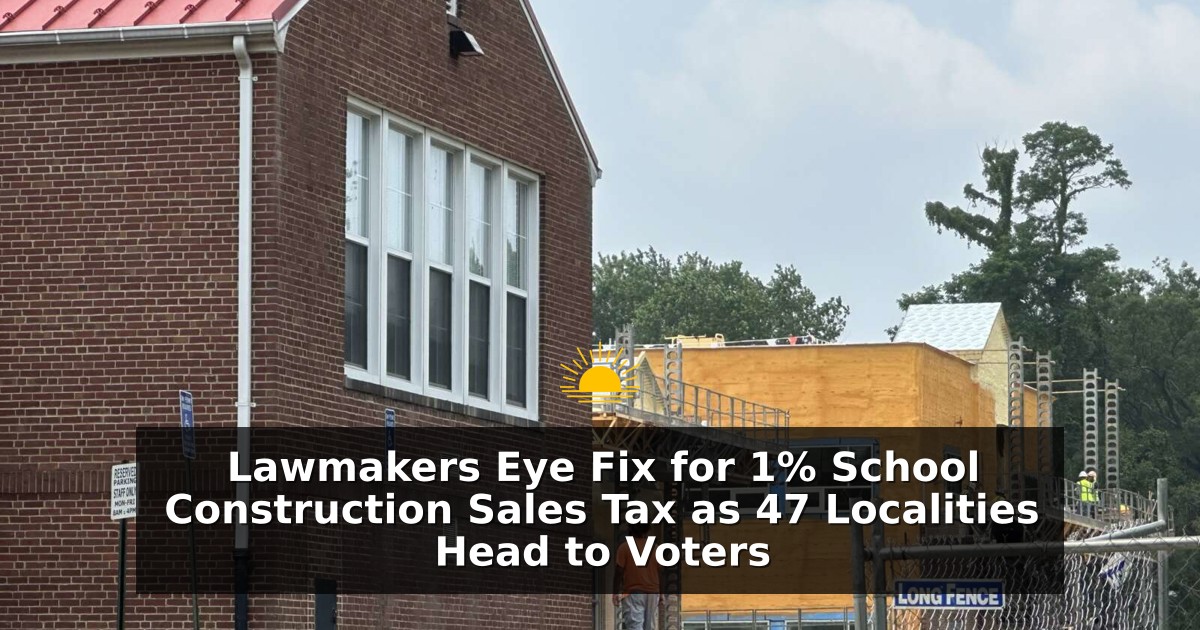
A brand-new local-option 1 percent sales tax for school construction is already prompting talk of a legislative tune-up, after Newport News officials told Del. Shelly Simonds that the law’s 20-year clock may start ticking before localities can issue the bonds they need to rebuild aging campuses.
Virginia Mercury reported that the tax authority — included in budget language just before the July 1 deadline — lets localities ask voters to approve a 1 percent sales tax primarily for school construction, with Planning District 8 localities also able to use revenue for public transportation. Forty-seven localities are seeking voter support this November.
Under the statute, the tax authority lasts 20 years after local leaders pass a resolution that must specify an expiration date or, if projects are financed with bonds or loans, when those obligations must be repaid. Because bonds often close months or years after a referendum, starting the 20-year countdown at approval can shrink the reliable revenue window that underwriters want to see.
Simonds, House Education Committee vice chair, told the Mercury she wants the tool to work for rebuilding crumbling schools and is willing to revisit the sunset if needed. She raised the issue at the Sept. 8 meeting of the Commission on School Construction and Modernization — the panel’s first gathering since December 2022 — after a presentation on the tax’s local impacts.
Newport News, in her district, is eager for the option because multiple buildings need replacement, not just roof and HVAC patches. Modern schools also need high-speed networking and other technology infrastructure that older designs never contemplated. Still, city officials warned that temporary taxing power may not align with bond schedules — a glitch Simonds said she had not heard until the city flagged it.
House Education Chair Sam Rasoul, who previously carried sales-tax-option legislation, said he is committed to giving local schools tools and flexibility. Del. Chris Runion, R-Rockingham, asked the commission for future briefings on whether revenue could cover regional career-and-technical centers, existing bond payments and projects already underway — uses the final budget language did not include.
Both concerns are about timing and fit: money available on a political calendar versus construction cash needs on a facilities calendar. The commission requested a future presentation on procurement and bonding but has not scheduled it yet.
For parents and taxpayers, the November referenda are the immediate decision point. Approving the tax raises local sales rates for up to two decades in exchange for dedicated school capital — and, in Northern Virginia’s Planning District 8, possible transit support. Rejecting it leaves divisions competing for scarce state construction dollars and local debt capacity without the new stream.
School facility backlogs are not abstract. Deferred maintenance compounds into emergency closures, portable classrooms and HVAC failures that disrupt learning. Construction inflation since the pandemic made previously scoped projects unaffordable, which is why the General Assembly finally opened a local sales-tax path after years of debate.
Bond counsel and county attorneys will now model scenarios: approve tax in November, resolve details in early 2026, issue bonds in 2027 — and check whether the statutory clock still covers debt service. If models show a cliff, expect a narrow fix bill in the 2027 session focused on starting the 20-year period at first bond issuance or first tax collection rather than at resolution adoption.
Supporters of a fix will cast it as making the tool usable, not expanding the tax. Opponents of the original tax will argue that any reopening invites mission creep toward CTE centers and existing debt, as Runion’s questions previewed. Transparency about allowable uses will matter as much as the sunset math.
Newport News is one case study among 47. Other cities and counties watching the referendum calendar should compare notes on bond timing before lobbying Richmond. A patchwork of local interpretations could produce uneven credit treatments and voter confusion if some localities promise 20 full years of collections while documents show a shorter practical window.
Education advocates will also watch whether the tax crowds out other local priorities or simply substitutes for general-fund transfers that previously patched roofs. Good practice is publishing a facilities master list tied to referendum materials so voters see which schools are first in line.
For now, Simonds and Rasoul have signaled openness to flexibility, Runion has teed up use-of-funds questions, and the commission has asked for bonding expertise. Voters in nearly four dozen localities will decide the tax itself in November. The General Assembly may decide, next year, whether the fine print needs a repair so the yes votes can actually finance the buildings they were sold on.
Until a fix lands, local finance teams should document the mismatch in writing — resolution date, expected bond date, coverage years — and share it with legislators. That paper trail is what turns a Newport News worry into a statewide statutory cleanup rather than a one-city anecdote.
Email Newport News City Council at:
Phillip Jones — mayorsoffice@nnva.gov,
Marcellus Harris — council@nnva.gov,
Curtis Bethany — council@nnva.gov,
Cleon Long — council@nnva.gov,
Robert Coleman — council@nnva.gov,
Tina Vick — council@nnva.gov,
John Eley — council@nnva.gov,
Email the Newport News School Board:
Lisa R. Surles-Law,
Terri L. Best,
Rebecca S. Aman, rebecca.aman@nn.k12.va.us,
Douglas C. Brown,
Maritsa Alger,
Rasheena D. Harris, Rasheena.Harris@nn.k12.va.us,
Gary B. Hunter,
Newport News Ali Faruk Andrew Breton Anne Holton Budget Cheryl Burke Chris Runion Cleon Long Curtis Bethany Cynthia Newbille Debate Debt Douglas C. Brown Education Ellen Robertson Emmett Jafari Gary B. Hunter inflation John Eley Katherine Jordan Kathryn Ricard Kenya Gibson Lawmakers Legislation Lisa R. Surles-Law Marcellus Harris Maritsa Alger Matthew Percival Newport News City Council Newport News School Board Nicole Jones Northern Virginia Parents Phillip Jones Power Rasheena D. Harris Rasoul Rebecca S. Aman Reva Trammell Richmond Richmond City Council Richmond School Board Robert Coleman Sam Sam Rasoul Sarah Abubaker School Schools Shavonda Fernandez Shelly Simonds Stephanie Lynch Stephanie Rizzi Technology Terri L. Best Tina Vick Transportation Virginia Virginia House of Delegates Wesley Hedgepeth