Loudoun County Officials Weigh New Teacher Contract Options in FY27 Budget Talks
Updated
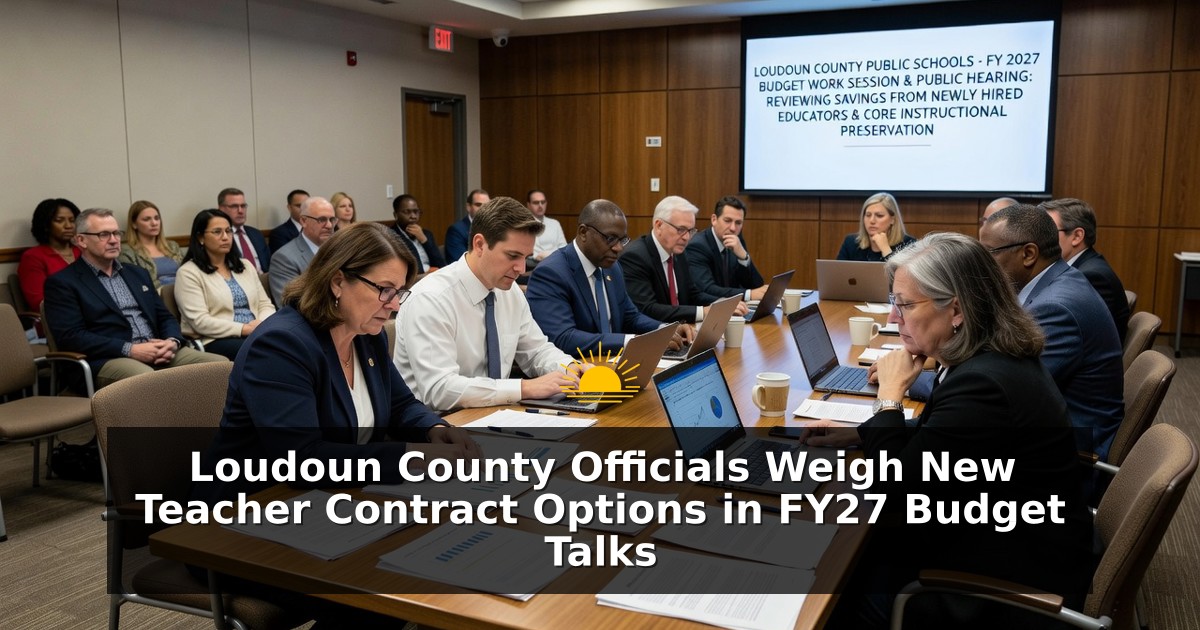
Loudoun County Public Schools leaders gathered for a fiscal year 2027 budget work session and public hearing to identify possible areas of cost reduction while preserving core instructional goals. Participants reviewed personnel-related expenses as one avenue for creating flexibility in the overall spending plan. Attention turned specifically to provisions affecting brand new teachers entering the division. Officials sought targeted adjustments that could free resources for other stated priorities without broadly disrupting established pay structures.
The Loudoun County School Board oversees these deliberations and currently includes Chair Melinda Mansfield, Vice Chair Kari LaBell, Ian Serotkin, Tiffany Polifko, Harris Mahedavi, John Beatty, April Chandler, Lauren Shernoff, and Atoosa Reaser. Each member represents a distinct geographic district or the at-large seat across the county. Their collective responsibility includes approving an annual operating budget that supports tens of thousands of students and thousands of staff. Discussions of this nature routinely occur in open sessions so that residents can follow the reasoning behind proposed changes.
Potential Adjustments Involving New Educators
A speaker during the session observed that some cost savings might be located by examining arrangements for brand new teachers. The same speaker voiced clear reluctance, emphasizing that these educators often make meaningful contributions in classrooms and could readily use additional financial support. One concrete alternative raised involved keeping teachers who are new to Loudoun County Public Schools at a three-day schedule. Such a step was framed as a narrower way to generate savings compared with wider compensation changes.
The remarks underscored an effort to locate precise, limited places inside the draft budget where reductions could occur. The stated purpose was to redirect any realized savings toward other wants and improvements identified by the board and administration. No final decisions were announced at the hearing, and the comments remained exploratory in tone. Further analysis of enrollment projections, state funding formulas, and local revenue estimates will shape later versions of the proposal.
Context of Teacher Staffing and Compensation
Loudoun County Public Schools ranks among the larger divisions in Virginia and continually manages recruitment and retention of instructional staff. New teachers typically enter on a defined salary scale that reflects degree level and prior experience. Adjustments to contract days or initial placement on that scale can produce measurable differences in total personnel outlays. Division leaders have historically balanced competitive starting offers against the need to fund classroom resources, transportation, and facility needs.
State and local funding streams both influence how much flexibility exists in any given budget cycle. Virginia’s composite index and basic aid calculations determine a substantial share of operating revenue. Local property tax collections supply the remainder, subject to Board of Supervisors appropriations. When those sources tighten or when enrollment shifts, school boards often revisit discrete line items such as orientation days or entry-level stipends. The current conversation fits within that longer pattern of incremental review.
Broader Fiscal Pressures Facing the Division
Budget work sessions customarily examine multiple cost centers beyond salaries alone. Transportation routes, special education services, technology refresh cycles, and maintenance backlogs all compete for limited dollars. Public hearings provide residents an opportunity to comment on proposed trade-offs before the board adopts a final spending plan. In the present cycle, the emphasis on fine-grained savings reflects an attempt to protect classroom-facing programs while still addressing emerging requests from schools and departments.
Teacher workload and professional development days remain sensitive topics because they affect both instructional quality and employee satisfaction. Reducing contract days for a subset of staff can lower immediate expenses yet may also alter onboarding experiences. Board members therefore weigh short-term fiscal relief against longer-term effects on workforce stability. Data on vacancy rates, application volumes, and exit survey results typically inform those judgments in subsequent meetings.
Community Priorities and Next Steps
Residents of Loudoun County consistently express interest in competitive educator pay alongside efficient use of tax dollars. The hearing format allows speakers to place specific ideas on the record for staff follow-up. Administration officials are expected to model the financial impact of the three-day option and any related contract refinements before returning with revised figures. Those models will incorporate current salary schedules, projected hiring numbers, and benefits costs.
Any eventual recommendation will move through additional public meetings prior to final adoption. The board retains authority to accept, modify, or reject individual savings concepts. Transparency requirements under Virginia law ensure that supporting documents and revised drafts remain available for public inspection. Continued monitoring of state budget actions in Richmond will also affect the local picture as the fiscal year 2027 process advances.
Balancing Support for Educators with System-Wide Needs
The discussion illustrated the inherent tension between supporting early-career teachers and meeting wider system demands. New educators frequently bring energy and recent training that benefit students, yet their compensation forms a visible portion of the personnel budget. Identifying limited, well-defined adjustments offers one path to free capacity for other initiatives without across-the-board cuts. Officials signaled that further refinement of these ideas will continue in coming weeks.
Observers note that similar conversations occur in school divisions statewide whenever revenue growth slows or mandated costs rise. Loudoun County’s relatively strong local tax base provides some cushion, yet rising enrollment in certain corridors and inflation in supply chains still create pressure. The board’s focus on fine places for savings aims to preserve as much instructional integrity as possible while responding to those realities. Final outcomes will depend on updated revenue forecasts and the full range of public input received.
Longer-Term Implications for Workforce Planning
Decisions made in the fiscal year 2027 cycle can influence recruitment messaging for the following hiring season. Clear communication about contract expectations helps candidates evaluate offers from Loudoun County Public Schools against those of neighboring divisions. Maintaining an attractive entry point remains important in a competitive regional labor market. At the same time, demonstrable fiscal discipline supports broader community confidence in the division’s stewardship of resources.
Staff will likely prepare side-by-side comparisons showing the dollar impact of retaining a three-day schedule for new hires versus other potential modifications. Those comparisons will appear in future agenda packets. Board members can then deliberate with concrete numbers rather than conceptual options alone. The process exemplifies the iterative nature of public-school budgeting in Virginia localities.
Conclusion of Initial Review
The work session and public hearing marked an early stage in constructing the fiscal year 2027 operating budget. Comments regarding brand new teachers formed one element of a wider search for achievable efficiencies. Reluctance to diminish support for those educators was openly acknowledged alongside the practical need to locate savings. Subsequent meetings will determine whether the three-day approach or related measures advance into the advertised budget.
Loudoun County residents can track developments through official school board channels and remaining public comment periods. The board’s nine members will ultimately vote on a comprehensive package that reflects both instructional priorities and fiscal constraints. Careful documentation of each proposed adjustment helps ensure accountability as the process moves forward. The emphasis on precise, limited changes seeks to protect classroom quality while addressing legitimate requests for additional improvements across the division.
board meeting budget cuts budget hearing budget priorities budget work session cost savings education budget education funding fiscal year 2027 FY27 budget LCPS new hires new teachers public hearing savings options School Board School Funding teacher pay teacher positions teacher support