Loudoun County Updates Student Search Policy with New Notices
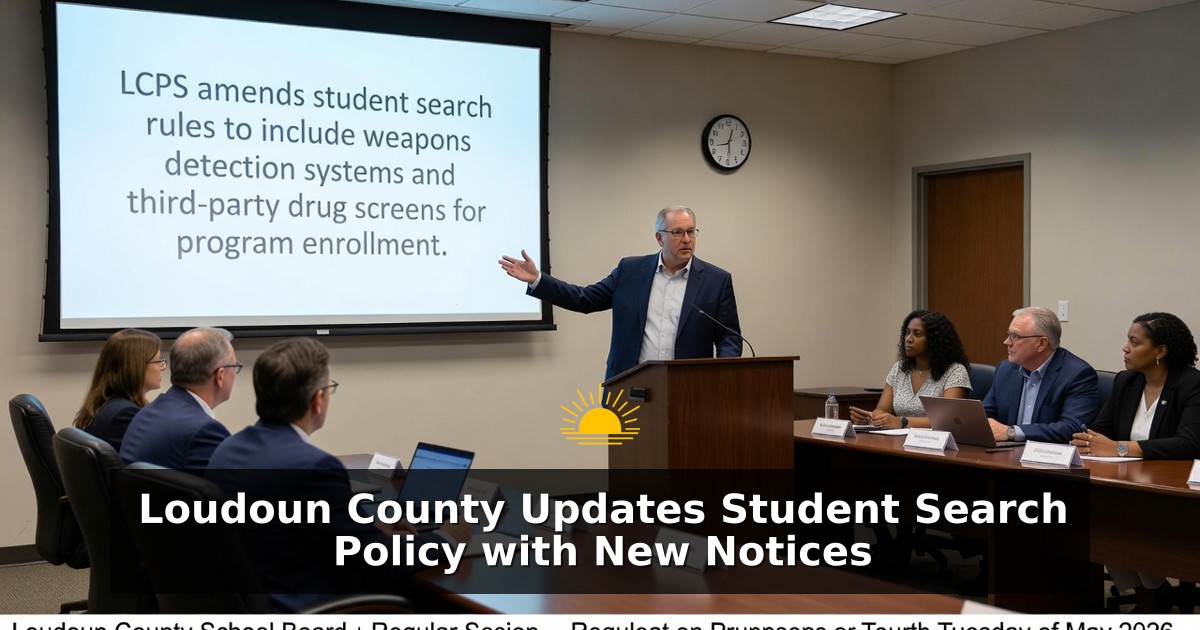
The Loudoun County School Board reviewed proposed amendments to its student search policy during a regular meeting held on the fourth Tuesday of May in 2026. Staff presented changes designed to give students and families clearer advance notice about existing and potential search practices used across Loudoun County Public Schools. The updates focus on weapons detection technology already in limited use and the possible involvement of outside vendors for drug screening tied to certain specialized programs. Officials emphasized that the revisions bring the written policy into closer alignment with established legal standards governing searches on school property. Transparency remains the central goal so that families understand the conditions under which searches may occur.
Loudoun County Public Schools serves a large and growing student population in Northern Virginia, making consistent and lawful search procedures a recurring operational priority. The current members of the Loudoun County School Board are Chair Melinda Mansfield, Vice Chair Atoosa Reaser, April Chandler, Deana Griffiths, Harris Mahedavi, John Beatty, Jeff Morse, Lauren Sherban, Ian Serotkin, and Erika Ogedegbe. These elected representatives oversee policy development for the division and routinely examine how administrative practices affect student rights and school safety. During the May session, board members heard a detailed staff briefing before opening the floor to questions. No immediate objections were recorded in the available meeting record.
Notice Requirements for Weapons Detection
One key addition addresses the occasional deployment of weapons detection systems throughout LCPS facilities. These systems include traditional metal detectors placed at entrances during heightened security periods and certain security cameras now equipped with artificial intelligence capable of identifying weapons. School officials stated that the technology has already been employed on a limited basis and that formal policy language simply confirms its existence for the benefit of students and parents. Providing written notice helps ensure that families are not surprised when such equipment appears at school events or daily entry points. The change also reduces the risk of later legal challenges based on lack of prior disclosure.
Legal frameworks surrounding student searches have evolved through decades of court decisions that balance safety needs against privacy expectations. Schools generally may conduct searches based on reasonable suspicion rather than the stricter probable-cause standard applied to law enforcement outside educational settings. Weapons detection tools that scan large groups without targeting individuals have frequently been upheld when implemented in a nondiscriminatory manner. By codifying notice of these systems, LCPS aims to demonstrate good-faith compliance with both constitutional requirements and state education guidelines. The policy language stops short of mandating continuous use and instead describes the tools as available resources.
Third-Party Drug Screening Provisions
A second amendment clarifies that LCPS may contract with an outside vendor to perform drug screens when such testing is required as a condition of enrollment in a designated program. Staff explained that a drug screening constitutes a form of search under the broader policy and therefore belongs in the same document that governs other search activities. The notice does not create new testing mandates; it simply informs families that third-party involvement is possible for programs that already include screening as an entry requirement. Examples of such programs often include certain career and technical pathways, competitive athletics, or specialized academies where safety or industry standards demand a drug-free environment. Clear disclosure allows parents to evaluate participation decisions with full information.
Drug-testing conditions attached to voluntary extracurricular or specialized programs have been examined repeatedly by federal courts. Decisions have generally permitted schools to require testing for students who choose to join activities that carry elevated safety risks or that serve as privileges rather than rights. By routing any necessary screening through an independent third party, the division can maintain chain-of-custody integrity and reduce perceptions of internal bias. The policy amendment underscores that the practice remains limited to programs where screening is an explicit enrollment condition rather than a general student body requirement. This limitation helps preserve the distinction between targeted and random testing regimes.
Alignment with Legal Standards and Family Trust
Ms. Scanlon, presenting on behalf of staff, walked board members through each revision and invited questions about wording or implementation. She noted that the overarching purpose is to supply adequate notice so that the policy itself becomes a reliable reference document for the school community. Board members present at the meeting had the opportunity to seek clarification on how often weapons detection systems might be activated or which specific programs currently impose drug-screen conditions. The discussion remained focused on procedural clarity rather than expansion of search authority. Officials reiterated that every search must still satisfy applicable legal thresholds before it proceeds.
Maintaining public trust requires that written policies accurately reflect day-to-day practices inside schools. When families discover security measures only after an incident, confidence in administrative transparency can erode quickly. The newly added language attempts to close that gap by placing both weapons-detection capabilities and third-party drug-screen options into the official student search policy. Educators and legal advisors routinely review such documents to confirm consistency with the Fourth Amendment as interpreted in the school context and with Virginia statutes governing student conduct. Periodic updates of this kind are standard practice across large school divisions facing evolving safety technologies.
Broader Context for School Safety Measures
School divisions nationwide have expanded the use of detection technology in response to concerns about weapons on campus. Metal detectors and AI-enhanced cameras represent one layer within a larger safety strategy that also includes training, anonymous tip lines, and collaboration with local law enforcement. Loudoun County’s decision to document these tools inside its search policy mirrors similar steps taken by other Virginia divisions seeking to avoid ambiguity. The inclusion of drug-screen notice follows the same logic of proactive disclosure. Together the changes create a single reference point that students, parents, and staff can consult when questions arise.
Implementation details will continue to be managed at the school and program level under the umbrella of the revised policy. Principals and program coordinators remain responsible for ensuring that any actual search or screening adheres to the reasonable-suspicion or voluntary-condition standards already recognized by courts. Training for staff who operate detection equipment or coordinate third-party testing will need to incorporate the updated notice language. Families who wish to understand how the policy applies to a particular school or program are encouraged to review the full text once it is finalized and posted. The board’s action in receiving the amendments marks a routine but important step in keeping division regulations current.
Ongoing evaluation of search practices helps school systems adapt to new technologies while respecting student privacy interests. Loudoun County Public Schools has chosen to address two concrete examples—weapons detection systems and conditional drug screens—through explicit policy language rather than informal practice. The approach favors clarity over silence and supplies families with information they can use when making educational choices. As safety tools continue to advance, similar notice provisions may appear in future policy cycles. For now, the amendments presented in May 2026 stand as the division’s latest effort to keep its student search framework both lawful and understandable.
AI board members cameras condition detection drug screen drug screening enrollment Families LCPS metal detectors Ms Recardi notice Policy search specified program Students systems third party weapons weapons detection systems