Virginia Measure Advances to Lift Caps on Local Homeownership Grants for Public Employees
Updated
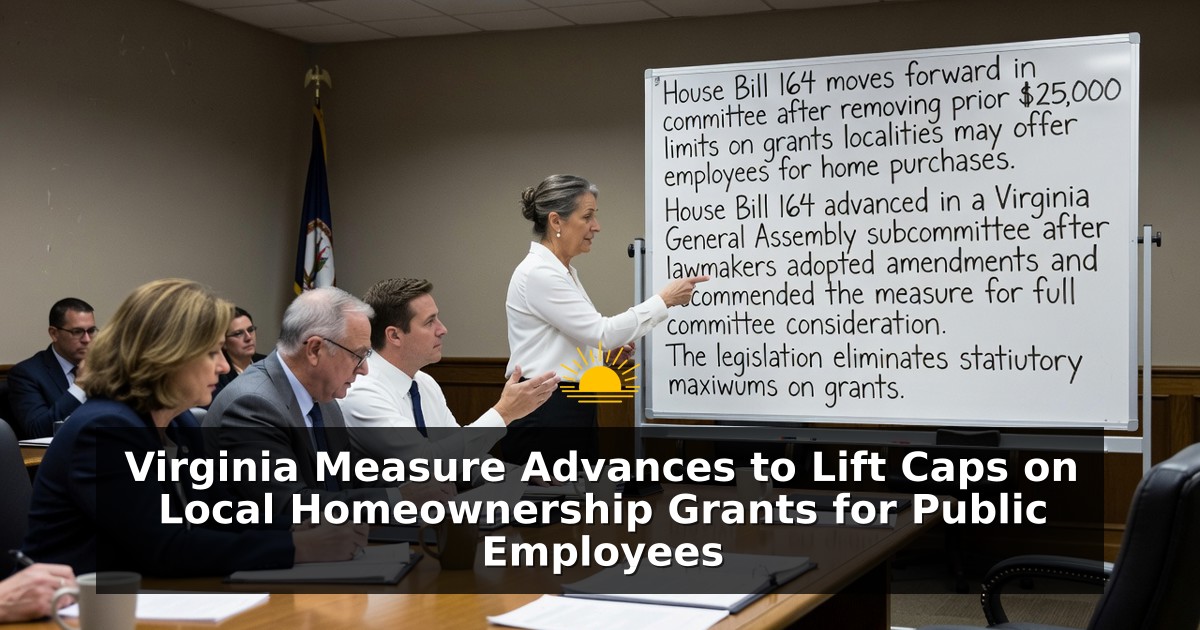
House Bill 164 advanced in a Virginia General Assembly subcommittee after lawmakers adopted amendments and recommended the measure for full committee consideration. The legislation eliminates statutory maximums on grants that cities, counties, and towns may provide to support homeownership among their own workforce. Under the proposal, localities would no longer face a $25,000 ceiling on individual awards or a matching lifetime cumulative limit per employee. The change applies to employees of the locality itself, school board staff, and personnel working for constitutional officers.
Current Virginia law restricts these homeownership grants to no more than $25,000 for any single award. The same statute also caps the total amount any one employee may receive over a career at $25,000. Supporters of the bill argue that fixed dollar limits have grown outdated as housing prices have risen across many parts of the Commonwealth. By removing both the per-grant and lifetime ceilings, the measure gives local governing bodies greater flexibility to design assistance programs that reflect actual market conditions in their communities.
Committee Process and Amendment Adoption
During the recent subcommittee hearing, an amendment to House Bill 164 was formally moved and properly seconded. Members then adopted the amendments by voice vote without recorded opposition. Following that action, the subcommittee voted to recommend reporting the bill with the adopted changes. The recorded tally showed no negative votes, allowing the legislation to proceed to the next stage of review. Procedural steps followed standard General Assembly practice for measures originating in the House of Delegates.
The core provision of the bill strikes the existing dollar caps while leaving intact the underlying authority for localities to offer such grants. Local governments retain full discretion over whether to create or continue a homeownership assistance program. They also keep the power to set eligibility rules, funding levels, and administrative procedures. Nothing in the legislation requires any locality to increase spending or to establish a new grant program if one does not already exist.
Scope of Eligible Recipients
House Bill 164 covers three distinct groups of public employees. First are individuals directly employed by the city, county, or town. Second are employees of the local school board, a category that commonly includes teachers, administrators, and support staff. Third are employees of constitutional officers such as sheriffs, clerks of court, commonwealth’s attorneys, treasurers, and commissioners of the revenue. Extending eligibility across these categories recognizes that many localities view workforce housing stability as important for multiple public functions.
Local officials have long used modest financial incentives to help employees live closer to their workplaces. Shorter commutes can improve retention, reduce turnover costs, and strengthen community ties. In higher-cost regions of Virginia, even a grant of several tens of thousands of dollars can make the difference between renting and purchasing a first home. Removal of the previous statutory ceiling allows governing bodies to calibrate assistance more closely to median home prices and to the specific recruitment challenges they face.
Housing Market Context Across Virginia Localities
Housing affordability varies widely from one Virginia locality to another. In Northern Virginia and parts of the Richmond and Hampton Roads metropolitan areas, entry-level home prices frequently exceed levels that public-sector salaries can easily support. Rural and smaller urban localities confront different pressures, including limited housing inventory and competition from remote workers relocating from higher-cost states. A uniform statewide cap of $25,000 has therefore produced uneven practical results depending on local market conditions.
By eliminating the maximum grant amount, House Bill 164 returns decision-making authority to the elected boards and councils closest to those markets. A locality experiencing acute teacher shortages, for example, could choose to offer larger down-payment assistance while another locality with more moderate prices might maintain smaller awards. The legislation does not dictate program design; it simply removes an upper bound that many local administrators described as increasingly restrictive.
Fiscal and Administrative Considerations
Because the bill is permissive rather than mandatory, its fiscal impact on the state treasury is expected to be negligible. Any costs would be borne entirely by the localities that elect to expand existing grant programs or to launch new ones. Local governments already appropriate funds for workforce housing initiatives through their annual budgets and must continue to balance those choices against other spending priorities. Transparency requirements and public hearing processes that accompany local budget adoption remain unchanged.
Administrative oversight also stays at the local level. Localities that operate grant programs typically require employees to meet length-of-service thresholds, occupy the purchased home as a primary residence, and sometimes repay a portion of the grant if they leave employment within a set number of years. House Bill 164 does not alter those common safeguard provisions. It merely clears the statutory dollar limits that previously constrained program scale.
Next Legislative Steps
With the subcommittee’s favorable recommendation, House Bill 164 moves to the full committee for further examination. Additional amendments remain possible as the measure progresses through the House of Delegates and, if approved, the Senate. Final passage would require majority support in both chambers and the governor’s signature before any change in law takes effect. Until that process concludes, the existing $25,000 individual and lifetime caps continue to govern local homeownership grant programs.
Observers note that similar flexibility measures have appeared in prior legislative sessions as housing costs have climbed. The current bill’s straightforward approach—simply striking the numerical ceilings—has drawn attention for its clarity. Local government associations and employee groups are expected to monitor the bill’s path and to supply additional testimony as it advances. For now, the subcommittee’s unanimous recommendation marks the first formal step toward giving Virginia localities broader tools to support homeownership among the public servants who deliver essential services every day.
Amendment amendments adopted aye committee amendment constitutional officers cumulative amount current law employees grant amount home ownership House bill 164 individual grants Legislation lifetime amount locality Moved nay School Board seconded subcommittee vote