Data Center Development Could Triple Energy Demand if Unconstrained
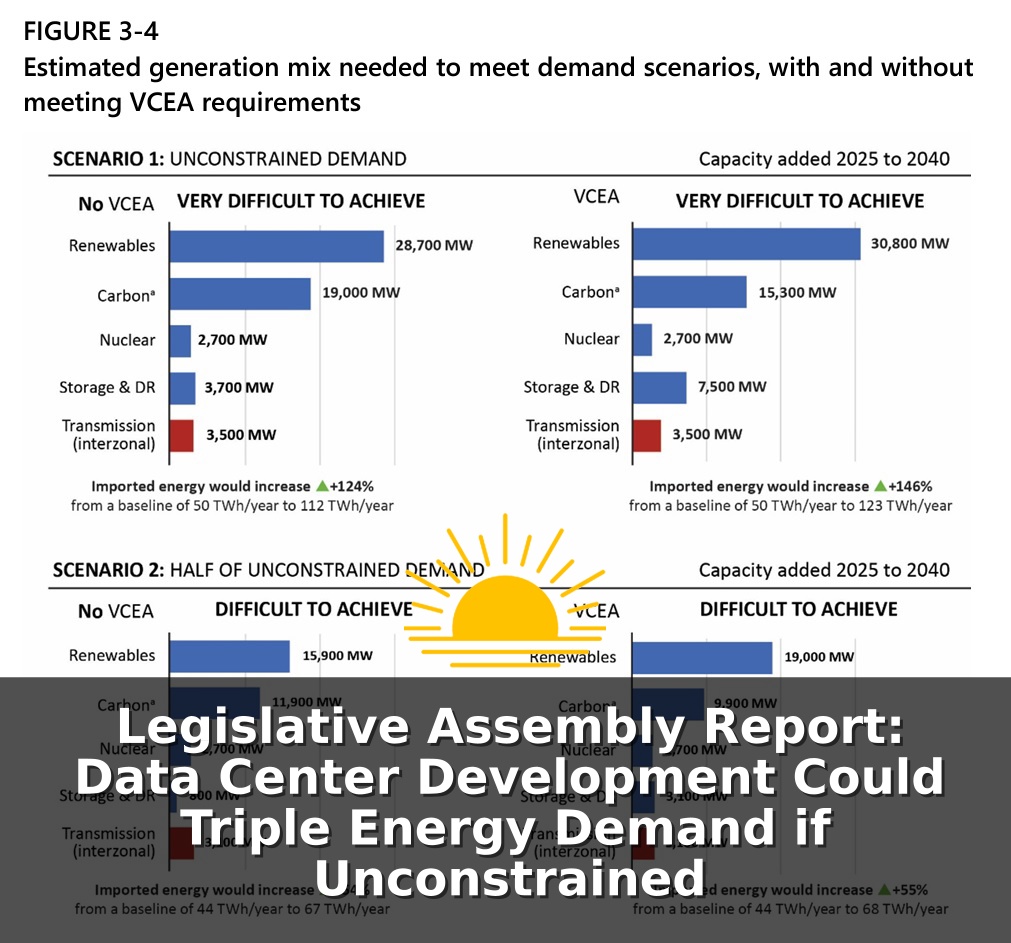
On Monday, the Joint Legislative Audit Review Commission published its long-awaited Report about data centers. The report outlines the expected high energy demand and the large economic benefits that the industry will bring ahead of 2025’s General Assembly session.
Residents and activists have complained about the projections of a tripled energy demand by 2040. According to JLARC, this could result in a $37 increase per month for Dominion Energy Virginia’s customers. The industry is responsible for about $9.1 Billion in economic activity each year.
According the the report, Northern Virginia was the largest datacenter market in the World, ahead of Beijing, and London.
The report offers three suggestions to the state regarding the current tax exemptions it provides data centers. Mark Gribbin is JLARC’s Chief Legislative Analyst. He explained that the exemptions could either be extended to maintain data growth, economic benefits or allowed to expire in order to reduce growth and energy impacts.
In a statement made to The Mercury after the report was released, Youngkin expressed a desire for the industry to be stronger in the state.
“ Let’s get serious and embrace common sense and growth to keep Virginia winning,” Youngkin said.
To meet the increasing demand for energy, the report models the use of natural gas plants that emit harmful pollutants and climate-changing emissions to the community.
Youngkin stated that Virginia has a choice to make: either embrace all the above, and provide affordable, reliable and yes, increasingly cleaner baseload power, in order to support future economic development, or take advantage of the billions in capital investments, high-paying job opportunities, and local and State tax revenues, which come from data centres. “Or give up Virginia’s position as a leader by bending the knee to green energy.”
Energy
This report confirms a recent regulatory filing by Dominion Energy, which stated that annual increases in electricity demand would be relatively flat if data centers weren’t present.
E3, a consultant third party, did modeling that showed the energy demand of the state would rise from just under 10,000 gigawatt-hours in 2023 to a little over 30,000 gigawatt-hours by 2040 if data centers didn’t need to consider constraints like having transmission lines available before coming online.
The demand for electricity would have increased by about 12,500 gigawatt-hours without the development of data centers.
In order to meet these demands, JLARC’s report states that more renewable energy sources like solar and off-shore will be required, as well as natural gas. This would mean a new plant is built approximately every year and a half.
JLARC has stated that the “unproven small modular reactor” technology could be able to meet the unconstrained demand.
Gribbin said that the State Corporation Commission (which regulates Virginia utilities) will host a technical conference on December 16 to discuss the percentage of the costs of those upgrades which could be covered by the data centre industry.
Air pollution and water use
The cooling systems of data centers, which use water depending on their technology, are also a part of the high energy demand.
Gribbin stated that there were enough environmental protections in the facility to allow it to use as much water per year as a large building of offices, which is about 6.7 millions gallons.
In an interview, Sen. Danica R. Roem (D-Prince William) said, “It is still a lot.”
She said she would like to give more information about water demand to localities instead of hiding behind a shroud containing “proprietary” data.
According to the report, data centers use fossil fuel burning generators for backup power, but they “contribute only a small amount of air pollution in Northern Virginia — less than 4 percent, or 0.1 percent, of regional nitrogen oxides emissions, and particulate and carbon monoxide emissions.”
In 2023, diesel generators used for backup power only emit 7% of the allowed emissions, mainly due to maintenance testing.
According to JLARC, Virginia’s exemption for data centers totaled $928.6 millions in savings by 2023. These savings went to four major tech companies: Amazon Web Services (AWS), Google Meta, Microsoft and Meta.
Data centers in the state compete with those located in other “primary” markets that provide tax exemptions. These markets include data centers with a combined capacity of 1,600 megawatts located in Hillsboro (Oregon), 1,560 megawatts situated in Phoenix (Arizona), 1,170 megawatts situated in Columbus, Ohio, and 1,070 megawatts located in Atlanta, Georgia.
Around 74,000 jobs are generated by the industry each year; approximately 1,500 of these jobs are created in construction as concrete pourers and electrical workers. Data centers are staffed by 50 people once they’re operational, including managers, IT specialists, and security personnel.
I don’t think that it is possible to see nothing happening
Republican Del. Ian Lovejoy (R-Prince William).
Localities throughout the state have benefitted from the real estate and business personal property taxes. Gribbin explained that the different tax incentives offered to attract data centers may offset the revenue given to localities. Economically distressed areas, with less flat land or limited access to transmission lines, might have a hard time competing.
The Republican Del. Ian Lovejoy (R-Prince William) suggested that legislative action regarding data centers will be inevitable in January.
Lovejoy: “I don’t think I can see anything happen.”
“I believe pragmatically that you should have pro-economic policy and there is certainly tax revenue here,” said he.
State Corporation Commission Virginia Virginia House of Delegates Virginia Senate Amazon Data Data Center Data Centers Dominion Don Drought economy Electrical Electricity Energy Google Ian Lovejoy Jobs Land Natural Gas Northern Virginia Policy Power Prince William Republican Taxes Technology Virginia Virginia Clean Economy Act VirginiaMercury Water