Loudoun School Board Clarifies Education Association Access Under Bargaining Pact
Updated
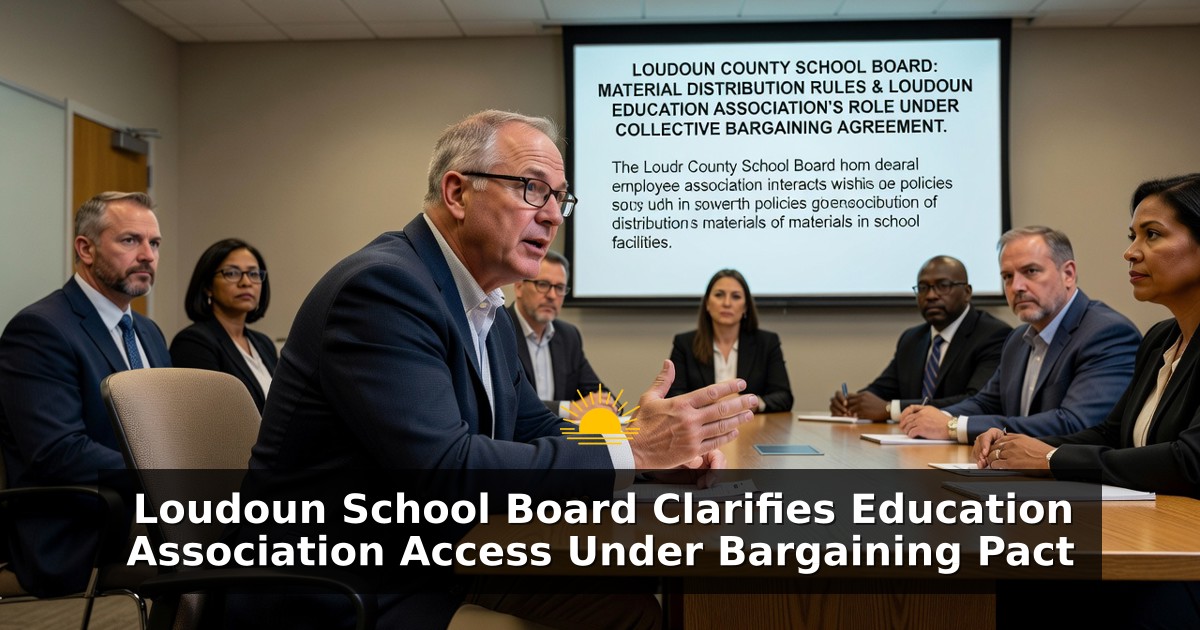
The Loudoun County School Board examined rules governing the distribution of materials in school facilities during its recent meeting, focusing on how employee associations interact with existing policies. A board member raised a specific question about the Loudoun Education Association and its ability to place informational flyers in teachers' lounges. The inquiry centered on whether such actions would align with the district's permissibility standards for postings inside school buildings. Officials indicated that building access and related posting activities fall under the terms of the collective bargaining agreement rather than a separate general policy. This exchange highlighted the structured approach Loudoun County Public Schools takes toward organized labor groups operating on campus.
Loudoun County encompasses a large public school system serving tens of thousands of students across numerous elementary, middle, and high schools in Northern Virginia. The School Board oversees policy decisions that affect daily operations, staff relations, and facility use throughout the district. Current members of the Loudoun County School Board include Chair Melinda Mansfield, April Chandler, John Beatty, Joy Maloney, Kari LaBell, Sumera Rashid, Lauren Shernoff, Joe Coughenour, and Mandi Smith. These representatives deliberate on matters ranging from curriculum to employee agreements during regular public sessions. Their discussions often reference negotiated contracts that define rights and responsibilities for recognized associations.
Policy Context for Material Distribution
School districts across Virginia maintain clear guidelines on what materials may appear in shared staff areas such as lounges and workrooms. These rules typically aim to ensure that postings remain professional, non-disruptive, and consistent with educational missions. In Loudoun County, the permissibility policy outlines categories of acceptable content while restricting unauthorized commercial or external advocacy items. The recent board conversation sought to determine the precise placement of the Loudoun Education Association within that framework. By linking association activities to the collective bargaining agreement, the district creates a dedicated channel for handling such requests.
Collective bargaining for public school employees became permissible in Virginia following legislative changes that took effect in recent years. Localities gained authority to negotiate with certified representative organizations on topics including working conditions, access privileges, and communication methods. Loudoun County moved forward with this process, resulting in a formal agreement that covers the Loudoun Education Association. That pact addresses practical issues such as entry to school buildings during designated times and the display of association-related notices. Officials at the meeting confirmed that these provisions govern flyer placement and similar outreach efforts by the group.
Role of the Loudoun Education Association
The Loudoun Education Association serves as the primary professional organization representing many teachers and support staff in the county. It provides members with resources on professional development, advocacy, and workplace matters while maintaining affiliation with broader state and national education groups. Association representatives periodically visit schools to share information about membership benefits and upcoming events. Under the clarified approach, any distribution of join-up flyers or similar materials must comply with the access protocols established in the bargaining contract. This arrangement seeks to balance organizational outreach with the orderly management of school environments.
Board members received a concise explanation from administrative staff during the session. References to Mr. Pepper and Ms. Bowling indicated that detailed implementation guidance remains available from those individuals if further questions arise. The short response satisfied the inquiring member, who noted that the information met the immediate need for clarity. Such exchanges demonstrate how routine policy reviews can resolve ambiguities before they affect day-to-day school operations. Maintaining transparent communication between the board, administration, and employee groups supports consistent application of rules across all Loudoun facilities.
Broader Framework of Facility Access
Public school buildings in Virginia function as controlled spaces dedicated to student learning and staff professional duties. Access policies therefore distinguish between internal school business, approved partner organizations, and external entities. When a collective bargaining agreement exists, it often supersedes general visitor or posting rules for the recognized exclusive representative. In Loudoun County this means the Loudoun Education Association follows negotiated procedures for entering lounges and placing materials rather than seeking case-by-case permission under the standard permissibility policy. The distinction reduces administrative burden while affirming the association's formal status.
Educators and administrators alike benefit from predictable guidelines that prevent confusion over allowable activities. Teachers' lounges traditionally serve as spaces for brief breaks, collaboration, and informal information sharing among colleagues. Allowing association flyers under contract terms preserves that function without opening the areas to unrestricted external postings. At the same time, the agreement can include reasonable limitations on timing, location, and content to avoid interference with instructional schedules. Loudoun's approach mirrors practices in other Virginia divisions that have adopted similar bargaining frameworks since state law authorized them.
Implications for Daily School Operations
Implementation of the clarified policy will rely on principals and building supervisors understanding the collective bargaining provisions. Training and reference materials distributed by the central office help ensure uniform enforcement from one school to another. Staff members who encounter association representatives posting materials can refer to the agreement for confirmation of authorized practices. This reduces potential friction and supports a cooperative climate between management and the employee organization. Over time, clear boundaries contribute to stable labor relations within the large Loudoun system.
Virginia localities continue to refine their collective bargaining ordinances and resulting contracts as experience accumulates. Loudoun County's handling of material distribution questions offers an example of integrating association rights into existing operational policies. Future board meetings may revisit related topics such as electronic communications, meeting space reservations, or orientation session participation. Each refinement builds on the foundational principle that negotiated agreements provide the governing structure for these interactions. Observers of local education governance note that such details, while technical, directly influence how professional associations engage with educators on a daily basis.
The discussion at the Loudoun County School Board meeting ultimately reinforced the primacy of the collective bargaining agreement in regulating association access. By confirming that building entry and flyer posting fall under that document, officials provided a straightforward resolution to the policy question. This outcome aligns with the broader goal of maintaining orderly, transparent processes inside public schools. Residents, parents, and staff can expect continued attention to these operational matters as the board fulfills its oversight responsibilities. The clarification stands as a practical step toward consistent application of rules affecting Virginia educators in Loudoun County.
bargaining agreement board meeting collective bargaining agreement education unions flyers LA Loudoun Loudoun Education Association Mr Pepper Ms Bowling permissibility policy policy discussion Public Schools school access School Board School Board Meeting school buildings Teachers teachers lounges union access