Loudoun County School Board Unanimously Opposes Overhead Transmission Lines
Updated
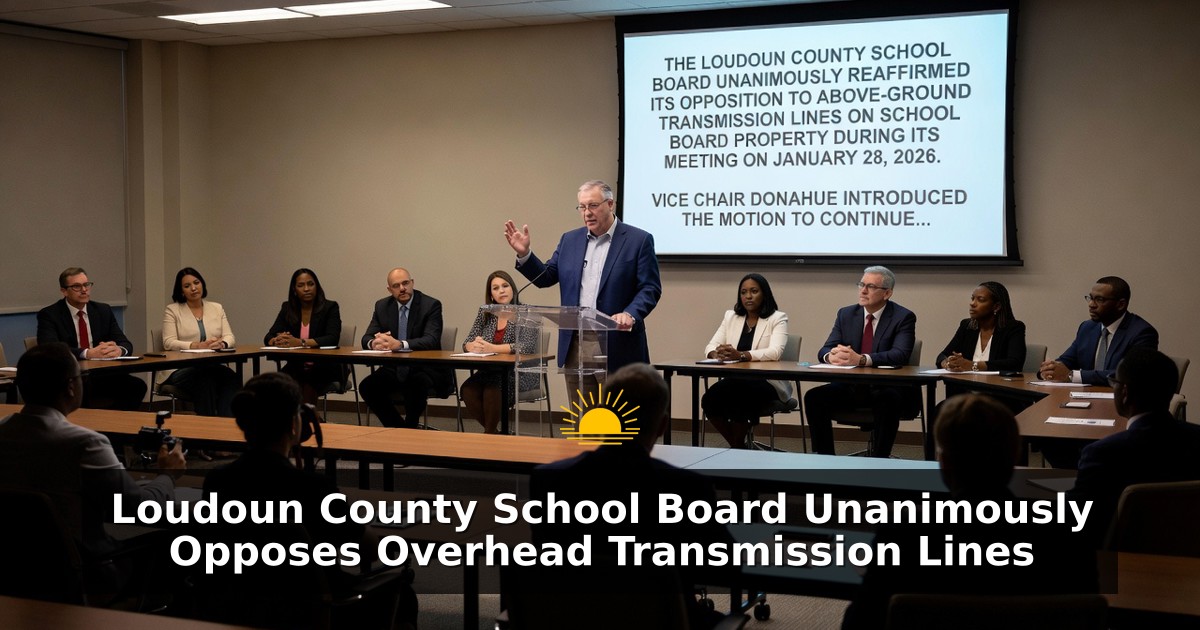
The Loudoun County School Board unanimously reaffirmed its opposition to above-ground transmission lines on school board property during its meeting on January 28, 2026. Vice Chair Donahue introduced the motion to continue supporting exploration of underground solutions for the proposed power infrastructure. The board specifically rejected overhead options tied to the Golden Tamar's Line Alignment that would cross school-owned land. This stance builds directly on an earlier action taken on March 25, 2025, and seeks to safeguard educational environments. Staff received clear direction to forward the board's position to the Loudoun County Board of Supervisors for further coordination.
Loudoun County School Board Members and Meeting Context
The current Loudoun County School Board members are Chair Melinda Mansfield, Vice Chair Anne Donahue, April Chandler, Deana Griffiths, Tiffany Polifko, Erick Chirinos, Jeff Morse, Sumera Rashid, and Lauren Sherbourne. All members joined in full support of the motion, producing a unanimous outcome that highlighted shared priorities across districts. The rescheduled session, originally set for the prior day, allowed thorough consideration of the transmission proposals from Dominion Energy Virginia. Board members emphasized the need to protect students while addressing broader community appearance concerns. Their collective vote demonstrated a unified local response to regional energy infrastructure plans.
Details of the Reaffirmed Motion
The adopted language restated the board's backing for ongoing study of underground alternatives and its firm rejection of every above-ground transmission line option located on school board property. Named routes facing opposition include Route 2, also called the Yellow Line, Route 3 known as the Green Line, and Route 4 referred to as the Blue Line within the Golden Tamar's Line Alignment. Officials stressed that these overhead paths would conflict with the goal of maintaining safe and visually consistent school settings. The motion further required staff to relay the full decision promptly to county supervisors. This step ensures alignment between the school board and other local governing bodies on the sensitive project.
Established Ranking of Route Preferences
When required to rank available underground and overhead possibilities, the school board set a precise order of preference beginning with Route one F as the most favored. Route underground C secured the second position, followed by Route one in third place. Route underground A ranked fourth, and Route underground B completed the list in fifth. These preferences clearly elevate buried lines over visible towers wherever feasible. The ranking provides Dominion Energy Virginia and county leaders with an explicit guide to the board's values regarding student welfare and neighborhood character.
Routes Explicitly Not Supported
The Loudoun County School Board declared that it does not support Routes 3, 3B, 4, 2, 3A, and 5 in the forms currently advanced by Dominion Energy Virginia. Each of these alignments was judged incompatible with the objective of shielding school properties from overhead infrastructure. Board members noted that the rejected paths could introduce unwanted visual and operational effects near educational sites. By listing the unsupported options outright, the board removed ambiguity for project planners. This clarity helps focus future technical reviews on alternatives that better match local expectations.
Broader Energy and Community Considerations
Loudoun County continues to experience substantial growth in electricity demand linked to technology and data-related development across Northern Virginia. Transmission upgrades remain essential to maintain reliable service for homes, businesses, and public facilities including schools. At the same time, overhead high-voltage lines raise persistent questions about aesthetics, land use, and proximity to places where children learn and play. Underground construction offers one method to reduce surface-level disruption even though it typically involves higher upfront costs and complex engineering. The school board's action illustrates how education officials weigh these competing factors when proposals directly affect their properties.
Communication and Next Steps with County Leaders
Direction to staff centers on delivering the reaffirmed position and the detailed route ranking to the Loudoun County Board of Supervisors without delay. Effective information sharing between the two bodies supports consistent handling of infrastructure that crosses multiple areas of responsibility. Supervisors will now have a documented record of the school board's ranked preferences and its categorical opposition to listed overhead paths on school land. Subsequent joint discussions can incorporate this input while evaluating overall system needs. The process underscores the value of coordinated local government responses to utility proposals.
Implications for School Environments and Neighborhoods
Protecting the physical setting of schools formed a central theme of the board's deliberations and final vote. Above-ground transmission facilities can alter sightlines, require ongoing easement maintenance, and generate community debate over long-term land impacts. By championing underground options, the board seeks to limit those changes on properties dedicated to education. Neighborhoods adjacent to school sites stand to benefit from the same emphasis on reduced visual presence. The unanimous result signals that these quality-of-life considerations carry substantial weight in Loudoun County decision-making.
The school board's clear ranking and formal opposition supply a structured framework for upcoming conversations with Dominion Energy Virginia and county officials. Continued technical study of the preferred underground routes will determine practical feasibility and cost implications. Local leaders remain tasked with reconciling legitimate power-capacity requirements against the desire to preserve welcoming school campuses and residential areas. The January 28 action stands as a definitive expression of educational priorities within the larger infrastructure dialogue. Further updates are expected once supervisors review the communicated stance and related engineering assessments proceed.
above-ground board members community aesthetics community priorities Dominion Energy Virginia energy infrastructure environment protection Loudoun County public meeting resolution route options School Board school environments school property transmission lines unanimous support underground solutions Vice Chair Donahue Virginia vote