Loudoun County School Board Urged to Block Power Lines Near Schools
Updated
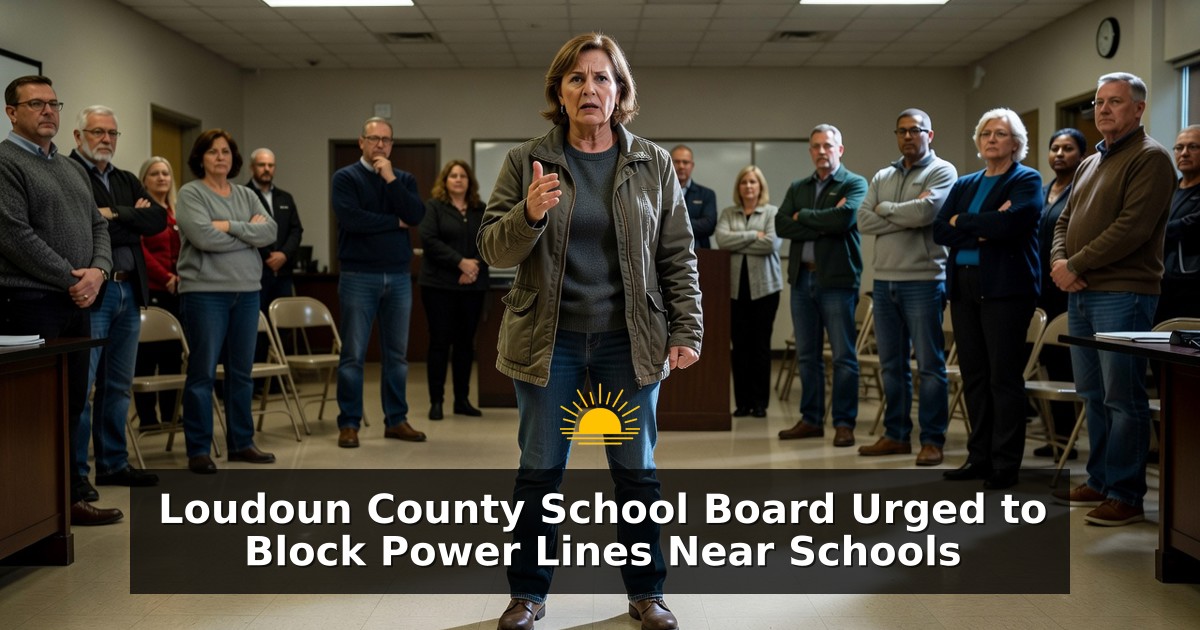
Residents of Loudoun County continue to watch closely as local education leaders confront proposals that could place high-voltage infrastructure near public schools. During a recent school board meeting in Leesburg, a speaker publicly thanked members for an earlier decision that rejected Dominion Energy plans for power lines in and around school property. The address highlighted ongoing pressure from both the utility company and the county Board of Supervisors to revisit or adjust those plans. Officials and parents alike have framed the matter as one that directly affects student safety and long-term land-use decisions for educational campuses. The discussion occurs against a backdrop of rapid growth in Northern Virginia that has increased demand for electrical transmission capacity.
The Loudoun County School Board currently includes Chair Melinda Mansfield together with members April Chandler, Deana Griffiths, John Beatty, Jeff Morse, Erika Ogedegbe, Sumera Rashid, Arben Istrefi and Anne Donohue. These nine members oversee policy for one of the largest school divisions in Virginia. Their prior 8-1 vote against the original Dominion routing demonstrated a clear majority preference for keeping major utility corridors away from campuses. That outcome drew attention because it came despite reported advocacy from county supervisors who favored alternative alignments tied to regional power needs. Community observers note that such votes help define how the board balances infrastructure demands with the daily environment of students and staff.
Earlier Board Actions on Campus Infrastructure
In September 2024 the same board approved an 8-1 measure that prohibited construction of new cell towers on school property. Parental concerns about potential health effects from radiofrequency exposure supplied the primary motivation for that policy. The speaker at the latest meeting explicitly linked the two issues and requested a comparable formal ban on power-line construction or easements that touch school land. Supporters of the request argue that consistent standards would prevent schools from becoming default locations for utility projects that face resistance elsewhere. Critics of expansive restrictions counter that regional energy reliability requires flexible siting options, yet the board has so far prioritized campus buffers.
Dominion Energy has pursued comparable transmission projects in neighboring Prince William County, where school-adjacent routes have likewise generated public comment. The pattern of proposals near educational sites has prompted some residents to describe schools as increasingly vulnerable to external development pressures. Loudoun County itself hosts one of the densest concentrations of data centers in the United States, a reality that drives much of the need for upgraded high-voltage lines. Transmission upgrades are presented by the utility as essential to serving both existing customers and projected load growth. At the same time, families living near proposed corridors frequently cite electromagnetic-field exposure, visual impact, and property-value questions as reasons for opposition.
Development Pressures and School Safety Considerations
Nothing fundamental has altered the underlying technical or land-use facts since the board’s earlier rejection of the in-and-around-school routing, according to the speaker. Dominion and county representatives are now examining alignments that would place lines immediately outside property boundaries or, in limited instances, directly on school-owned parcels. Such adjustments keep the infrastructure close enough that many of the original objections remain relevant. School board authority over its own real estate gives members a distinct role separate from the county Board of Supervisors, which holds broader zoning and franchise responsibilities. Maintaining clear separation between those roles has been described by speakers as important to preserving public confidence in education governance.
Health and safety questions surrounding high-voltage lines near children continue to surface in public forums even though regulatory bodies maintain that lines built to code operate within established exposure limits. Parents who spoke in favor of the 2024 cell-tower ban carried similar caution into the power-line debate. The board’s willingness to adopt precautionary campus policies has been welcomed by those groups as evidence that student welfare can take precedence over external development timelines. Utility planners emphasize that undergrounding or long detours raise costs that ultimately affect ratepayers across the service territory. These competing priorities leave the school board in the position of deciding how much weight to assign campus-specific protections.
Regional Context and Future Policy Options
Prince William County’s experience offers a parallel case study in which school systems and local governments have negotiated buffer distances and design modifications. Loudoun officials can examine those outcomes when weighing whether to codify a standing prohibition similar to the cell-tower rule. A formal policy would give staff clear guidance for evaluating future easement requests and would signal to utilities that school property is not a path of least resistance. Opponents of a blanket ban contend that each project should be judged on its engineering merits and that absolute exclusions could complicate grid resilience. The board retains the ability to review individual applications even without a new overarching policy.
Public trust in local education leadership often rests on perceptions of independence from both partisan and commercial influence. Speakers at the Leesburg meeting underscored the value of decisions that place student interests first when infrastructure and learning spaces intersect. The earlier 8-1 votes on power lines and cell towers remain reference points for residents who want continuity in that approach. As Dominion refines its routing studies and county planners update growth forecasts, the school board will likely face additional requests for comment or consent. How members respond will shape the physical setting of Loudoun schools for decades and will influence whether other Virginia divisions adopt comparable property safeguards.
Continued monitoring of transmission proposals across Northern Virginia will remain necessary as data-center expansion and electrification trends elevate power demand. The Loudoun County School Board’s record shows a readiness to assert control over its campuses when majority sentiment favors protection. Formalizing that stance through policy, as requested, would convert case-by-case votes into lasting guidance. Residents, utility representatives, and county officials will all watch the next steps for indications of how firmly educational property will be insulated from surrounding development pressures. The outcome carries practical consequences for facility planning, community relations, and the everyday experience of students who attend schools near potential corridor routes.
against board Community Pressure County Dominion faces Infrastructure Loudoun Loudoun County maintain Power power lines pressure property Protect safety concerns School School Board stance Urged
